

Commentary
Judy Dempsey
{
  "authors": [
    "Judy Dempsey"
  ],
  "type": "commentary",
  "blog": "Strategic Europe",
  "centerAffiliationAll": "",
  "centers": [
    "Carnegie Endowment for International Peace",
    "Carnegie Europe"
  ],
  "collections": [],
  "englishNewsletterAll": "",
  "nonEnglishNewsletterAll": "",
  "primaryCenter": "Carnegie Europe",
  "programAffiliation": "",
  "programs": [],
  "projects": [],
  "regions": [
    "Eastern Europe",
    "Ukraine",
    "Western Europe",
    "Germany",
    "Europe",
    "Russia"
  ],
  "topics": [
    "Democracy",
    "EU",
    "Security",
    "Civil Society"
  ]
}
Source: Getty
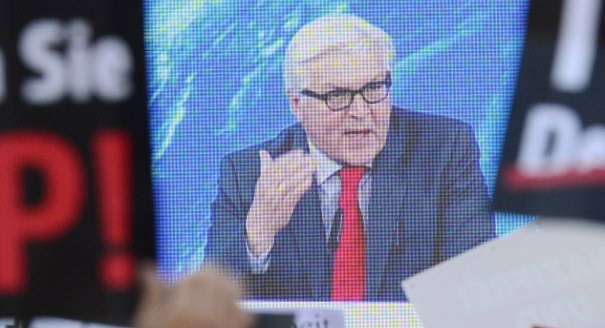
Germany’s foreign minister blew his temper in public when demonstrators called him a warmonger. His outburst holds a lesson for dealing with populists.
On the evening of May 19, Frank-Walter Steinmeier took to the stump—not in Ukraine, where presidential elections will be held on May 25, but on Alexanderplatz, a big, ugly concrete square in eastern Berlin. Germany’s foreign minister was campaigning for the European Parliament elections, which in Germany will also take place on May 25.
Over the past three months, Steinmeier has spent most of his time trying to find a diplomatic way out of the Ukraine crisis. Whatever his critics think of his efforts and dealings with Russia, Steinmeier’s speech at the election rally revealed a side to him rarely seen in public: anger.
Some of those attending the rally carried posters with the words “Stop the Nazis in Ukraine!”—a favorite characterization by Russia’s state media of Ukraine’s interim government. Other demonstrators shouted and held up placards that called Steinmeier a warmonger. Still others had posters that read “EU out, NATO out!”—as if NATO or indeed the EU were going to send troops to Ukraine.
There was some applause but also more heckling and whistles. Steinmeier became angrier. “Because we want peace, we can’t let you have it easy,” he shouted. “The world doesn’t just consist of peace angels on the one side and evildoers on the other. Unfortunately, the world is more complicated,” he added. Steinmeier went on to defend the EU with a fierce conviction.
It is not only the German public that shows a surprising amount of sympathy for Russia and an equal amount of hostility toward Ukraine, the EU, and NATO. Nor is this phenomenon limited to the left wing. Throughout Europe, there are nationalist, populist parties, many of which have become sympathetic toward Russian President Vladimir Putin, that could make big gains in the European Parliament elections.
Several of these parties admire Putin’s Russia, an accolade that eluded former Soviet leaders, despite their attempts to gain an ideological foothold in Western Europe through their proxy Communist parties.
Many nationalist and populist parties in Europe see Russia under Putin as a country of peace and a defender against moral decay. To them, Russia is the alternative to what they see as U.S. hegemony and European spinelessness. They ignore Putin’s annexation of Crimea, his meddling in Eastern Ukraine, and his erosion of civil liberties.
Such rhetoric has resonance among voters, if the opinion polls are to be believed. These fringe parties have something in common with Russia: a fear of globalization, a fear of the “other,” and a fear of the open societies that the West stands for.
This fear of globalization includes hatred of the social media that an increasing number of governments try to curb. An exposure to different languages and cultures, brought about by mobility or immigration, can also be threatening for those seeking comfort in certainty and predictability.
Yet, despite calls by Europe’s nationalist parties for governments to put their own countries and citizens first, Europe is part of that globalization. No EU country can go it alone by building fortress walls around itself.
Globalization has provided Southern and Eastern Europe with an invaluable safety valve. The free movement of people enshrined in the EU treaties has allowed young Europeans to find work and opportunities. Globalization also inspires and empowers civil society in many parts of the world.
Yet in Europe, mainstream parties often pander to the nationalist parties instead of defending European values. Britain’s Prime Minister David Cameron has been hypocritical about Poles and other Eastern Europeans who came to work in Britain after the EU’s 2004 eastern enlargement. Incidentally, Cameron hasn’t dared to criticize the presence of immensely rich Russians living in London.
If nationalist and populist parties do make big gains in this week’s European Parliament elections, one reason will be that mainstream politicians did not do enough to stand up for an open Europe. They also need to make much more of an effort to explain the complexities of the modern, globalized world.
Passion and even an occasional outburst of anger can help, as Frank-Walter Steinmeier could tell his colleagues after his campaign speech in Berlin. The video of his performance became a huge hit on YouTube, with over 1.2 million views in just three days.

Nonresident Senior Fellow, Carnegie Europe
Judy Dempsey is a nonresident senior fellow at Carnegie Europe
Recent Work
Judy Dempsey
Judy Dempsey
Carnegie does not take institutional positions on public policy issues; the views represented herein are those of the author(s) and do not necessarily reflect the views of Carnegie, its staff, or its trustees.

With its public finances in shambles, the far right polling at 35 percent ahead of the 2027 presidential election, and a growing protest movement, is France’s crisis a threat to the EU’s geopolitical awakening?

Rym Momtaz, ed.

Ahead of a tough winter for Ukraine, Donald Trump’s swing back toward Russia bodes ill. But instead of panicking, Kyiv’s European allies are focusing on action.
Rym Momtaz

While the EU and European governments are embracing the much-lauded middle-power moment, this entails three difficult conundrums.

Richard Youngs

Much has been said of the changes Brussels is trying to make to the EU enlargement process. Here’s why gradual integration might—or might not—be the answer.

Dimitar Bechev

The European Commissioner for Trade is headed to China. But after President Xi’s bridge-building visit to Washington, can a more isolated EU overcome Beijing’s stranglehold on critical raw materials? Who will blink first?
Rym Momtaz, ed.