

Commentary
Nathalie Tocci, Jan Techau
{
  "authors": [
    "Jan Techau"
  ],
  "type": "commentary",
  "blog": "Strategic Europe",
  "centerAffiliationAll": "",
  "centers": [
    "Carnegie Endowment for International Peace",
    "Carnegie Europe"
  ],
  "collections": [],
  "englishNewsletterAll": "",
  "nonEnglishNewsletterAll": "",
  "primaryCenter": "Carnegie Europe",
  "programAffiliation": "",
  "programs": [],
  "projects": [],
  "regions": [
    "Western Europe",
    "Germany",
    "Europe"
  ],
  "topics": [
    "Security",
    "Military",
    "EU",
    "Foreign Policy"
  ]
}
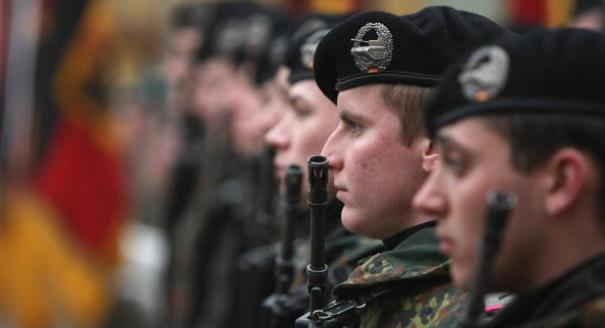
Source: Getty
Germany is starting to think seriously about its potential military role in the world. But will changes in thinking lead to a shift in political behavior?
Something is sprouting in Germany. As Europeans ponder the necessity of military strength after Russia’s annexation of Crimea, and NATO charts its course for the post-Afghanistan era, Europe’s reluctant central power is doing some serious soul-searching on its role as a military player.
This reflective process started years ago, when former defense minister Karl-Theodor zu Guttenberg started to set things straight by calling the war in Afghanistan a war and a fallen soldier a fallen soldier—things that had previously been taboo. But now, after those linguistic adaptations to reality, it seems that a more profound change is happening, one that might eventually lead to a shift in political behavior.
The strongest evidence for this change comes from the reassurance debate in NATO that ensued after Russia’s military aggression in Ukraine. Not only did Germany pledge to reinforce rotating air-policing capacities in the Baltic states and send a vessel for NATO’s naval task force in the Baltic Sea. It also doubled its presence in the alliance’s Multinational Corps Northeast headquarters in Szczecin, Poland, from 60 to 120 staff officers, enabling the corps to increase its level of readiness significantly. This NATO headquarters is predominantly dedicated to territorial defense—in other words, more than anything else, it looks at Russia.
Most importantly, Germany decided to integrate its land forces into the exercise scheme NATO is currently putting together to strengthen the alliance’s troop presence on its Eastern flank. This scheme, which will likely be adopted at a major NATO summit in South Wales in September, will lead to an ongoing exercise activity in Central Europe. That would put NATO troops on the ground at all times on a rotating basis, but without the permanent stationing of units in that region.Only months ago, Berlin would have categorically ruled out such a step. Now, Germany has put itself firmly at the center of a substantial NATO compromise that is addressed, of course, at Moscow. This is not a revolution in Germany’s military posture, but it is substantial progress.
Even before the Ukraine crisis made such steps necessary, Germany had contributed to NATO’s planning for the post-Afghanistan period by proposing a “framework nations” concept. This plan is designed to form groups of allies within NATO that focus on specific capabilities clusters, with the goal of making those capabilities more readily available for military contingencies. The idea is to assign the leadership of each cluster to a framework nation in charge of leading the effort.
Germany has volunteered to lead one cluster to fill the idea with life. After some initial hesitation, particularly on behalf of the United States and France, the framework nations idea is now accepted inside NATO.
The proposal is not only a substantial conceptual contribution by Germany to the debate about NATO’s future. It is also a clever self-binding mechanism. Knowing full well the risks of the volatile domestic debate about all things military, by committing itself as a framework nation, the leadership in Berlin has one more argument at home as to why Germany can’t weasel out any longer. Germans dislike violating multinational commitments. The framework nations concept is just as much about tactics at home as it is about strategy in NATO.
And indeed, the German home front offers additional hints of a changed attitude toward military issues. Much has been made of German President Joachim Gauck’s speech at this year’s Munich Security Conference. It was a momentous speech that went to the very core of Germany’s deeply engrained reluctance to embrace military power as a means to engage in international affairs.
More significant is the pattern of reactions to the speech. Apart from some angry criticism from the usual suspects, especially on the far left of the political spectrum, Gauck received a lot of applause for his foray into formerly untouched territory. Criticism was very muted in a country that only a few years earlier had forced one of Gauck’s predecessors to resign over some daring remarks on the use of German military power.
Even more significant is the fact that since Gauck’s remarks, a string of similar pronouncements by the president and others has followed. All have made the same claim, and all have created less of a reaction than would have been expected not so long ago.
But Germany’s domestic debate has something more substantial to offer than just speeches. When the current grand coalition took office at the end of 2013, it agreed to review the country’s agonizingly long-winded parliamentary rules on military deployments. A crossparty committee headed by former defense minister Volker Rühe is currently charting the terrain for a new compromise on one of Germany’s most delicate political questions.
Political elites in Berlin have realized that the deployment process must be speedier and more predictable so that Germany’s allies can put more trust in Berlin’s readiness to deliver what is needed if push comes to shove. At the same time, these requirements must be squared with the the parliament’s sacrosanct role in the process. Various options have been put forward. It is too early to predict a result, but the mere fact that the issue is being addressed in a formalized way constitutes significant change.
Of course, all of these plans are still in their early stages. Germany will not become a completely relaxed military partner anytime soon. Many of the enormous structural problems of Germany’s defense posture remain unresolved. There is a yawning capabilities gap, especially on strategic airlift and on combat and transport helicopters, a problem that decades-old procurement programs have failed to tackle.
There is also the issue of defense underspending, which the Americans will continue to point out with growing impatience. And it is by no means clear whether an increased commitment to mutual reassurance under NATO’s article 5 will mean a greater willingness to conduct expeditionary missions if needed.
At the same time, changes do seem to be under way in German political thinking on military affairs. It is now also up to Germany’s allies to carefully tend to this delicate budding flower.
Director, Europe Team, Eurasia Group
Techau is director with Eurasia Group's Europe team, covering Germany and European security from Berlin. Previously, he was director of Carnegie Europe.
Recent Work

Nathalie Tocci, Jan Techau
Jan Techau
Carnegie does not take institutional positions on public policy issues; the views represented herein are those of the author(s) and do not necessarily reflect the views of Carnegie, its staff, or its trustees.

The EU’s new migration policy is not suited to today’s realities. With climate change increasingly becoming a driver of displacement, Europe needs to rethink its deterrence-focused approach.

Shana Tabak
The battle over free speech has taken center stage since U.S. Vice President JD Vance accused Europe of censorship. From travel bans to social media regulation, especially around the Israel-Palestine conflict, are liberal democratic governments weaponizing free speech?

Rym Momtaz, ed.
Europe seems to have accepted its sidelining in the Middle East. The EU must reassert its support for the international rules-based order and step up engagement.
Rym Momtaz
Amid uncertainty caused by the Iran war, the global drive for nonproliferation has stalled. With Europe diplomatically marginalized and countries reassessing their nuclear options, efforts to curb the spread of nuclear weapons risk becoming irrelevant.

Jane Darby Menton
Preparing candidate countries for EU membership is no longer enough. As the enlargement process becomes a reality, the union must also prepare its own societies.

Iliriana Gjoni