

Commentary
Judy Dempsey
{
  "authors": [
    "Judy Dempsey"
  ],
  "type": "commentary",
  "blog": "Strategic Europe",
  "centerAffiliationAll": "",
  "centers": [
    "Carnegie Endowment for International Peace",
    "Carnegie Europe"
  ],
  "collections": [
    "Europe’s Eastern Neighborhood"
  ],
  "englishNewsletterAll": "",
  "nonEnglishNewsletterAll": "",
  "primaryCenter": "Carnegie Europe",
  "programAffiliation": "",
  "programs": [],
  "projects": [],
  "regions": [
    "Europe",
    "Russia",
    "Western Europe",
    "Germany"
  ],
  "topics": [
    "EU",
    "Foreign Policy"
  ]
}
Source: Getty
If European leaders weaken their sanctions on Russia, they will destroy any chance of doing foreign policy and strategy.
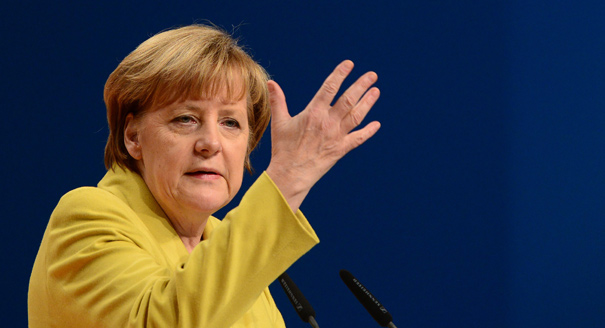
Angela Merkel desperately wants to end the Ukraine crisis. That was clear after her telephone call on December 16 with her French, Russian, and Ukrainian counterparts.
In a short statement, the German Chancellor said she wanted a “comprehensive” solution to the crisis. It is not clear what that means in practice.
One thing, however, is certain. Merkel wants to seek an end to the Ukraine crisis because the longer it continues, the greater the pressure by several European governments to soften the EU’s stance toward Russia.
EU sanctions on Russia, which come up for renewal in March 2015, will test the unity of the 28 member states – and Merkel’s own leadership role.
Discussions are already taking place in the European capitals about whether to continue, lift, reduce, or introduce a moratorium on the sanctions.
Merkel knows what is at stake, both for Europe and for her own Christian Democratic Union party. The outcome will be the making or breaking of Europe’s ability, led by Berlin, to make foreign policy and to do strategy.
Merkel and her Christian Democrats believe that the sanctions should be maintained. The Social Democrats and their foreign minister, Frank-Walter Steinmeier, are wavering.
Much will depend on Russian President Vladimir Putin.
German conservative foreign policy lawmakers have no doubt that Putin will begin a charm offensive in Europe and will pull back Russian troops further inside Russia so as to swing European governments around to lifting the sanctions against Moscow.
Having been taken aback by European unity over imposing sanctions, under Merkel’s lead, Putin is now doing everything possible to dent that unity and to weaken her.
As it is, the Social Democrats are highly uncomfortable with the sanctions, not to speak of the economic crisis engulfing Russia. It’s probably only a matter of time before they will say: “enough is enough;” that it is time to help Russia out of its economic crisis.
With such pending shifts, Merkel will have to weigh up the impact of these growing sentiments inside the Social Democratic party, how they affect her own convictions, and how they will influence public opinion. So far, the German public supports Merkel’s stance toward Russia.
Since Putin annexed #Crimea, Merkel is at the forefront in calling for sanctions against Russia.Tweet This
Ever since Putin annexed the Crimean Peninsula last March, Merkel has been at the forefront in calling for and adopting sanctions against Russia.
It was she who managed to keep the other 27 European leaders united. And it was she who has been forthright about Russia’s aggression, convinced that Putin was intent on causing trouble in Moldova and Serbia.
Yet precisely because Merkel spoke her mind about Putin’s intentions, she now runs the risk of playing into the hands of the Social Democrats.
The Social Democrats, who are languishing in the opinion polls, are slowly dealing the pacifist card.
By saying that they don’t want a war in Europe (who does?), they are implying that Merkel and her Christian Democrats are warmongers who also want a return to the Cold War.
In short, the Ukraine crisis has thrown up two strategies in Germany over how to deal with Russia. One is Merkel’s policy of containment, which has so far held sway. The other is the policy of appeasement prevalent among older Social Democrats.
Merkel’s containment policy is about Europe going for the long haul over Russia in a way that would fundamentally change Europe’s long-term relationship with Russia.
The #Ukraine crisis has given Europeans a much-needed lesson in foreign policy and strategy.Tweet This
If anything, the Ukraine crisis has given Europeans a much-needed lesson in foreign policy and strategy. It has also jolted Europe out of its complacency about its Eastern European neighbors and about Russia, which was long overdue.
To backtrack on sanctions at this stage—unless Putin radically changes course—would mean Europeans denying that they have entered the post-Cold War era. Somehow, it would amount to accepting that a return to business as usual with Russia. Merkel’s role and the pressure she faces over renewing the sanctions are not enviable.

Nonresident Senior Fellow, Carnegie Europe
Judy Dempsey is a nonresident senior fellow at Carnegie Europe
Recent Work
Judy Dempsey
Judy Dempsey
Carnegie does not take institutional positions on public policy issues; the views represented herein are those of the author(s) and do not necessarily reflect the views of Carnegie, its staff, or its trustees.

As we close out another season of Strategic Europe, it is worth taking stock of the deep shifts underway.

Rym Momtaz
The EU had to compromise to adopt a twenty-first sanctions package against Russia, exposing growing cracks in the union’s resolve. Is this latest, weaker round worth it to keep pressure on Moscow?
Rym Momtaz, ed.

Trump is distracted and Ukraine wants Europe to step up. The continent’s leaders must find their voice and assert it in talks with Russia.

Alissa de Carbonnel

Mounting economic strain and battlefield losses will not necessarily make the Kremlin less dangerous. They could instead push Moscow toward a more aggressive hybrid campaign designed to test NATO’s Eastern flank, exploit allied hesitation, and fracture European resolve.

Maksym Beznosiuk

Over the past ten years, NATO has held almost as many summits as it did during the entirety of the Cold War. Are they still useful, or is it time to stop holding annual meetings?
Rym Momtaz, ed.