

Commentary
Judy Dempsey
{
  "authors": [
    "Judy Dempsey"
  ],
  "type": "commentary",
  "blog": "Strategic Europe",
  "centerAffiliationAll": "",
  "centers": [
    "Carnegie Endowment for International Peace",
    "Carnegie Europe"
  ],
  "collections": [
    "Europe’s Eastern Neighborhood",
    "Transatlantic Cooperation"
  ],
  "englishNewsletterAll": "",
  "nonEnglishNewsletterAll": "",
  "primaryCenter": "Carnegie Europe",
  "programAffiliation": "",
  "programs": [],
  "projects": [],
  "regions": [
    "Europe",
    "North America",
    "Eastern Europe",
    "United States",
    "Ukraine",
    "Western Europe"
  ],
  "topics": [
    "Security",
    "Military",
    "EU"
  ]
}
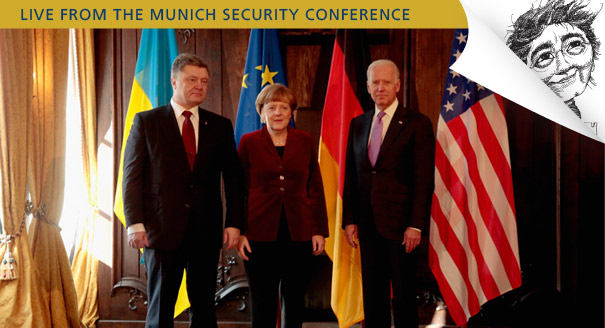
Source: Getty
A selection of leading experts answer a new question from Judy Dempsey on the foreign and security policy challenges shaping Europe’s role in the world.
A selection of leading experts answer a new question from Judy Dempsey on the foreign and security policy challenges shaping Europe’s role in the world.
The West can help Ukrainians save Ukraine, but the West itself cannot save the country. Ukraine has to embrace reforms like those that Poland made in the early 1990s. It has to sweep away decades of corruption and poor governance and build a new system more or less from the ground up. That is why steps like lustration—getting rid of corrupt or incompetent officials—are so important.
The West can help Ukrainians save #Ukraine, but it cannot save the country.Tweet This
It would be hard enough for Ukraine to implement the necessary reforms in ideal conditions; it will be well-nigh impossible as long as Russian President Vladimir Putin is intent on dismantling the country. The West should use all the means it can to prevent further Russian aggression against Ukraine. The attempt launched on February 5 by French President François Hollande and German Chancellor Angela Merkel to broker at least a renewed ceasefire looks like a last diplomatic effort to give Ukraine some breathing space. If it fails, there should be even more painful sanctions against Russia; and Western countries willing to do so should start giving Ukraine military aid.
Those who argue that this will provoke Russia need to explain why even without this “provocation” Russia has been occupying Ukrainian territory for the last year. It is in Europe’s interest that Ukraine should in the future be strong enough to stand up for itself.
If saving Ukraine means rescuing it from “evil Russia,” definitely not. No doubt, Russia is playing a destabilizing role in eastern Ukraine, presumably providing separatists with heavy weapons and troops. But there can be no diplomatic solution of the conflict without Russia.
Of course, that does not necessarily mean that there is—at the moment—a solution with Russia. Instead of solving the crisis, the West has to think of a way to manage it. That was the idea of the Organization for Security and Cooperation in Europe during the Cold War. That is the approach for dealing with the frozen conflicts in Eastern Europe. And that was the mission of German Chancellor Angela Merkel and French President François Hollande in Kyiv and Moscow on February 5–6.
The West cannot save #Ukraine if it means rescuing it from "evil Russia."Tweet This
The two leaders’ spontaneous visit was one of the strongest diplomatic means the West has, and many rightly see the effort as a last chance for a ceasefire in eastern Ukraine. As a result, there is now talk of reviving the September 2014 Minsk Protocol, an agreement aimed at ending the fighting.
If this fails and war in eastern Ukraine goes on, the West has three options. First, it can ban Russia from using the SWIFT system for exchanging information on financial transactions, one of the toughest economic sanctions. Second, the West can urge the Ukrainian government to enter direct talks with the separatists. Third, the EU and the United States can support the Ukrainian army with defensive weapons—and the ongoing debate on this issue is necessary.
Merkel and Hollande’s initiative might be the last window of opportunity before a massive escalation of the conflict.
No. On its own, the West cannot save Ukraine. The war in the country’s east will end, or at least freeze, when all the key players on the ground agree it is time for it to do so. The key actors in this respect are, in no particular order, Ukrainian President Petro Poroshenko, the Ukrainian government, the pro-Russian separatists, and Russian President Vladimir Putin.
Western actors, in different combinations, can help speed up the realization that a peace deal is the only option, facilitate the negotiation of such an agreement, and monitor its implementation. U.S. military aid to Ukraine, whether defensive or lethal, can have only one effect: to escalate the standoff further, as Putin’s reaction is predictable.
U.S. military aid to #Ukraine would escalate the standoff further.Tweet This
References to NATO action in Bosnia and Herzegovina and in Kosovo in the 1990s and comparisons between Putin and former Serbian president Slobodan Milošević currently circulating in the West represent a very selective reading of recent history. Russia is an important international actor. Recognizing this has nothing to do with condoning Russian actions.
Saving Ukraine includes at least three further dimensions that are being sidelined by the talk about military aid: first, Western financial assistance of a different magnitude from what has been contemplated to date; second, more Western humanitarian aid; and third, an internal commitment of the Ukrainian political elite to implement constitutional and structural reforms.
Two things have to happen for Ukraine to succeed. First, Ukrainian President Petro Poroshenko needs to move forward with painful economic reforms; and second, Russian President Vladimir Putin needs to stop fueling the violence in eastern Ukraine.
Can the West help on those two fronts? It certainly can in regard to the first point. By providing Ukraine with much-needed economic assistance and thoughtful advice on issues from how to tackle corruption to how to build more effective ministries, the West can make a difference.
The risk is that #Putin succeeds in dividing the West.Tweet This
On the question of persuading Putin to halt aggression in the Ukraine’s east, that’s where things become more difficult. The West is doing its best to push for a diplomatic solution, but it is still unclear whether the efforts of the past few days will yield real results.
If Putin still refuses to stand down, the West will then face tough choices on next steps. Do the EU and the United States increase sanctions? Or would the two sides agree on providing the Ukrainians with lethal weapons?
Judging by the discussions at the 2015 Munich Security Conference, Europe and the United States are unlikely to agree on a common course, particularly on the issue of lethal aid. The risk, therefore, is that Putin succeeds in dividing the West on next steps and Ukraine finds itself drifting toward a frozen conflict. That is an outcome that would be very bad news for Ukraine itself and for the transatlantic partners.
Ukraine is threatened from the outside and the inside: from the outside by an attack by Russia, and from the inside by corruption and a growing financial crisis. The two threats go hand in hand. The more fragile Ukraine is, the easier it will fall prey to Russian President Vladimir Putin. And the harder Russia attacks in the east, the more difficult it becomes to reform and stabilize the Ukrainian state.
What the West can do is support Ukraine on both fronts. It can help push back Russia, and it can help on reform. The West is indeed doing both, but only halfheartedly.
Regarding the military attack on Ukraine by Russia, the West is both afraid of Russia and hesitant to fully join the Ukrainian side in the conflict, as Russia is a great power and Ukraine isn’t. Regarding support for reform and the fight against corruption, the effort is still timid in scale and scope. And with a financial crisis that is becoming more dramatic day by day, only massive Western help can prevent a collapse.
The conflict in #Ukraine will determine the future character of the European order.Tweet This
What the West hasn’t fully realized is what is at stake in Ukraine. This conflict will determine the future character of Russia—whether Moscow goes into a full revisionist swing or understands that the post-1991 order isn’t going to be reversed. In other words, whether Russia will be a nation-state with borders or will aspire to be an empire with a center and a periphery, starting endless conflicts with its neighbors.
Also at stake is the character of the European order—whether that order will be multipolar as in the nineteenth century, with few rights for weaker states, or multilateral as embodied by the EU, on the basis of equal rights for all states.

Nonresident Senior Fellow, Carnegie Europe
Judy Dempsey is a nonresident senior fellow at Carnegie Europe
Recent Work
Judy Dempsey
Judy Dempsey
Carnegie does not take institutional positions on public policy issues; the views represented herein are those of the author(s) and do not necessarily reflect the views of Carnegie, its staff, or its trustees.

As we close out another season of Strategic Europe, it is worth taking stock of the deep shifts underway.

Rym Momtaz
The EU had to compromise to adopt a twenty-first sanctions package against Russia, exposing growing cracks in the union’s resolve. Is this latest, weaker round worth it to keep pressure on Moscow?
Rym Momtaz, ed.

Trump is distracted and Ukraine wants Europe to step up. The continent’s leaders must find their voice and assert it in talks with Russia.

Alissa de Carbonnel

Mounting economic strain and battlefield losses will not necessarily make the Kremlin less dangerous. They could instead push Moscow toward a more aggressive hybrid campaign designed to test NATO’s Eastern flank, exploit allied hesitation, and fracture European resolve.

Maksym Beznosiuk

Over the past ten years, NATO has held almost as many summits as it did during the entirety of the Cold War. Are they still useful, or is it time to stop holding annual meetings?
Rym Momtaz, ed.