

Commentary
Judy Dempsey
{
  "authors": [
    "Judy Dempsey"
  ],
  "type": "commentary",
  "blog": "Strategic Europe",
  "centerAffiliationAll": "",
  "centers": [
    "Carnegie Endowment for International Peace",
    "Carnegie Europe"
  ],
  "collections": [
    "Europe’s Eastern Neighborhood"
  ],
  "englishNewsletterAll": "",
  "nonEnglishNewsletterAll": "",
  "primaryCenter": "Carnegie Europe",
  "programAffiliation": "",
  "programs": [],
  "projects": [],
  "regions": [
    "Russia",
    "Europe",
    "Eastern Europe",
    "Ukraine",
    "Western Europe",
    "Germany"
  ],
  "topics": [
    "Foreign Policy",
    "EU",
    "Security"
  ]
}
Source: Getty
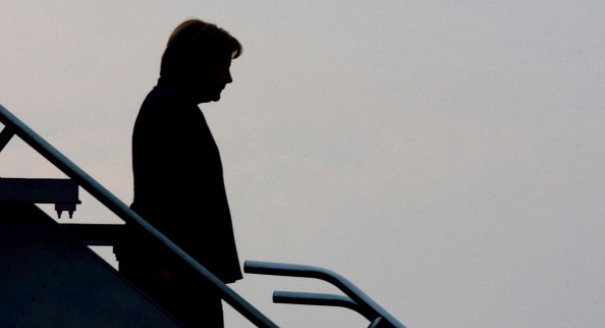
The German chancellor has done everything possible, excluding using force, to end the war in eastern Ukraine. Now, she needs wide support to make a new peace accord stick.
Angela Merkel traveled to Minsk on February 11 to try to broker a permanent ceasefire in eastern Ukraine. After marathon talks lasting seventeen hours, the German chancellor, along with the French, Russian, and Ukrainian leaders, reached a breakthrough.
The accord ensures the territorial integrity of Ukraine, which will throw down the gauntlet to Russian President Vladimir Putin. The agreement also includes a host of other measures to end the months of fighting and relieve the terrible suffering.
Despite her perseverance, Merkel knows that she cannot resolve the crisis alone. She is going to need maximum support from Petro Poroshenko, Ukraine’s president, and Putin to implement the new agreement.
Poroshenko will have to sell the deal to his public, and Putin will have to rein in the separatists, who have made big territorial gains in eastern Ukraine. As Merkel herself said after the February 11 meeting, the agreement offers only “a glimmer of hope,” and there is still a big effort to be made in future talks over Ukraine.
Having led the negotiations on Ukraine since the establishment in July 2014 of the so-called Normandy format, which also includes the French, Russian, and Ukrainian leaders, Merkel has chosen diplomacy and sanctions against Russia as her negotiating tools.
Her critics, particularly leading U.S. Republican senators, say this stance has only encouraged the Russian-backed separatists in eastern Ukraine to continue their land grabs and to weaken Ukraine as a viable state. Senators including John McCain want the United States to supply weapons to Ukraine. U.S. President Barack Obama, who met Merkel in Washington on February 9, said he had not yet made up his mind on sending arms.
Whatever happens after the talks in Minsk, the Ukraine crisis should now convince European leaders that the EU’s security, defense, and foreign policy is in a pitiful state.
The EU's security, defense, and foreign policy is in a pitiful state.Tweet This
The EU as a whole has been politically and militarily unwilling to consider how to defend the basic principles of territorial integrity. It has even been unwilling to establish a serious and viable foreign and security strategy to cope with its Eastern neighbors, let alone its turbulent Southern neighborhood.
Instead, the EU has relied on diplomacy and sanctions against Russia to stop the shocking violence in eastern Ukraine, in the naive belief that Europe’s post–Cold War security architecture has been sufficient to maintain peace and stability. Russia’s annexation of Crimea in March 2014 and its takeover via proxy rebels of Ukraine’s eastern regions of Donetsk and Luhansk should by now have debunked that belief.
That hasn’t happened—at least, not for many of Germany’s Social Democrats. Merkel’s coalition partners still cling to the idea of a comfortable European security architecture that includes Russia. German Foreign Minister Frank-Walter Steinmeier made that clear during the February 6–8 Munich Security Conference, an annual gathering of leaders and defense experts.
Whether or not he was pandering to the pacifist, anti-American, pro-Russian constituency in his own party, his remarks showed a reluctance in accepting that the post–Cold War era is over—and with it, Germany’s Ostpolitik, the country’s long-standing policy of rapprochement toward Moscow.
These are sentiments that Merkel has always had to consider when negotiating with Putin. She has not had such a free hand. She has sought to take the German public along with her in the hope she will not be blamed if any new ceasefire breaks down.
The Ukraine crisis has also shown how European leaders, instead of addressing the issues of hard power and strategy, have preferred to seek comfort in NATO providing their security. And on the cheap at that. As the alliance’s military commander, General Philip Breedlove, has repeatedly said, the Europeans are not willing to pay for their own defense, even when their borders are threatened.
Europeans are unwilling to pay for their own defense, even when threatened.Tweet This
The weakness of the September 2014 Minsk Protocol—a ceasefire accord that is now in tatters—is another example of Europe’s lack of political will. The EU was passive in the talks that produced that agreement, just as it has been conspicuously absent from the latest round of discussions.
In fact, the Normandy format eclipsed the EU, sidelined Poland, and excluded the United States, something that Putin surely wanted. Small negotiating formats may certainly be more effective than larger ones. But the presence of the EU and the United States would have signaled a strong and united transatlantic front.
Since the Minsk Protocol was signed, the pro-Russian rebels, who are supported militarily by Russia, have had no incentive to stop the fighting. One reason was that there has been no robust monitoring system in place, even though the Organization for Security and Cooperation in Europe (OSCE) was charged with doing just that.
From day one of its task, the OSCE has struggled to fulfill its mandate. According to a senior official, the organization has been strapped for cash (a budget of €76 million—$86 million—from March 2014 to March 2015), short of personnel (a total of 500 people, of whom 350 are based in eastern Ukraine), and saddled with insufficient equipment (two drones, one now damaged).
Furthermore, when the OSCE did try to monitor the ceasefire or investigate shelling, in many cases its personnel had to be escorted to the investigation sites by the separatists. Not only that; the OSCE was also unable to base its monitors along the border between Ukraine and Russia, let alone use a drone to do that. Russia did not allow it.
These restrictions, imposed by the separatists, have made a mockery of the OSCE. They also show the lack of political will of European governments, which say they strongly support the OSCE monitoring mission but are unprepared to back up the organization’s mandate with personnel, equipment, and teeth.
These are precisely the difficulties involved in implementing the new ceasefire agreement in eastern Ukraine, a task in which the OSCE will again be involved. Merkel cannot achieve peace alone.

Nonresident Senior Fellow, Carnegie Europe
Judy Dempsey is a nonresident senior fellow at Carnegie Europe
Recent Work
Judy Dempsey
Judy Dempsey
Carnegie does not take institutional positions on public policy issues; the views represented herein are those of the author(s) and do not necessarily reflect the views of Carnegie, its staff, or its trustees.

Russia is testing the waters of NATO’s mutual defense clause. What do strikes in Romanian territorial waters mean for the alliance’s posture toward Moscow?

Dimitar Bechev

With its public finances in shambles, the far right polling at 35 percent ahead of the 2027 presidential election, and a growing protest movement, is France’s crisis a threat to the EU’s geopolitical awakening?

Rym Momtaz, ed.

Ahead of a tough winter for Ukraine, Donald Trump’s swing back toward Russia bodes ill. But instead of panicking, Kyiv’s European allies are focusing on action.
Rym Momtaz

While the EU and European governments are embracing the much-lauded middle-power moment, this entails three difficult conundrums.

Richard Youngs

Much has been said of the changes Brussels is trying to make to the EU enlargement process. Here’s why gradual integration might—or might not—be the answer.
Dimitar Bechev