

Commentary
Judy Dempsey
{
  "authors": [
    "Judy Dempsey"
  ],
  "type": "commentary",
  "blog": "Strategic Europe",
  "centerAffiliationAll": "",
  "centers": [
    "Carnegie Endowment for International Peace",
    "Carnegie Europe"
  ],
  "collections": [
    "Europe’s Eastern Neighborhood"
  ],
  "englishNewsletterAll": "",
  "nonEnglishNewsletterAll": "",
  "primaryCenter": "Carnegie Europe",
  "programAffiliation": "",
  "programs": [],
  "projects": [],
  "regions": [
    "Russia",
    "Europe",
    "Eastern Europe",
    "Ukraine",
    "Western Europe",
    "Germany"
  ],
  "topics": [
    "Foreign Policy",
    "EU",
    "Security"
  ]
}
Source: Getty
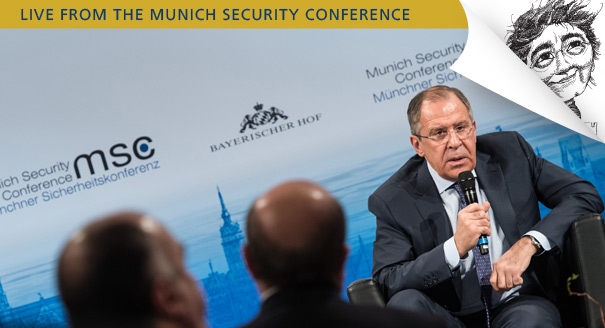
The gap between the Kremlin and the transatlantic allies was exposed to the full at the Munich Security Conference—and shows no signs of narrowing.
Minutes after German Chancellor Angela Merkel finished her hour-long discussion at the Munich Security Conference (MSC) on February 7, it was the turn of the Russian foreign minister, Sergei Lavrov, to take the floor.
After listening to Merkel give her candid view about very complex issues from the crisis in Ukraine to hybrid warfare, it was instructive to hear Lavrov. The Russian, who comes to Munich each year for this annual gathering of world leaders, defense chiefs, and security experts, could have simply sent a video of his performance of last year.
For Lavrov, nationalists run the government in Kiev. The West, he says, doesn’t care about the 1 million refugees who have fled to Russia to escape the fighting in eastern Ukraine. Forget the fact that Russia continues to support the pro-Russian separatists in eastern Ukraine; Lavrov accused the West of ignoring the facts, of taking sides, of not taking Russia’s concerns seriously.
MSC delegates are used to Lavrov by now. But his performance—and the fact that he is representing the Russian leadership—shows either that President Vladimir Putin really doesn’t care what the West thinks or that Putin is just using Lavrov.
Yet other Russians attending the MSC do care about the future of their country and its relations with the West. In private conversations, young and old Russians bemoaned the dangerous standoff between the West and Russia and the situation in Ukraine. Above all, they really worry that Russia is losing—or rather, has lost—Germany, one of Russia’s most important allies in Europe.
Some Russians at #MSC2015 worry that Russia is losing, or has lost, Germany.Tweet This
“I often ask myself if Putin knows what he is doing,” said a (young) Russian security analyst. The fact that he and others wanted to go off the record betrayed their sense of worry about saying what they thought in public. “Merkel has gone overboard to give Putin a way out,” said a highly experienced former Russian diplomat. “But Putin has given her nothing. Nothing. I don’t know why. We are losing Germany.”
Not only that. Well before the Ukraine crisis began, Germany went out of its way to help Russia modernize its economy, with the support of German expertise and know-how. Indeed, it is worth reading the speech that Frank-Walter Steinmeier, the German foreign minister, gave in Yekaterinburg in 2008, when he presented proposals for a German-Russian partnership. Russia didn’t take up the offer.
“I remember that speech. It would have meant decentralizing power,” said a youngish Russian analyst attending the MSC. “Putin doesn’t understand the damage he is doing. We know that the chemistry between Putin and Merkel is not great. But Merkel has really tried to find a political solution to the Ukraine crisis. He gives her nothing.”
What Russia is doing in #Ukraine is destroying any kind of trust.Tweet This
Some U.S. officials, also speaking privately, tried to be a little bit upbeat about a dialogue. Russia, one official said, had played an important role in helping remove Syria’s 1,000 tons of chemical weapons. But what Russia is doing in Ukraine is destroying any kind of trust. “The communication is breaking down,” another official said. “Look at the recent near miss between Russian fighter jets and a civilian aircraft,” he added.
Russian analysts in Munich are frustrated. They acknowledge that fewer and fewer Russians attend international conferences that might stimulate some dialogue. “They don’t want to speak out of line,” a German diplomat told me. “I have never seen so few Russians attending these meetings, even though we keep inviting them.” Lavrov is one of the exceptions.
What it boils down to is that the longer this dialogue of the deaf continues, the longer the war in Ukraine will go on, and the greater the risk of even more crises—and accidents. That’s Merkel’s ongoing nightmare.
Image source: Widmann / MSC

Nonresident Senior Fellow, Carnegie Europe
Judy Dempsey is a nonresident senior fellow at Carnegie Europe
Recent Work
Judy Dempsey
Judy Dempsey
Carnegie does not take institutional positions on public policy issues; the views represented herein are those of the author(s) and do not necessarily reflect the views of Carnegie, its staff, or its trustees.

The European Commissioner for Trade is headed to China. But after President Xi’s bridge-building visit to Washington, can a more isolated EU overcome Beijing’s stranglehold on critical raw materials? Who will blink first?

Rym Momtaz, ed.

The domestic impacts of how long it is taking to end the war in Ukraine have pushed the French electorate to the political extremes and compromised the country’s diplomatic capacity.
Rym Momtaz

Before the next wave of EU enlargement takes place, the union needs to grapple with thorny questions of how power is distributed among its members.


Emil Sondaj Hansen, Ditte Brasso Sørensen

A summer of escalation in the Black Sea has hurt Ukraine economically and is exacerbating world food security. A truce is needed—as is a broader reframing of Europe’s Ukraine strategy.

Thomas de Waal

Are Germany’s economic, industrial, and political struggles becoming a liability for the EU’s ability to rise to the geopolitical moment?
Rym Momtaz, ed.