

Commentary
Judy Dempsey
{
  "authors": [
    "Judy Dempsey"
  ],
  "type": "commentary",
  "blog": "Strategic Europe",
  "centerAffiliationAll": "",
  "centers": [
    "Carnegie Endowment for International Peace",
    "Carnegie Europe"
  ],
  "collections": [
    "Europe’s Eastern Neighborhood"
  ],
  "englishNewsletterAll": "",
  "nonEnglishNewsletterAll": "",
  "primaryCenter": "Carnegie Europe",
  "programAffiliation": "",
  "programs": [],
  "projects": [],
  "regions": [
    "Russia",
    "Europe",
    "Eastern Europe",
    "Ukraine",
    "Western Europe"
  ],
  "topics": [
    "Foreign Policy",
    "Security",
    "EU"
  ]
}
Source: Getty
Damned if he does, damned if he doesn’t, Ukraine’s president may have to cede more territory to end the conflict raging in the country’s east.
Try selling a peace deal to your people when your country has been invaded, part of your territory has been annexed, and, after months of bitter fighting, you are being asked to cede a bit more ground as the price to pay to stop the conflict.
This is the choice facing Petro Poroshenko, Ukraine’s president and commander in chief of its armed forces, after his long discussions in Kiev on February 5 with Angela Merkel, the German chancellor, and François Hollande, the French president.
The new peace deal would consist of a broad demilitarized zone plus greater autonomy for those parts of eastern Ukraine held by the pro-Russian separatists. Poroshenko had already agreed several months ago to give the regions of Donetsk and Luhansk a wide degree of autonomy, which in practice means they are under the control of the rebels and beyond Kiev’s authority.
“On the table is a ceasefire that the Germans hope will stick,” a European diplomat who was briefed by the Germans told me. “But who knows what the separatists or Putin will do? Poroshenko is in an extremely difficult situation. He has to show his people that he has gained something from the deal and all the months of fighting.”
Merkel publicly acknowledged the Ukrainian president’s vulnerability. “Poroshenko ran a big political risk in accepting the Minsk agreement [to end the fighting], in accepting the status of Donetsk and Luhansk,” she told participants attending the 2015 Munich Security Conference, an annual gathering of world leaders, defense chiefs, and security experts.
Over the weekend of February 7–8, officials were working on the details of the new peace plan, with four-way talks between the leaders of France, Germany, Russia, and Ukraine expected on February 8. Merkel is hoping for some official answer from Putin before she flies on the same day to Washington, where she will hold talks with U.S. President Barack Obama.
The proposals are based on the Minsk Protocol, a ceasefire accord that was signed in September 2014 between Russia, Ukraine, separatist leaders, and the Organization for Security and Cooperation in Europe (OSCE). Since then, the ceasefire has been repeatedly broken. And over the past several weeks, Russian-backed separatists have established even more facts on the ground in eastern Ukraine because they are well equipped and trained, unlike the Ukrainian armed forces.
Furthermore, the OSCE has been unable to systematically monitor the withdrawal of heavy weapons from special zones established by the Minsk accord. Nor has the organization had the possibility to monitor in any way the flow of weapons from Russia to the separatists.
At #MSC2015, Poroshenko ruled out making any further territorial concession for a ceasefire.Tweet This
The border between Ukraine and Russia is porous, and Russia has prevented the OSCE from monitoring movements along it. Western diplomats told Carnegie Europe that it would be extremely difficult to believe that Putin would give the OSCE unhindered access to the frontier.
The new proposals also envision a wider buffer zone designed to separate the two sides. Diplomats said a broader zone could give the OSCE monitors greater safety and more of a chance to supervise any new ceasefire. But such a plan would also mean that pro-Russian separatists could consolidate the territory they have gained over the past few months.
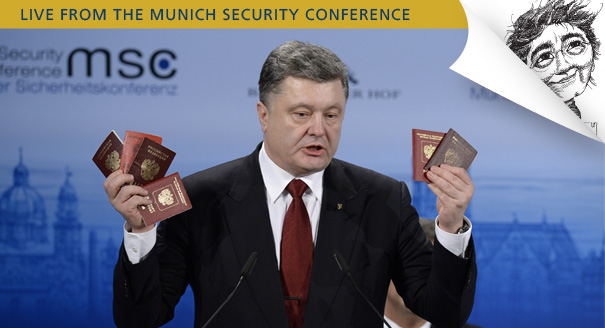
Speaking at the Munich Security Conference on February 7, Poroshenko ruled out making any further territorial concession in return for a ceasefire. “The Minsk accord is not a buffet in the Bayerischer Hof,” he said, referring to the conference venue.
Later, when asked by reporters about the details of the peace plan he discussed with Merkel and Hollande, Poroshenko sidestepped the question. Instead, he repeated his call for military assistance. Diplomacy, he said, had to be backed up by strong defenses.
#Poroshenko believes diplomacy has to be backed up by strong defenses.Tweet This
“The stronger our defense, the more convincing our diplomatic voice.” He said Ukraine wanted defensive weapons as well as communications equipment and counterbattery radar. Merkel was adamant in her refusal to send weapons to Ukraine, for which she was criticized by several U.S. officials attending the conference in Munich.
Even though several European countries want Ukraine to receive weapons, it was difficult at the Munich Security Conference to find a representative of any European state who was prepared to say publicly that their government would arm the Ukrainians.

Nonresident Senior Fellow, Carnegie Europe
Judy Dempsey is a nonresident senior fellow at Carnegie Europe
Recent Work
Judy Dempsey
Judy Dempsey
Carnegie does not take institutional positions on public policy issues; the views represented herein are those of the author(s) and do not necessarily reflect the views of Carnegie, its staff, or its trustees.
Europe has an interest in supporting Armenian leader Nikol Pashinyan as he tries to make peace with neighbors and loosen ties with Russia. But it is depersonalized support in the long term, not quickfire flash, that will win the day.

Thomas de Waal
Following Ursula von der Leyen’s gaffe equating Turkey to Russia and China, relations with Ankara risk deteriorating even further. Without better, more consistent diplomatic messaging, how can the EU pretend to be a geopolitical power?

Sinan Ülgen
Closer EU-UK ties could help address urgent European concerns. But is the EU ready for rapprochement with the United Kingdom?

Rym Momtaz, ed.
Europe has been standing by while its Southern neighborhood is being redrawn by force. To establish a path to peace between Israel and Lebanon, it’s time for Europeans to get involved with hard power.
Rym Momtaz
In Ukraine, Gaza, and Iran, AI warfare has come to dominate, with barely any oversight or accountability. Europe must lead the charge on the responsible use of new military technologies.

Raluca Csernatoni