

Commentary
Judy Dempsey
{
  "authors": [
    "Judy Dempsey"
  ],
  "type": "commentary",
  "blog": "Strategic Europe",
  "centerAffiliationAll": "",
  "centers": [
    "Carnegie Endowment for International Peace",
    "Carnegie Europe"
  ],
  "collections": [],
  "englishNewsletterAll": "",
  "nonEnglishNewsletterAll": "",
  "primaryCenter": "Carnegie Europe",
  "programAffiliation": "",
  "programs": [],
  "projects": [],
  "regions": [
    "Russia",
    "Europe",
    "Western Europe"
  ],
  "topics": [
    "Security",
    "Military"
  ]
}
Source: Getty
The seventieth anniversary of the end of World War Two coincides with a rift between the West and Russia that shows no sign of ending.
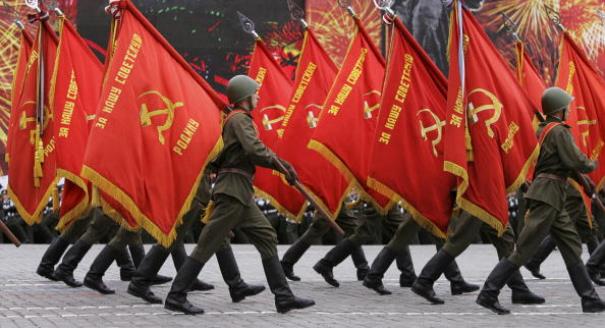
Every year on May 9, Russia celebrates Victory Day, the anniversary of the Soviet Union’s defeat of Nazi Germany, with a military parade in Moscow. Twice—in 1995 and in 2005—Western leaders attended. Then, there was a sense of hope for a new relationship between the West and Russia.
But the West did not have a unanimous view of the parades. Nor, indeed, was the West unanimous that its relationship with Russia would be based on genuine cooperation—perhaps even on shared values.
Old Europe, or Western Europe, perceived the parades as a celebration to mark the end of Nazism and fascism. The Red Army’s march into Berlin in 1945 ended a horrific and cataclysmic era of European history.
Nazism managed to destroy Europe’s rich and old Judeo-Christian heritage, despite attempts after 1945 to build Jewish communities and life in some parts of Europe. Over 5.7 million Jews were sent to the Nazi death camps. In the Soviet Union, an estimated 16 million people died, half of whom were soldiers.
Rereading British historian Tony Judt’s Postwar and American historian Timothy Snyder’s Bloodlands on the war and its aftermath is a salutary reminder of the original and noble intentions of the founding fathers of the European Union.
New Europe’s view of the Victory Day Parades was completely different. The Soviet Union’s Red Army was seen not as a liberator but as an oppressor. As soon as the Nazi yoke was lifted in 1945, populations across Eastern, Central, and Southeastern Europe were saddled with an oppressive totalitarian system that was to last until 1989.
Even after regaining its independence, with few exceptions, New Europe never shook off its suspicion of Russia. New Europe, particularly Poland and the Baltic states, craved security. That is why joining the Euro-Atlantic structures of NATO and the EU was their goal. Entering those organizations meant being reunited with Europe. It meant feeling safe.
Russian President Vladimir Putin’s annexation of the Crimean Peninsula in March 2014 and Russia’s military support for pro-Russian rebels in eastern Ukraine punctured that sense of security.
This interference was in sharp contrast to the wars in the former Yugoslavia during the 1990s and Russia’s quick war in Georgia in 2008. Those conflicts didn’t disturb New Europe’s sense of security, but in the case of Georgia, the warnings by some governments in New Europe of Russia’s intentions were vindicated. Old Europe had not taken those warnings seriously.
But it was Putin’s attempts to destabilize Ukraine—in a bid to jeopardize the country’s chances to become a vibrant democracy with a market economy and tied to Europe —that changed Old Europe’s view of Putin’s Russia.
The decision by most EU leaders or heads of state, with the exception of those of the Czech Republic and Slovakia, to stay away from this year’s May 9 Victory Day Parade signifies a shift by Old Europe. Old Europe doesn’t want to be associated with Putin’s triumphant nationalism and with a Kremlin that has manipulated history by invoking an antifascist narrative to justify its war against Ukraine.
The Kremlin has already blamed the United States for being behind Europe’s refusal to attend the parade—as if the United States had that much influence.
Some of Putin’s closest allies haven’t made any travel arrangements. Viktor Orbán, the prime minister of Hungary, is staying at home, and so is the country’s president, János Áder. Aleksander Lukashenko, the president of Belarus, a member of Russian-led Eurasian Economic Union, isn’t going to turn up either. And Kim Jong-un, the leader of North Korea, has canceled, apparently after first accepting the invitation.
Still, the leaders of China and India will attend, as will Islam Karimov, the president of Uzbekistan, and his Turkmen counterpart, Gurbanguly Berdimuhamedow, both of whom have appalling human rights records.
But there is one European leader who had to weigh up particularly carefully what decision to make: Angela Merkel. The German chancellor knows all too well the historical and present complex relationship between Berlin and Moscow—and Germany’s responsibility and culpability. She could not attend the Victory Day Parade because of how Putin has manipulated it. But nor could she stay away.
Instead, Merkel, whose discovery of diplomacy and foreign policy has been the hallmark of her third term in office, found a compromise worthy of war veterans and the huge suffering of the people of the Soviet Union. Merkel will travel to Moscow on May 10.
“We now have very deep differences of opinion with Russia, especially in connection with the events in Ukraine,” the chancellor said. “And yet it is important for me to lay a wreath at the Tomb of the Unknown Soldier on May 10, together with the Russian president, to honor the memory of the millions who died during the Second World War and for whom Germany is responsible.”

Nonresident Senior Fellow, Carnegie Europe
Judy Dempsey is a nonresident senior fellow at Carnegie Europe
Recent Work
Judy Dempsey
Judy Dempsey
Carnegie does not take institutional positions on public policy issues; the views represented herein are those of the author(s) and do not necessarily reflect the views of Carnegie, its staff, or its trustees.

The aftermath of the Ceuta crisis shows Europe has drawn the wrong lessons. Rather than doubling down on failed migration policies, the EU needs to address the underlying roots of such episodes.

Richard Youngs

An overwhelming victory by a far-right-wing party in a small state in eastern Germany will have major repercussions for Chancellor Friedrich Merz’s coalition.
Judy Dempsey

Canadian Prime Minister Mark Carney has twice inspired praise for standing up to U.S. President Donald Trump: at the 2026 World Economic Forum in Davos and on Canada-U.S. trade negotiations. Is Carney showing a third way better than the EU has in dealing with the Trump administration?

Rym Momtaz, ed.

The EU’s responses to two recent incidents expose the gulf between European perceptions and capabilities. Unless the union can bridge that gap, it will never become a real geostrategic power.
Rym Momtaz

In supporting Europe’s far-right, MAGA and Russia both want the same thing: a weaker EU. Europe must defend itself without abandoning the openness these forces exploit.

Armida van Rij