

Commentary
Judy Dempsey
{
  "authors": [
    "Judy Dempsey"
  ],
  "type": "commentary",
  "blog": "Strategic Europe",
  "centerAffiliationAll": "",
  "centers": [
    "Carnegie Endowment for International Peace",
    "Carnegie Europe"
  ],
  "collections": [
    "Transatlantic Cooperation"
  ],
  "englishNewsletterAll": "",
  "nonEnglishNewsletterAll": "",
  "primaryCenter": "Carnegie Europe",
  "programAffiliation": "",
  "programs": [],
  "projects": [],
  "regions": [
    "Europe",
    "North America",
    "United States",
    "Western Europe",
    "Germany"
  ],
  "topics": [
    "EU",
    "Climate Change",
    "Economy"
  ]
}
Source: Getty
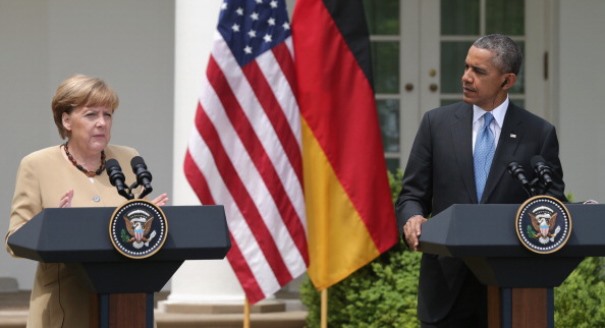
Despite eurozone leaders reaching a deal with Greece on July 13, Washington and Berlin have two competing economic philosophies about overcoming the Greek economic crisis.
There has been no end of criticism by leading American economic commentators, notably Paul Krugman, about Europe’s handling of the Greek crisis.
And no doubt there’ll be much more criticism after eurozone leaders clinched a complex deal with Athens on July 13, following seventeen hours of talks, over how to introduce reforms in return for a new bailout package.
Krugman and other U.S. economists believe the tough conditions demanded by Merkel and many other eurozone leaders are simply misguided. According to the Americans, these measures will do nothing to bring Greece out of its long recession. They will do nothing for the credibility of the euro. And they will do nothing for boosting growth across the EU.
The U.S. administration, however, sees the Greek economic crisis and Germany’s handling of it in a different light from these economists. For U.S. President Barack Obama, the crisis is not just about the credibility of the Europeans to deal with this immense economic problem. It is also about the security and strategic implications for Europe and for the United States.
“During the Greek crisis, the U.S. establishment has been looking at Europe through the prism of [Washington’s] military solidarity with Europe and the EU’s mirror framework of economic solidarity,” explained Krzysztof Bledowski, senior economist and council director for the Manufacturers Alliance for Productivity and Innovation (MAPI).
Seen from the United States, “this large-scale investment in European peace is universally judged as successful and money well spent,” Bledowski, a former senior official at the International Monetary Fund, told Carnegie Europe.
As an American organization focused on manufacturing, competitiveness and the challenges of the global economy, MAPI has been closely watching the euro crisis and what it means for the EU.
“Today, the average, reasonably well-informed American sees the EU as a hugely successful family that shares values and money and manages its big house smartly,” Bledowski added. “In this context, saving Greece with ‘whatever it takes’ is taken for granted. That this has not yet materialized raises eyebrows and confuses many.”
Nicolaus Heinen, an economist at Deutsche Bank Research and an expert on European integration, agrees that the United States and Germany see the Greek crisis through different lenses.
“Germany looks at Greece rather from a fiscal policy perspective, while the United States takes a foreign policy perspective,” Heinen told Carnegie Europe. “Germany has never had the same understanding of geostrategic issues as the United States and France have—and this applies particularly with regard to Greece.”
But the differences go beyond security and strategy. There are essential economic and philosophical differences between Washington and Berlin. The American view is anchored on demand-side economics; the German perspective is based on supply-side economics.
Bledowski argues that during the Great Depression and after World War II, Keynesian demand-side economics drove the policy debate in the United States. This policy also underlay the economic recovery of Europe through the Marshall Plan. The United States, the UK, and most other continental economies embraced activist monetary and fiscal policies to manage cyclical variations in the postwar era. In fact, this new orthodoxy spread to the rest of the world as its success became evident.
But not Germany. According to Bledowski, Germany remained an exception as it struggled to accept Keynesian concepts of countercyclical policies. Instead, the country’s economists and policymakers opted for an ordoliberal approach. According to this doctrine, the social market economy relies on heavy redistribution of income through the state but avoids activist demand management.
Heinen concurs largely with this view. “[Germany’s view is] basically an expression of a different understanding of economic policy in crisis countries,” he said. The German approach, shared by other northern European countries, has a political dimension. “The difference is taxpayers’ money. Most politicians are worried about losing votes if it becomes manifest that a part of public loans to Greece cannot be redeemed,” Heinen added.
European economists do not believe in a U.S.-style Marshall Plan for Greece. Indeed, neither do American economists, unless Greece seriously committed itself to a major reform program, Heinen argued.
“Most economists on both sides of the Atlantic realize that additional financial resources—for example, within some kind of Marshall aid program—could not create additional growth effects as long as the institutional environment in Greece does not encourage companies to invest,” he added.
In other words, solving the crisis is about making reforms—but also about sticking to the EU rules that Greece and other eurozone countries have not adhered to.
Back in 2010, the Greek crisis gave a new impetus for EU institutions to further develop the institutional framework of economic policy coordination among the eurozone countries. But these reforms were not really successful.
“[The reforms] followed a rules-based approach—and most euro area countries did not want to follow the rules that they had set up themselves,” Heinen said. “In 2013, only 10 percent of economic policy recommendations coming from EU institutions were fully implemented by euro area member states.” That miserable record surely proves the need for greater economic and political integration.

Nonresident Senior Fellow, Carnegie Europe
Judy Dempsey is a nonresident senior fellow at Carnegie Europe
Recent Work
Judy Dempsey
Judy Dempsey
Carnegie does not take institutional positions on public policy issues; the views represented herein are those of the author(s) and do not necessarily reflect the views of Carnegie, its staff, or its trustees.

As we close out another season of Strategic Europe, it is worth taking stock of the deep shifts underway.

Rym Momtaz
The EU had to compromise to adopt a twenty-first sanctions package against Russia, exposing growing cracks in the union’s resolve. Is this latest, weaker round worth it to keep pressure on Moscow?
Rym Momtaz, ed.

Trump is distracted and Ukraine wants Europe to step up. The continent’s leaders must find their voice and assert it in talks with Russia.

Alissa de Carbonnel

Mounting economic strain and battlefield losses will not necessarily make the Kremlin less dangerous. They could instead push Moscow toward a more aggressive hybrid campaign designed to test NATO’s Eastern flank, exploit allied hesitation, and fracture European resolve.

Maksym Beznosiuk

Over the past ten years, NATO has held almost as many summits as it did during the entirety of the Cold War. Are they still useful, or is it time to stop holding annual meetings?
Rym Momtaz, ed.