

Commentary
Marc Pierini
{
  "authors": [
    "Marc Pierini"
  ],
  "type": "commentary",
  "blog": "Strategic Europe",
  "centerAffiliationAll": "",
  "centers": [
    "Carnegie Endowment for International Peace",
    "Carnegie Europe"
  ],
  "collections": [],
  "englishNewsletterAll": "",
  "nonEnglishNewsletterAll": "",
  "primaryCenter": "Carnegie Europe",
  "programAffiliation": "",
  "programs": [],
  "projects": [],
  "regions": [
    "Europe",
    "Western Europe"
  ],
  "topics": [
    "Foreign Policy",
    "EU",
    "Migration"
  ]
}
Source: Getty
As Europe’s refugee crisis continues, EU governments urgently need to find concrete solutions. At stake are questions of rights, dignity, and Europe’s moral stance.
As the surge in asylum seekers heading to the EU was beginning to be felt in May 2015, the European Commission issued a sensible proposal that dealt with all aspects of the forthcoming crisis. The paper, which included a scheme to resettle quotas of refugees across the member states, was torn to pieces by the vast majority of EU governments. Only a few weeks ago, quotas were still out of the question.
Then came the photo of three-year-old Syrian Alan Kurdi, seemingly sleeping on a beach like a child sleeps in his bed. He had drowned as his family attempted to cross from Turkey to Greece, and his body had been washed ashore.
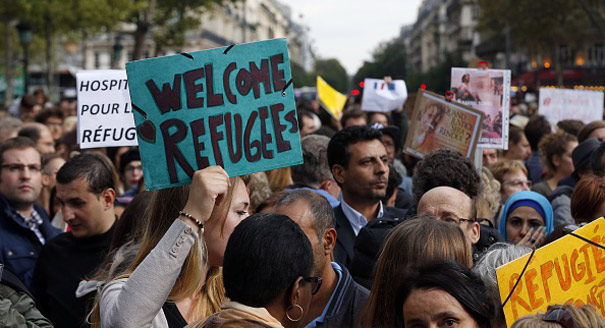
But the real game changer was the attitude of European citizens, starting with the Germans. Tired of EU ministerial meetings ending in repeated disagreements, citizens took the initiative, and associations began to help refugees. In Dortmund, citizens went to the train station to greet Syrian refugees with applause, banners, and sweets. In Stuttgart, the police tweeted to ask the public to stop bringing supplies because they had enough for the day. Two German dailies published pullout guides for refugees in Arabic under the title “Welcome to Berlin.”
When EU foreign ministers discussed the refugee crisis (again) on September 5, deep divergences remained: on how to sort refugees from economic migrants; on whether there should be a centrally managed distribution of refugees; on whether quotas should be compulsory; and on whether setting numbers would be interpreted as an invitation.
The issue remains immensely difficult to handle—all the more so as no end is in sight to the Libyan and Syrian conflicts, to name only two. The UN high commissioner for refugees recently recalled the principles applying to the current crisis. The European Commission president, Jean-Claude Juncker, called on EU member governments on September 9 to face up to the emergency, and the commission amended its proposal, urging member states to accept 160,000 refugees.
No decent politician can brush away the horrors of the #refugeecrisis anymore.Tweet This
Now, amid vast divergences, citizens’ initiatives, and scenes of asylum seekers marching along highways and rail tracks, EU interior ministers are tasked with finding concrete solutions when they meet for an emergency summit on September 14.
The ministers should take into account four main considerations.
First, an orderly process should be put in place at the EU level and with transit countries. Access routes should be designated and made public, and air and sea transportation should be organized from transit countries to Europe, to cut off the tragic business of human traffickers.
Asylum transit camps should be organized both in EU countries of first entry (such as Bulgaria, Greece, Hungary, and Italy) and in non-EU transit countries (such as Macedonia, Serbia, and Turkey). The determination of refugee status should be processed in full coordination with the UN refugee agency and the International Organization for Migration. EU funds should be applied to the entire operation.
Second, sorting asylum seekers from economic migrants remains a necessity. Refugees fleeing a war zone are entitled to international protection, and the determination of refugee status should be handled with great care. Conversely, people coming from regions and countries where their lives are in not in danger will do everything they possibly can to avoid being repatriated. A credible screening process is therefore essential for a political agreement at the EU level.
Third, in an aging European Union with declining demographic trends, welcoming refugees is a genuine economic opportunity. They bring skills, energy, and resilience, not misery. Germany, a country massively affected by the aging phenomenon, has understood the benefits of an influx of new workers and is creating new job positions—interpreters, police officers, healthcare personnel, language teachers—to manage a rapid process of screening, integration, and repatriation.
Because of the hefty costs involved, few EU governments will be able to afford large influxes of refugees, which in turn renders the discussion about compulsory quotas somewhat unrealistic. In practice, Germany will set the pace on its own terms, while others will contribute what they can. Some will simply opt out.
Fourth, the EU is bound to take a strong stand. As the largest peace and human rights project in history, the European Union should take the lead instead of silently watching this human tragedy engineered by dictators and their foreign supporters. Short of a strong policy decision, the very fabric of the EU will be torn apart.
Short of a strong policy decision, the fabric of the EU will be torn apart.Tweet This
Central European governments should remember their recent history and agree to contribute their share of solidarity. Similarly, the United States should take its fair share of Syrian and Iraqi refugees. In parallel, the EU should work relentlessly to convince Russia and Iran of the necessity to end the Syrian tragedy.
Overall, the issue is now one of rights, dignity, and Europe’s moral stance.
Maybe it is time to remember the words of Italian poet Erri De Luca from his 2005 poem Solo andata (One-Way Ticket):
No police can unleash more violence on us than we have already been subjected to.
We will be the servant, the children you do not make, our lives will be your adventure books.
We bring Homerus and Dante, the blind and the pilgrim, the smell you have lost, the equality you have subordinated.

Senior Fellow, Carnegie Europe
Marc Pierini is a senior fellow at Carnegie Europe, where his research focuses on developments in the Middle East and Turkey from a European perspective.
Recent Work
Marc Pierini
Marc Pierini
Carnegie does not take institutional positions on public policy issues; the views represented herein are those of the author(s) and do not necessarily reflect the views of Carnegie, its staff, or its trustees.

Trump is distracted and Ukraine wants Europe to step up. The continent’s leaders must find their voice and assert it in talks with Russia.

Alissa de Carbonnel

Mounting economic strain and battlefield losses will not necessarily make the Kremlin less dangerous. They could instead push Moscow toward a more aggressive hybrid campaign designed to test NATO’s Eastern flank, exploit allied hesitation, and fracture European resolve.

Maksym Beznosiuk
Over the past ten years, NATO has held almost as many summits as it did during the entirety of the Cold War. Are they still useful, or is it time to stop holding annual meetings?

Rym Momtaz, ed.
Nearly a year and a half after Europeans leaned into sucking up to Trump, the strategy has produced some benefits when it comes to Ukraine.
Rym Momtaz
Far-right leader Marine Le Pen can—and will—run in France’s next presidential election. What does the outcome of her appeal against a 2025 embezzlement conviction mean for the country’s political future?
Catherine Fieschi