

Commentary
Judy Dempsey
{
  "authors": [
    "Judy Dempsey"
  ],
  "type": "commentary",
  "blog": "Strategic Europe",
  "centerAffiliationAll": "",
  "centers": [
    "Carnegie Endowment for International Peace",
    "Carnegie Europe"
  ],
  "collections": [
    "Europe’s Southern Neighborhood"
  ],
  "englishNewsletterAll": "",
  "nonEnglishNewsletterAll": "",
  "primaryCenter": "Carnegie Europe",
  "programAffiliation": "",
  "programs": [],
  "projects": [],
  "regions": [
    "Middle East",
    "Europe",
    "Western Europe"
  ],
  "topics": [
    "Foreign Policy",
    "Security",
    "Military",
    "EU"
  ]
}
Source: Getty
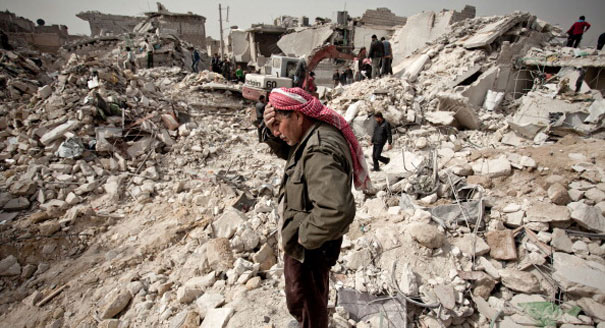
Europe has ceded all influence in its Southern neighborhood, as Russia intervenes in Syria to protect its interests.
Russia’s recently launched bombing of opposition targets in Syria is a brutal reminder of the decline of Western influence in the Middle East and North Africa.
In Afghanistan, the growing military might of Taliban fighters, who are now in open warfare with Afghan security forces, has exposed the weaknesses of the NATO-led mission in that country. Since the alliance’s withdrawal from Afghanistan in December 2014 after an eleven-year stint there, the country is lurching into another war.
Meanwhile, the United States’ decision to leave Iraq in December 2011, when the government in Baghdad was paralyzed by sectarian interests and the security forces were unprepared for later taking on the so-called Islamic State, has plunged the country into a new war.
The European Union’s 28 member states are now collectively faced with three unpalatable truths that expose Europe’s appalling lack of strategy, foresight, and understanding of crisis management.
The first is Europe’s—but also the United States’—inability to do state building. The second is the questionable impact of hard power. The third is the fallout of wars: millions of refugees on the move, fleeing the areas of conflict.
The EU provided over €3 billion ($3.3 billion) in development aid and humanitarian assistance to Afghanistan between 2002 and 2013. In that time, the Afghans could boast how many girls were attending school for the first time and how many women were now able to work.
But neither the EU nor the United States was able to build strong state institutions that could preserve some of those gains. That would have required decades of commitment that the West was unwilling to invest.
Now, a mixture of deeply entrenched corruption, traditions, ethnic rivalries, and Taliban forces that never disappeared from the scene is coming back with a vengeance to undo the West’s intervention. Indeed, once it became clear that NATO’s military operation in Afghanistan was to be replaced by a small training mission, many competing groups quickly exploited the ensuing security vacuum.
The same could be said of Iraq. The 2003 U.S.-led military invasion, which actually destroyed the country’s preexisting state institutions, was not followed up by a sustained effort to build new ones. Libya is also another case in point.
The second issue is the efficacy of hard power. Military means can only be successful if they are followed up by a very long-term state-building strategy aimed at supporting and institutionalizing democracy.
This is what happened in Germany and Japan after 1945. That U.S. commitment was unqualified. Certainly, the Cold War played a crucial role in persuading the United States of the strategic need to bring stability to Western Europe and build democracy in Germany and Japan.
Had the United States neglected state building, America’s hard power would have been squandered. It would have done untold damage to postwar Europe’s stability, prosperity, and ability to defend itself against the Soviet Union. In short, without the duality of hard power and a long-term policy of soft power, countries have little or no chance of being stable.
In this context, Russia’s bombing of forces opposed to Syrian President Bashar al-Assad’s regime has little to do with the day after the conflict in terms of rebuilding state institutions. Indeed, Russian President Vladimir Putin’s decision to intervene militarily in Syria could repeat the same mistakes of 1979, when the Soviet Union invaded Afghanistan to protect Moscow’s ally in Kabul.
Finally, Europe (after Jordan, Lebanon, and Turkey) is now picking up the pieces of these military ventures. Precisely because there are no stable, functioning state institutions—let alone the faintest hope of peace and freedom in several Middle Eastern countries—refugees are on the move.
And if any European government believes or hopes that Russia’s bombing campaign will end the flow of refugees, they are deceiving themselves. This is the new reality that European governments will have to accept.
It is questionable, however, whether Europe’s helplessness in the Middle East and its struggle to cope with refugees will make EU governments consider the miserable weaknesses of their foreign, security, and development aid policies.

Nonresident Senior Fellow, Carnegie Europe
Dempsey is a nonresident senior fellow at Carnegie Europe
Recent Work
Judy Dempsey
Judy Dempsey
Carnegie does not take institutional positions on public policy issues; the views represented herein are those of the author(s) and do not necessarily reflect the views of Carnegie, its staff, or its trustees.
Montenegro and Albania are frontrunners for EU enlargement in the Western Balkans, but they can’t just sit back and wait. To meet their 2030 accession ambitions, they must make a strong positive case.


Dimitar Bechev, Iliriana Gjoni
Donald Trump has repeatedly bashed NATO and European allies, threatening to annex Canada and Greenland and deploring their lack of enthusiasm for his war of choice in Iran. Is this latest round of abuse the final straw?

Rym Momtaz, ed.
Donald Trump’s repudiation of NATO goes against the Make America Great Again vision of a U.S.-centered foreign policy. If the goal is to preserve the alliance by boosting Europe’s commitments, leaning into France’s vision is the most America First way forward.
Rym Momtaz
Hungarians head to the polls on April 12 for an election of national and European consequence. Three different outcomes are on the cards, each with their own implications for the EU.

Zsuzsanna Szelényi
The far right failed to win big in France’s municipal elections. But that’s not good news for the country’s left wing, which remained disunited while the broader right consolidated its momentum ahead of the 2027 presidential race.

Catherine Fieschi