

Commentary
Judy Dempsey
{
  "authors": [
    "Judy Dempsey"
  ],
  "type": "commentary",
  "blog": "Strategic Europe",
  "centerAffiliationAll": "",
  "centers": [
    "Carnegie Endowment for International Peace",
    "Carnegie Europe"
  ],
  "collections": [
    "EU Integration and Enlargement"
  ],
  "englishNewsletterAll": "",
  "nonEnglishNewsletterAll": "",
  "primaryCenter": "Carnegie Europe",
  "programAffiliation": "",
  "programs": [],
  "projects": [],
  "regions": [
    "Europe",
    "Western Europe",
    "Germany"
  ],
  "topics": [
    "Foreign Policy",
    "EU",
    "Migration"
  ]
}
Source: Getty
Germany desperately needs support from Europe to cope with the refugee crisis but will not get it.
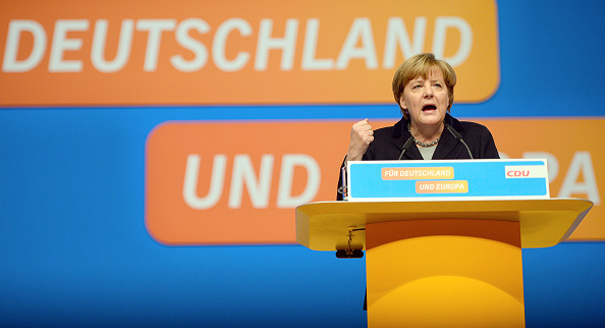
Angela Merkel is not for caving in. Ever since becoming chancellor in 2005, the German leader has seen off any rebellion inside her Christian Democratic Union party. So it was on December 14 during the party’s annual congress.
If any critic inside or outside Germany believes Merkel is politically vulnerable because of her open-door policy toward the refugees fleeing the war-torn Middle East, they have miscalculated—at least for the moment. Merkel has won some time.
Her hour-long speech, delivered with conviction, reassured her supporters and surprised her opponents. Only two of the 1,000 conference delegates voted against her proposals for dealing with the refugee crisis.
As it is, many EU countries want to close, or have already closed, their doors to people fleeing war and persecution. It’s as if these states want Germany to pick up the bill. Alone. And that is what worries Merkel’s supporters. Europe is turning its back on Germany—if not to the world beyond its borders.
Merkel’s stance on the refugee crisis has been based on moral and humanitarian principles. “We will live up to our humanitarian responsibility,” she told the delegates. “The refugee crisis is a historic test for Europe, which I am convinced it will pass. Even if everything we do in Europe is interminably arduous,” she added, with a dig at the EU’s lackluster response to the crisis.
But in the run-up to the congress, Merkel could not ignore the problems involved in the sheer effort needed to deal with the 1 million refugees, migrants, and asylum seekers who have arrived in Germany in 2015. A top-heavy bureaucracy and inadequate numbers of civil servants to register so many arrivals have often been superseded by an extraordinary number of civic movements. Indeed, the refugee crisis has awoken German civil society. Merkel will need this support in the coming months, especially as she faces five important regional elections.
And she will have to show the German public that there is an end in sight to the huge numbers wanting to settle in Germany.
But as other EU members put up barriers, as Berlin seeks help from Turkey to protect the EU’s external borders, and as Brussels wants to establish a special European police force to reinforce those frontiers, Merkel is left with two other immense problems. The first is war; the second is the continuing rise of populist and right-wing movements that want nothing to do with refugees and that believe Europe can lock itself away from globalization and conflict.
No matter the physical cost, as long as the wars and fighting in Syria, Iraq, and Afghanistan continue, people will try to flee. They no longer want to be stuck in camps in Jordan or be condemned to miserable conditions in Lebanon or have no perspective whatsoever in Turkey. They want to reach Europe.
The reality is that the exodus to Europe has no chance of ebbing while war and instability plague the Middle East and the so-called Islamic State continues to wreak havoc on lands it controls or seeks to conquer.
The second problem is the specter of populism, whose xenophobia has the potential to turn Europe into a fortress. This is not an exaggeration. In cities such as Dresden, in eastern Germany, where anti-immigrant movements such as Pegida hold weekly demonstrations against refugees, academics told me how visiting non-German lecturers do not want to live in the city. And that is only one small example.
In France, even though Marine Le Pen’s far-right National Front suffered a setback in the second round of regional elections on December 13, it was only because the mainstream political parties united. In addition, France’s electoral system of first past the post instead of proportional representation robbed her of victory.
Such determination to stop Le Pen in this way does little to reduce the growing antipathy toward immigrants and the deepening malaise and insecurity of sections of society that feel threatened or marginalized. Le Pen is adept at exploiting these fears—as is Poland’s new government.
This is where Merkel’s speech fell short. Wars, insecurity, and populism did not figure much in her appeal to her party. Yes, she reassured her voters and supporters that multiculturalism was a nonstarter. “Those who seek refuge with us also have to respect our laws and traditions, and learn to speak German,” she said. “Multiculturalism leads to parallel societies, and therefore multiculturalism remains a grand delusion,” she added. The delegates spared no applauses. When she finished, they gave her a nine-minute standing ovation.
But Merkel knows that once the delegates return to their constituencies, they will have to cope with the refugees—and with questions from their supporters about how much longer the crisis will last. Quoting Wolfgang Schäuble, her finance minister, Merkel said the crisis was Germany’s rendezvous with globalization. It’s bound to be a long and lonely rendezvous that will not be shared by the rest of Europe, whatever Merkel pleads.

Nonresident Senior Fellow, Carnegie Europe
Judy Dempsey is a nonresident senior fellow at Carnegie Europe
Recent Work
Judy Dempsey
Judy Dempsey
Carnegie does not take institutional positions on public policy issues; the views represented herein are those of the author(s) and do not necessarily reflect the views of Carnegie, its staff, or its trustees.

As we close out another season of Strategic Europe, it is worth taking stock of the deep shifts underway.

Rym Momtaz
The EU had to compromise to adopt a twenty-first sanctions package against Russia, exposing growing cracks in the union’s resolve. Is this latest, weaker round worth it to keep pressure on Moscow?
Rym Momtaz, ed.

Trump is distracted and Ukraine wants Europe to step up. The continent’s leaders must find their voice and assert it in talks with Russia.

Alissa de Carbonnel

Mounting economic strain and battlefield losses will not necessarily make the Kremlin less dangerous. They could instead push Moscow toward a more aggressive hybrid campaign designed to test NATO’s Eastern flank, exploit allied hesitation, and fracture European resolve.

Maksym Beznosiuk

Over the past ten years, NATO has held almost as many summits as it did during the entirety of the Cold War. Are they still useful, or is it time to stop holding annual meetings?
Rym Momtaz, ed.