

Commentary
Dmitri Trenin
{
  "authors": [
    "Dmitri Trenin"
  ],
  "type": "commentary",
  "blog": "Strategic Europe",
  "centerAffiliationAll": "",
  "centers": [
    "Carnegie Endowment for International Peace",
    "Carnegie Europe",
    "Carnegie Russia Eurasia Center"
  ],
  "collections": [],
  "englishNewsletterAll": "",
  "nonEnglishNewsletterAll": "",
  "primaryCenter": "Carnegie Russia Eurasia Center",
  "programAffiliation": "",
  "programs": [],
  "projects": [],
  "regions": [
    "Russia",
    "Western Europe",
    "Europe",
    "Middle East"
  ],
  "topics": [
    "Security",
    "Foreign Policy",
    "EU"
  ]
}
Source: Getty
The current confrontation between the West and Russia will continue. Within that confrontation, however, a degree of cooperation is possible.
Carnegie Europe was on the ground at the 2016 Munich Security Conference, offering readers exclusive access to the debates as they unfolded and providing insights on today’s most urgent international issues. Check out our live coverage here.
*
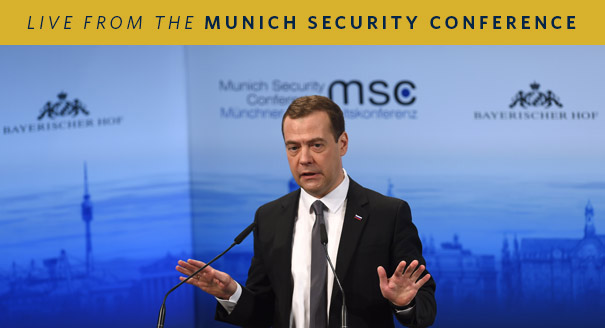
At the 52nd Munich Security Conference on February 12–14, Russian Prime Minister Dmitry Medvedev delivered the speech Vladimir Putin would have made had he cared to come to Munich this year. In fact, the Russian president has not attended this annual gathering of political leaders and security experts since 2007. Medvedev’s words were tough and his analysis exceedingly bleak, but his main point was an offer to put the glaring Russian-Western differences and bitter conflicts to one side and focus on a common threat coming from extremism.
This appears to be the new normal. Unlike in 2014 and 2015, Ukraine has not been a main theme at the 2016 Munich Security Conference. Nevertheless, U.S. Secretary of State John Kerry made a point of strongly condemning Russia’s policies and reassuring both Ukraine and NATO’s Eastern allies of America’s unwavering support. NATO Secretary General Jens Stoltenberg announced the alliance’s dual-track strategy toward Russia: defense and dialogue. Ukrainian and Lithuanian leaders were given the floor for vitriolic verbal attacks against Putin.
On Syria, the agreement on a ceasefire and humanitarian access reached in Munich on the eve of the security conference was tempered by vocal criticism of Russian bombardments in the Aleppo area. Russian Foreign Minister Sergei Lavrov, for his part, opined that absent closer military coordination on Syria between the Russian and U.S. militaries, the agreement would unravel. The Pentagon, however, was reluctant to be engaged beyond deconfliction. Compounding the picture, Saudi and Turkish ministers made it clear that their countries were on the verge of intervening directly in Syria.
If the conflict in Syria does not result in some sort of agreement leading to a peace settlement co-chaired by the United States and Russia, it may become the area where a head-on collision between Russia and NATO might occur. Turkey has just shelled the Syrian Kurds, whom it sees—alongside Syrian President Bashar al-Assad—as its main enemy. Should the Turks invade Syria or use their air force to attack the army of Damascus, Russia might use its aircraft or air defenses to push them back. That would certainly cause Turkey to invoke Article 5 of the Washington Treaty, which states that an attack against one NATO ally is considered an attack against all.
In November 2015, when the Turks shot down a Russian bomber over the Syrian border, NATO had shivers running down its spine. Dying for Warsaw and Riga was one thing; dying as a result of Turkish President Recep Tayyip Erdoğan’s failed brinkmanship was another. Luckily, that time Putin decided to give Ankara a nonmilitary answer. Next time, however, luck might run out. Erdoğan seems to believe that after having served NATO well for forty years against the Soviets, Turkey now has the right to count on the alliance’s support where it matters for Ankara—and Syria matters to Erdoğan as much as Ukraine does to Putin.
The United States does not share Erdoğan’s apparent logic, but U.S. influence in Turkey does not amount to full control over Ankara’s actions and policies. Should Turkey and Russia indeed clash in Syria, then not only NATO’s credibility but also peace in the Euro-Atlantic region and the whole world would be at risk. While Kerry in his statement in Munich evoked former U.S. president John F. Kennedy’s 1963 “Ich bin ein Berliner” speech and alliance solidarity, Medvedev referred to the 1962 Cuban missile crisis: a chilling and telling comparison.
NATO’s defense and deterrence of Russia is a familiar undertaking. Essentially, the alliance again sees Russia as an adversary to be contained. The dialogue option, however, is less clear. Russia and the West are generally talking past each other. The West is waiting for the combination of the Russian economy’s structural problems, low oil and commodity prices, and Western sanctions to bite Moscow hard enough to make it change course and surrender its outsize and outdated ambitions. The Kremlin realizes that such a surrender would lead to a collapse of the Russian regime and probably the Russian state as well. The Ukrainians are openly looking forward to that prospect.
In the present environment, war prevention remains the only big item on the agenda for Russian-NATO dialogue. When the NATO-Russia Council, which has been suspended since 2014, finally meets again, this instrument of cooperation will need to be converted to a crisis-management mechanism. Its new mission will be to avert dangerous incidents in the air and at sea, make sure that surprise military exercises are not taken for preparation for an attack, and see that communication channels are functioning properly to avoid tragic misunderstanding.
In the nine years that separate Putin’s and Medvedev’s appearances at the Munich Security Conference, the strategic climate between Russia and the West has experienced a dramatic change.
Former Director, Carnegie Moscow Center
Trenin was director of the Carnegie Moscow Center from 2008 to early 2022.
Recent Work
Dmitri Trenin
Dmitri Trenin
Carnegie does not take institutional positions on public policy issues; the views represented herein are those of the author(s) and do not necessarily reflect the views of Carnegie, its staff, or its trustees.

With its public finances in shambles, the far right polling at 35 percent ahead of the 2027 presidential election, and a growing protest movement, is France’s crisis a threat to the EU’s geopolitical awakening?

Rym Momtaz, ed.

Ahead of a tough winter for Ukraine, Donald Trump’s swing back toward Russia bodes ill. But instead of panicking, Kyiv’s European allies are focusing on action.
Rym Momtaz

While the EU and European governments are embracing the much-lauded middle-power moment, this entails three difficult conundrums.

Richard Youngs

Much has been said of the changes Brussels is trying to make to the EU enlargement process. Here’s why gradual integration might—or might not—be the answer.

Dimitar Bechev

The European Commissioner for Trade is headed to China. But after President Xi’s bridge-building visit to Washington, can a more isolated EU overcome Beijing’s stranglehold on critical raw materials? Who will blink first?
Rym Momtaz, ed.