

Commentary
Nathalie Tocci, Jan Techau
{
  "authors": [
    "Jan Techau"
  ],
  "type": "commentary",
  "blog": "Strategic Europe",
  "centerAffiliationAll": "",
  "centers": [
    "Carnegie Endowment for International Peace",
    "Carnegie Europe"
  ],
  "collections": [
    "Transatlantic Cooperation"
  ],
  "englishNewsletterAll": "",
  "nonEnglishNewsletterAll": "",
  "primaryCenter": "Carnegie Europe",
  "programAffiliation": "",
  "programs": [],
  "projects": [],
  "regions": [
    "Europe",
    "Western Europe",
    "France",
    "Germany"
  ],
  "topics": [
    "Foreign Policy",
    "Security",
    "EU"
  ]
}
Source: Getty
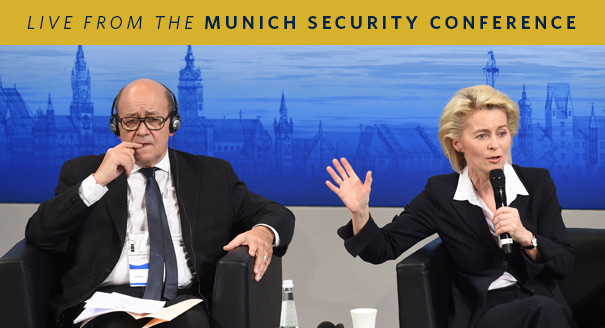
The first day of the 2016 Munich Security Conference was marked by little mention of the United States and by sharp differences between France and Germany.
Carnegie Europe was on the ground at the 2016 Munich Security Conference, offering readers exclusive access to the debates as they unfolded and providing insights on today’s most urgent international issues. Check out our live coverage here.
*
The 2016 Munich Security Conference has just started, and it is too early to tell where things will go here in the hotel Bayerischer Hof, but two observations can already be made, both of them of some significance for international affairs in the months to come. The conference has long been a key indicator for what’s hot and what’s not in foreign policy circles, so it matters what comes up here and what doesn’t.
Perhaps even more striking was the absence of any kind of discussion about the biggest piece of transatlantic news in several years, the quadrupling of U.S. defense spending in Europe that was announced by the Pentagon on February 2. Even at the traditional preconference Transatlantic Forum event, organized by the Christian Social Union, Bavaria’s governing conservative party, which was as always attended by political and military top brass from both sides of the Atlantic, the issue was not mentioned once. NATO Secretary General Jens Stoltenberg will address the conference only tomorrow, February 13, but it is still remarkable that what would have been a sensation under normal circumstances has raised no eyebrows here so far.
Good news is just not news, it seems, and it is perhaps more rewarding to spread pessimism about Russia and Syria than to weigh in on what could be at least a little game changer in Europe’s strategic architecture after the Ukraine crisis. Maybe Europeans have become so used to introspection and the absence of leadership from Washington on European affairs that it would take bigger things to stir them. But bigger things should not be expected anytime soon in this field, and much will now depend on what the Europeans can put on the table to reciprocate the new U.S. commitment to Europe. The Munich Security Conference used to be the high mass of transatlantic relations. Maybe Saturday will bring more substance to this direly needed debate.
The second observation is how big the difference was in tone between the German and the French defense ministers’ speeches. The addresses illustrated that two years into the new German foreign policy spurred by German President Joachim Gauck’s remarks at the 2014 Munich Security Conference, the strategic culture between the two countries still could not be more different.
Von der Leyen, as expected, put the refugee crisis at the center of her speech. She made a strong case for a pan-European solution to this enormous problem. She highlighted German contributions to the fight against the self-styled Islamic State only in passing and then turned to the technical contribution the German armed forces were making to integrating refugees into mainstream society. She spent a good amount of time explaining how the Bundeswehr was putting together apprenticeship programs so that refugees could learn a trade or a craft. She also allowed herself a sweet moment of self-delusion when she announced that “one day there will be peace again in the region, and then the refugees will return to their countries.”
Le Drian was very different. He began not with refugees—this is the issue that he chose to mention in passing—but with the French-led fight against the Islamic State, or Daesh. From this starting point, Le Drian did not go down into the weeds of technical detail, as von der Leyen had done, but instead moved up into the lofty heights of French leadership and the global significance of the fight for liberté—freedom.
So no sign of a new culture of global strategic scope from Germany, and no acknowledgement of military and economic weakness from France. Germany came out of the speeches as a well-meaning helper currently absorbed by domestic worries, France as the glorious nation on which the future of civilization depended.
These two images are exactly what the leaderships of the two countries currently need. The German government needs to come to grips with the refugee crisis, or else it might fall. President François Hollande of France needs to demonstrate strength to make people forget about the abysmal economic record of his government and the effective unreformability of the French state.
This would be less of a worry if less were at stake. But in a situation in which nothing is needed more than a joint European approach, seeing the two strategic cultures in Europe’s two indispensable countries diverge so much is deeply troublesome.

Director, Europe Team, Eurasia Group
Techau is director with Eurasia Group's Europe team, covering Germany and European security from Berlin. Previously, he was director of Carnegie Europe.
Recent Work

Nathalie Tocci, Jan Techau
Jan Techau
Carnegie does not take institutional positions on public policy issues; the views represented herein are those of the author(s) and do not necessarily reflect the views of Carnegie, its staff, or its trustees.

The EU can impose sanctions but struggles to enforce them without the United States. With Washington increasingly disinterested in backing European interests, the bloc must now fend for itself.


Nicu Popescu, Tiago Antunes

Russia is testing the waters of NATO’s mutual defense clause. What do strikes in Romanian territorial waters mean for the alliance’s posture toward Moscow?

Dimitar Bechev

With its public finances in shambles, the far right polling at 35 percent ahead of the 2027 presidential election, and a growing protest movement, is France’s crisis a threat to the EU’s geopolitical awakening?

Rym Momtaz, ed.

Ahead of a tough winter for Ukraine, Donald Trump’s swing back toward Russia bodes ill. But instead of panicking, Kyiv’s European allies are focusing on action.
Rym Momtaz

While the EU and European governments are embracing the much-lauded middle-power moment, this entails three difficult conundrums.

Richard Youngs