

Commentary
Judy Dempsey
{
  "authors": [
    "Judy Dempsey"
  ],
  "type": "commentary",
  "blog": "Strategic Europe",
  "centerAffiliationAll": "",
  "centers": [
    "Carnegie Endowment for International Peace",
    "Carnegie Europe"
  ],
  "collections": [],
  "englishNewsletterAll": "",
  "nonEnglishNewsletterAll": "",
  "primaryCenter": "Carnegie Europe",
  "programAffiliation": "",
  "programs": [],
  "projects": [],
  "regions": [
    "Europe",
    "Western Europe",
    "Germany"
  ],
  "topics": [
    "EU",
    "Migration",
    "Foreign Policy"
  ]
}
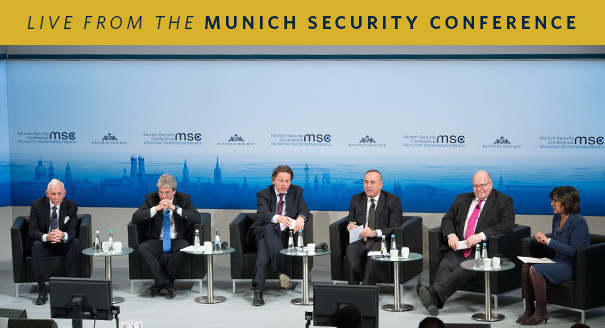
Source: Getty
Germany is doing everything possible to maintain its humanitarian and moral principles toward refugees. But Berlin can no longer do it alone.
Carnegie Europe was on the ground at the 2016 Munich Security Conference, offering readers exclusive access to the debates as they unfolded and providing insights on today’s most urgent international issues. Check out our live coverage here.
*
Peter Altmaier cuts an impressive figure. As Angela Merkel’s chief of staff—as if that were not enough on his plate—Altmaier is responsible for coordinating his boss’s greatest challenge since she became German chancellor in 2005: the refugee crisis.
Merkel had just ended talks with Ukrainian President Petro Poroshenko in Kiev, followed by a meeting with Russian President Vladimir Putin in Moscow, to try to forge a ceasefire agreement in eastern Ukraine. She then flew to Munich to explain her position and project a leadership that has kept Europe united over its policy toward Russia.
This year, the continuing war in Syria and the huge impact that the refugee crisis is having on the region—but also on Europe and particularly on Germany—is topping the agenda. Again, Germany has taken the lead, this time without its EU allies.
Altmaier, who said (perhaps feigning modesty) that he was not the most important official in the government but (in jest) that he was certainly the biggest, had no qualms about defending Germany’s refugee policy.
In 2015, Germany took in over 1.1 million refugees fleeing the wars in Syria and Iraq. So many other EU countries have literally closed their borders, with some leaders, notably Hungarian Prime Minister Viktor Orbán, saying that this crisis is Germany’s problem because Merkel had unilaterally welcomed them in the first place. Across most of Europe, renationalization of what should be European policies is on the march.
When asked about Germany’s refugee policy and the Chancellery’s recent efforts to improve the living conditions of the millions of refugees in Lebanon, Jordan, and Turkey, Altmaier was more than forthright.
“We have admitted the refugees for reasons of our European humanitarian values,” he told the banqueting hall that was almost half empty, despite the enormity of the crisis that is doing untold damage to European solidarity.
“And we admitted them because we are wholeheartedly convinced that the stability of the entire region, not just of Europe but the Middle East, largely depends on whether we handle this challenge with care, or there will be devastating results,” he added. The refugee crisis is a geostrategic crisis.
Germany is leaning on Turkey to try to stop smugglers from transporting refugees across the Aegean Sea to Greece. And Turkey, which has already spent $10 billion on providing food, shelter, and medical care to over 2.5 million refugees, is now under increasing pressure to open its borders to the many more thousands fleeing the Russian bombardment of Aleppo.
Mevlüt Çavuşoğlu, Turkey’s foreign minister, defended his country’s policy. “We have not closed the border,” he said. “But we also have security concerns,” he added. He insisted that Turkey is making it easier for refugees to work in the country.
But the more Çavuşoğlu spoke, the more he gave the impression that Germany—because the rest of the EU is not going to help the refugees—is outsourcing the problem, which would suit Berlin and other EU capitals. Indeed, NATO is now prepared to send patrol ships that will send back refugees attempting to cross the Aegean Sea to Turkey.
At the same time, there is a belated drive by the Europeans to increase their contributions to the UN refugee agency and the UN World Food Program—having miserably failed to respond to repeated requests by both UN agencies to finance housing, education, food, and health for refugees in the camps in Lebanon and Jordan.
“Yes, we are much too late,” said Bert Koenders, the Dutch foreign minister. “We have seen a complete lack of interest on the protection of civilians and the functioning of the United Nations Security Council to stop the fighting,” he added.
Somehow, Koenders’s approach to this unending crisis was so technical that it lacked a sense of how it is damaging the EU. His Italian counterpart, Paolo Gentiloni, conveniently ducked the question about Russia’s role in Syria. It was left up to William Lacy Swing, director general of the International Organization for Migration, to remind the panelists of their moral and humanitarian obligations.
That is not going to help Altmaier or his boss. Germany is doing what it can to provide safety for those who genuinely need it. Altmaier, as much as Merkel, knows that the refugee crisis will end once the war in Syria ends. On that note, Altmaier sounded far from optimistic about the latest attempts to agree a ceasefire among all the parties in Syria. “I believe it when I see it,” he said.
Let’s see how Russian Prime Minister Dmitry Medvedev will justify his country’s policies in Syria on day two of the Munich Security Conference and how he will use the occasion to tell his Russian sympathizers here that it’s time to turn over a new leaf.

Nonresident Senior Fellow, Carnegie Europe
Judy Dempsey is a nonresident senior fellow at Carnegie Europe
Recent Work
Judy Dempsey
Judy Dempsey
Carnegie does not take institutional positions on public policy issues; the views represented herein are those of the author(s) and do not necessarily reflect the views of Carnegie, its staff, or its trustees.

As we close out another season of Strategic Europe, it is worth taking stock of the deep shifts underway.

Rym Momtaz
The EU had to compromise to adopt a twenty-first sanctions package against Russia, exposing growing cracks in the union’s resolve. Is this latest, weaker round worth it to keep pressure on Moscow?
Rym Momtaz, ed.

Trump is distracted and Ukraine wants Europe to step up. The continent’s leaders must find their voice and assert it in talks with Russia.

Alissa de Carbonnel

Mounting economic strain and battlefield losses will not necessarily make the Kremlin less dangerous. They could instead push Moscow toward a more aggressive hybrid campaign designed to test NATO’s Eastern flank, exploit allied hesitation, and fracture European resolve.

Maksym Beznosiuk

Over the past ten years, NATO has held almost as many summits as it did during the entirety of the Cold War. Are they still useful, or is it time to stop holding annual meetings?
Rym Momtaz, ed.