

Commentary
Judy Dempsey
{
  "authors": [
    "Judy Dempsey"
  ],
  "type": "commentary",
  "blog": "Strategic Europe",
  "centerAffiliationAll": "",
  "centers": [
    "Carnegie Endowment for International Peace",
    "Carnegie Europe"
  ],
  "collections": [],
  "englishNewsletterAll": "",
  "nonEnglishNewsletterAll": "",
  "primaryCenter": "Carnegie Europe",
  "programAffiliation": "",
  "programs": [],
  "projects": [],
  "regions": [
    "Europe",
    "Western Europe"
  ],
  "topics": [
    "EU",
    "Security"
  ]
}
Source: Getty
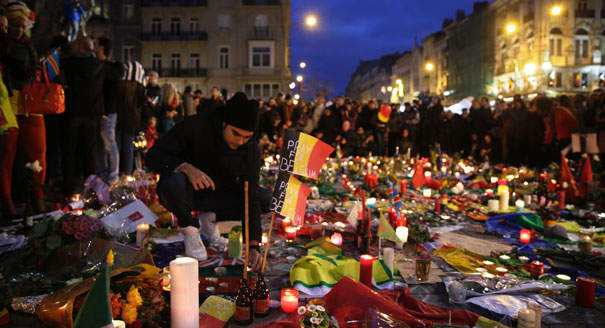
After the terrorist attacks in Brussels, European governments face the difficult question about how to balance liberalism with protecting their citizens.
The terrorist attacks that killed at least 31 people and injured some 270 others in Brussels on March 22 have changed Europe’s perception about itself. Until now, despite so many calculated murders of many civilians in Madrid, London, Copenhagen, and Paris—among other cities across Europe—since 2004, European leaders have adopted ad hoc measures to counter this new challenge. What makes Brussels different is that there’s now an acceptance by EU leaders that these attacks will continue.
All the measures taken so far have fallen way short of confronting the threat. European leaders didn’t want to admit that the peace that reigned across Europe since the end of World War II had been shattered. As Elmar Brok, the German chairman of the European Parliament’s foreign affairs committee, said after the Brussels bombings, “This is a new form of war that Europe has to deal with.”
Proclaiming that Europe stands by its values in the wake of the terrorist attacks is all very well. But the rhetoric will not make Europe’s citizens feel any safer, nor will it deter more bombers. European leaders face the uncomfortable but necessary task of dealing with a war that wants to destroy what Europe stands for.
Until now, in most cases European governments have found neither the means nor the political will to stop these attacks. For some reason, the attacks were never appalling enough to jolt Europe out of its belief, or blindness, that its values alone would protect a special way of life.
The Brussels attacks have shattered those illusions. Protecting values and dealing with war are almost a contradiction in terms. But European governments could weaken this contradiction in a number of ways.
The first is with better security. The EU and its member states have long refused to make intelligence sharing a major priority. There were many reasons for this. Intelligence agencies don’t want other agencies trampling over their turf. Some governments see sharing information as an infringement of their sovereignty. It is time to put these considerations to rest. If European citizens can crisscross borders, then the logic should follow that the intelligence agencies can do the same.
The advantages are clear. So are the disadvantages. The political culture of Europe’s intelligence agencies widely differs; so do their snooping powers and what they can do with that information.
Defenders of data protection and opponents of data sharing will understandably rush to keep the national laws as tight as possible from the reach of the agencies. They will also argue that intelligence agencies will snoop on innocent people. Look at the controversy raging around Apple’s determination not to unlock data stored in the mobile phones of the terrorist couple who killed several people in San Bernadino in 2015 or how U.S. and European agencies spy on each other. But the issue of intelligence sharing has to be tackled head-on, and now.
Another issue is public security. The public, unfortunately, will remain a target, and security services somehow need to find a way to make citizens more secure in public places. It is an enormous challenge and an enormous balancing act. Compromises will have to be made.
But the biggest issues that EU governments have to deal with are migration and integration. Populist and Euroskeptic parties across Europe were quick to exploit the attacks in Brussels as if these atrocities had vindicated their stance. Their stance is worrying and often anti-liberal, particularly when it comes to social issues.
But that is just the tip of the iceberg. These parties are anti-foreign—frankly, anti-Muslim—and as a corollary, against migration. They do not believe in the integration of large Muslim communities. Above all, they support a strong state. A Europe that has more security, more controls, more surveillance, and more state power has the potential to tap into the authoritarian tendencies of populist movements. That is an issue that has to be taken seriously.
As for integration, it is easy to forget the many Muslims living in Europe who have set up successful businesses, adopted European norms, and despise what is happening in the name of their religion. It is only a tiny minority that is sowing the seeds of hatred, violence, and fear and that exploits those who feel socially, economically, and politically marginalized. More certainly needs to be done across Europe so that the younger generations have greater opportunities for social advancement.
Of course, populist movements don’t see it that way. Instead, they are sapping support from people who fear globalization, who fear unemployment, who feel the political elites have forgotten them, and who believe immigrants will make matters even worse.
It is going to take an enormous effort by European governments to tackle and define integration. EU leaders will have to eschew political correctness by asking awkward questions about what Europe stands for and why terrorists are attacking those values.

Nonresident Senior Fellow, Carnegie Europe
Judy Dempsey is a nonresident senior fellow at Carnegie Europe
Recent Work
Judy Dempsey
Judy Dempsey
Carnegie does not take institutional positions on public policy issues; the views represented herein are those of the author(s) and do not necessarily reflect the views of Carnegie, its staff, or its trustees.

The European Commissioner for Trade is headed to China. But after President Xi’s bridge-building visit to Washington, can a more isolated EU overcome Beijing’s stranglehold on critical raw materials? Who will blink first?

Rym Momtaz, ed.

The domestic impacts of how long it is taking to end the war in Ukraine have pushed the French electorate to the political extremes and compromised the country’s diplomatic capacity.
Rym Momtaz

Before the next wave of EU enlargement takes place, the union needs to grapple with thorny questions of how power is distributed among its members.


Emil Sondaj Hansen, Ditte Brasso Sørensen

A summer of escalation in the Black Sea has hurt Ukraine economically and is exacerbating world food security. A truce is needed—as is a broader reframing of Europe’s Ukraine strategy.

Thomas de Waal

Are Germany’s economic, industrial, and political struggles becoming a liability for the EU’s ability to rise to the geopolitical moment?
Rym Momtaz, ed.