

Commentary
Judy Dempsey
{
  "authors": [
    "Judy Dempsey"
  ],
  "type": "commentary",
  "blog": "Strategic Europe",
  "centerAffiliationAll": "",
  "centers": [
    "Carnegie Endowment for International Peace",
    "Carnegie Europe"
  ],
  "collections": [
    "Transatlantic Cooperation"
  ],
  "englishNewsletterAll": "",
  "nonEnglishNewsletterAll": "",
  "primaryCenter": "Carnegie Europe",
  "programAffiliation": "",
  "programs": [],
  "projects": [],
  "regions": [
    "Europe",
    "North America",
    "United States",
    "Western Europe"
  ],
  "topics": [
    "Security",
    "Military"
  ]
}
Source: Getty
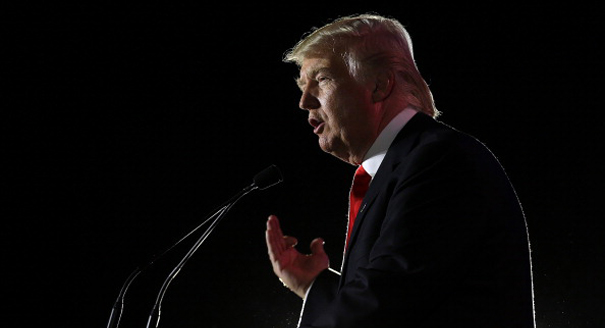
Donald Trump’s criticism of Europeans’ unwillingness to invest in NATO is misplaced. What he should have questioned is Europe’s reluctance to take its own security seriously.
Big foreign policy issues have played hardly any role in the 2016 U.S. presidential election campaign. That briefly changed on April 3 when the Republican contender Donald Trump delivered his verdict on NATO. “It’s obsolete,” he told supporters in Wisconsin. “It’s possible that we’re going to have to let NATO go.”
The reason, Trump explained, was that America’s European allies were dragging their feet on financing the military alliance. “When we’re paying and nobody else is really paying, a couple of other countries are but nobody else is really paying, you feel like the jerk,” he said. “I call up all of those countries . . . and say ‘fellas you haven’t paid for years, give us the money or get the hell out.’ . . . Maybe Nato will dissolve, and that’s OK, not the worst thing in the world.”
Now that must have been pleasing to the Kremlin, which has always pursued the idea of splitting if not ending the transatlantic alliance.
If, however, Trump looked at the “Trends in World Military Expenditure, 2015” factsheet published by the Stockholm International Peace Research Institute (SIPRI), he might change his mind about the Europeans. The document showed that European military spending increased by 1.7 percent in 2015 compared with the previous year, rising to $328 billion. That’s 5.4 percent higher than in 2006—admittedly coming from a pretty low base. Still, Europe’s big three—Britain, France (the two European countries that think and act strategically), and Germany—will be spending more in the coming years. This is good news for NATO.As for Central Europe, spending rose for a second consecutive year in 2015, increasing by 13 percent, again coming from a low base. In Poland, it jumped a whopping 22 percent to $10.5 billion, with military expenditure reaching 2.2 percent of the country’s GDP.
There are several reasons why defense spending in many European countries is on the increase. The first is Russia’s invasion of eastern Ukraine and its annexation of Crimea in 2014. The second, linked to Russia, is the pledge by all NATO countries at their summit in Wales in September 2014 to increase military spending to 2 percent of GDP. And the third is the terrorist threat. In short, Trump’s criticism of Europeans’ unwillingness to finance NATO is misplaced.
He would have had more credibility had he said that the Europeans have for far too long built a dependency culture by always relying on the United States to maintain and unflinchingly extend its vital security guarantee to the Europeans.
Spending more is not the main thing that NATO needs. What the alliance requires is a shared threat perception. “Despite the increase in military spending, [the allies] don’t yet have that,” said Ian Anthony, director of SIPRI’s European Security Program, in an interview. “Their enemy today is uncertainty. The NATO and EU countries have different problems on their plates that don’t lead to coherence.” Without a common perception of threats, can NATO have a common strategy?
There are the makings of a strategy when it comes to improving the defense of NATO’s Eastern members. Allies agreed to establish the Very High Readiness Joint Task Force (VJTF) at the Wales summit. In theory, the force should be able to deploy about 5,000 troops within two or three days, with up to five battalions supported by air, maritime, and special forces.
But as Daniel Fiott argued in a terrific essay in Survival, the journal of the International Institute for Strategic Studies, NATO lacks the critical defense infrastructure and capabilities to respond with speed to any Russian aggression in Europe. “Without the necessary infrastructure, including transportation networks and hubs, and energy supply lines, it will be difficult for NATO to preposition or sustain military units and ensure that the [VJTF] is able to deploy within a few days,” Fiott wrote.
Fiott detailed all the technical, financial, and infrastructure challenges for the VJTF. His conclusion was that EU funds could be mobilized to modernize infrastructure, which in turn could have substantial civilian and defense benefits.
One wonders how the EU member states and the European Parliament would react to the idea of European funds having such a role. There are rules that stipulate that the EU budget should be invested only in civilian projects or in initiatives with a dual-use capability that would serve civilian and military goals. Even then, argued Fiott, “this is not enough to sidestep the EU’s long-held embargo on using EU funds for military purposes.”
This EU obsession with soft power is redundant given the big threats Europe and its allies face. Surely, the modernization of the EU’s infrastructure—from railroads and highways to airfields and ports to power plants and bridges, not to speak of IT networks—should have a security component.
It is this argument that Poland, the Baltic states, and NATO’s other Central and Eastern European members should be promoting in the run-up to NATO’s July 2016 summit in Warsaw. Because NATO will not deploy troops in these countries on a permanent basis, there has to be a guarantee that the VJTF will actually work. After all, this is NATO’s response to Russian aggression and should be its signal to Trump that the alliance is not obsolete.

Nonresident Senior Fellow, Carnegie Europe
Judy Dempsey is a nonresident senior fellow at Carnegie Europe
Recent Work
Judy Dempsey
Judy Dempsey
Carnegie does not take institutional positions on public policy issues; the views represented herein are those of the author(s) and do not necessarily reflect the views of Carnegie, its staff, or its trustees.

Trump is distracted and Ukraine wants Europe to step up. The continent’s leaders must find their voice and assert it in talks with Russia.

Alissa de Carbonnel

Mounting economic strain and battlefield losses will not necessarily make the Kremlin less dangerous. They could instead push Moscow toward a more aggressive hybrid campaign designed to test NATO’s Eastern flank, exploit allied hesitation, and fracture European resolve.

Maksym Beznosiuk

Over the past ten years, NATO has held almost as many summits as it did during the entirety of the Cold War. Are they still useful, or is it time to stop holding annual meetings?

Rym Momtaz, ed.
Nearly a year and a half after Europeans leaned into sucking up to Trump, the strategy has produced some benefits when it comes to Ukraine.
Rym Momtaz
Far-right leader Marine Le Pen can—and will—run in France’s next presidential election. What does the outcome of her appeal against a 2025 embezzlement conviction mean for the country’s political future?

Catherine Fieschi