

Commentary
Judy Dempsey
{
  "authors": [
    "Judy Dempsey"
  ],
  "type": "commentary",
  "blog": "Strategic Europe",
  "centerAffiliationAll": "",
  "centers": [
    "Carnegie Endowment for International Peace",
    "Carnegie Europe"
  ],
  "collections": [
    "Transatlantic Cooperation"
  ],
  "englishNewsletterAll": "",
  "nonEnglishNewsletterAll": "",
  "primaryCenter": "Carnegie Europe",
  "programAffiliation": "",
  "programs": [],
  "projects": [],
  "regions": [
    "Europe",
    "Western Europe"
  ],
  "topics": [
    "Foreign Policy",
    "EU",
    "Security"
  ]
}
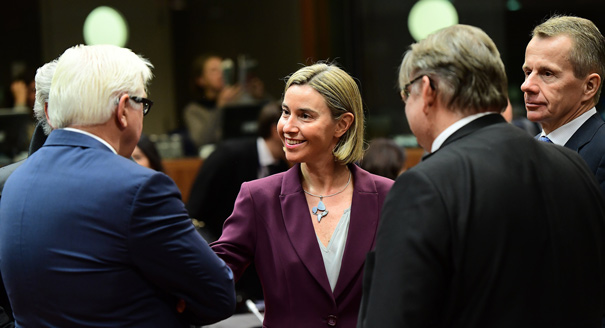
Source: Getty
The election of Donald Trump as U.S. president will eventually bring to an end Europe’s dependence on the United States.
Shortly before Donald Trump was elected U.S. president on November 8, leading EU officials paid a visit to NATO’s headquarters in Brussels. Led by Nathalie Tocci, who is the top security and foreign policy adviser to the EU’s foreign policy chief, Federica Mogherini, the delegation spent two hours briefing the alliance’s ambassadors during their regular Wednesday meeting of the North Atlantic Council.
Tocci explained in detail the implications of the EU’s global strategy, a document that sets out Europe’s foreign, security, and defense ambitions. The EU, she told her audience, was not set on establishing an army—contrary to what Jean-Claude Juncker, the European Commission president, keeps calling for. The union had no intention of duplicating the alliance. That would be a waste of money and resources. Nor was it in competition with NATO, a race that would be impossible to win.
Instead, Tocci wanted to explain how NATO and the EU could and should work together, something on which the two organizations agreed during the NATO summit in Warsaw in July 2016. She also explained how and why the EU had to be much more strategic on security and defense issues.
This need for the EU to take a hard look at its security and foreign policies has taken on an urgency since Trump was elected U.S. president. That’s not only because Trump has called some of America’s European allies free riders or said that the alliance might even be “obsolete.” It’s also because he has called into question the value of the transatlantic relationship. That is what scares Eastern as well as Western European allies.
For the first time since 1949, when NATO was founded, Europeans no longer have the luxury of taking the pillar of transatlantic security for granted. It is that—not the refugee crisis, not the eurozone crisis, not the rise of populist movements across Europe, not Brexit—that is finally shaking Europeans out of their comfort zone that they had become so used to.
And because they assumed the United States would always provide a security guarantee and be the guardian of their collective defense, Europeans didn’t bother to question that arrangement. Nor did they protect it by spending more and wisely on military capabilities in ways that would have reassured the United States that they were not free riding. Nor did they take their own security and defense seriously. Those times are now coming to an end.
The responses of some European leaders to Trump’s (unclear) views on the transatlantic relationship encapsulate both the fantasies and the possibilities of how Europe can reshape its security and defense policy. The idea that the EU can have its own army, which has become Juncker’s clarion call, is simply not going to fly—at least, not in the coming decades. There is neither sufficient political will nor available financial resources.
Christoph Heusgen, the foreign and security adviser to German Chancellor Angela Merkel, slapped down the idea of a European army. “A European army is just a buzzword,” he said during a conference organized by the German Federal Academy for Security Policy on November 14. “A European army would not be supported by [the German] parliament. It would not be possible.” By all means, he added, Europe should develop its security and foreign policies much further, but there should be “no duplication” with NATO. “NATO is the main pillar. NATO is the pillar of German policy.”
Other countries, particularly the Baltic states, support Germany’s views because they don’t believe that other Europeans can guarantee their protection by means of a collective defense clause—although in the future, that shouldn’t be ruled out. As things stand, the EU’s 2009 Lisbon Treaty has a reference to mutual assistance and solidarity. The clause states that “if an EU country is the victim of armed aggression on its territory, the other EU countries have an obligation to aid and assist it by all the means in their power.” Implementation of that clause requires a whole range of capabilities—military, logistics, and intelligence, to name just a few—that the EU as a whole does not yet have.
Trump’s victory could change this. The conclusions of the meeting of EU foreign ministers on November 14 reveal a hardheaded realism about what the member states have to do to increase their defense and security. It is a question of “addressing further Europe’s current and future security and defence needs, [enhancing] its strategic autonomy and [strengthening] its ability to cooperate with partners,” the conclusions state. If that sounds woolly, read the rest. Mogherini’s team spelled out in detail what was needed for the EU to carry out civilian missions and military operations. (Yes, military operations.)
These tasks will take time, money, and political will to implement. No doubt, populist leaders who believe their own countries can go it alone will balk—if not oppose—a stronger security and defense policy for Europe because it would mean some form of integration. But for once, among most EU governments, there is now an awareness that Europe’s comfort zone has come to an end. It’s not going to return.

Nonresident Senior Fellow, Carnegie Europe
Judy Dempsey is a nonresident senior fellow at Carnegie Europe
Recent Work
Judy Dempsey
Judy Dempsey
Carnegie does not take institutional positions on public policy issues; the views represented herein are those of the author(s) and do not necessarily reflect the views of Carnegie, its staff, or its trustees.

As we close out another season of Strategic Europe, it is worth taking stock of the deep shifts underway.

Rym Momtaz
The EU had to compromise to adopt a twenty-first sanctions package against Russia, exposing growing cracks in the union’s resolve. Is this latest, weaker round worth it to keep pressure on Moscow?
Rym Momtaz, ed.

Trump is distracted and Ukraine wants Europe to step up. The continent’s leaders must find their voice and assert it in talks with Russia.

Alissa de Carbonnel

Mounting economic strain and battlefield losses will not necessarily make the Kremlin less dangerous. They could instead push Moscow toward a more aggressive hybrid campaign designed to test NATO’s Eastern flank, exploit allied hesitation, and fracture European resolve.

Maksym Beznosiuk

Over the past ten years, NATO has held almost as many summits as it did during the entirety of the Cold War. Are they still useful, or is it time to stop holding annual meetings?
Rym Momtaz, ed.