

Commentary
Judy Dempsey
{
  "authors": [
    "Judy Dempsey"
  ],
  "type": "commentary",
  "blog": "Strategic Europe",
  "centerAffiliationAll": "",
  "centers": [
    "Carnegie Endowment for International Peace",
    "Carnegie Europe"
  ],
  "collections": [
    "Brexit and UK Politics"
  ],
  "englishNewsletterAll": "",
  "nonEnglishNewsletterAll": "",
  "primaryCenter": "Carnegie Europe",
  "programAffiliation": "",
  "programs": [],
  "projects": [],
  "regions": [
    "Europe",
    "Western Europe",
    "United Kingdom"
  ],
  "topics": [
    "EU",
    "Foreign Policy"
  ]
}
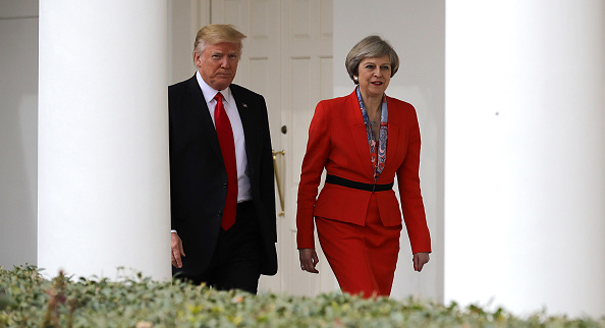
Source: Getty
Britain’s prime minister is fast finding out that turning to the United States to mitigate the costs of leaving the European Union is not going according to plan.
How Theresa May must be regretting the day she proposed inviting U.S. President Donald Trump on a state visit to the UK sometime in 2017. The British prime minister extended the invitation on behalf of the queen during her official visit to Washington on January 26–27. This was May’s way of proving that Britain could manage quite well without the European Union, thank you very much. London and Washington would have an even closer and even more special relationship than before now that the EU is soon going to be out of the way.
Just think of the trade deals the United States and Britain could forge, May argued, forgetting that as long as Britain remains a member of the EU, trade deals are the prerogative of Brussels, not of national governments. No matter. It was as if membership of the EU were hindering Britain’s foreign policy and its economic ties with third countries. Britain would now be free to go its own way.
No sooner had May returned home from the United States than a petition was launched to stop the visit “because it would cause embarrassment to Her Majesty the Queen.” The queen is not easily embarrassed. She has had no qualms in sharing the royal horse-drawn carriage with dictators including Romania’s Nicolae Ceauşescu, Zaire’s Mobutu Sese Seko, or Indonesia’s Haji Muhammad Suharto. Those visits were about political and ideological interests.
Still, it was nice of the petition organizers to think of the queen, whose popularity, respect, and hard work are the hallmarks of her long reign. And it was a clever move. It wasn’t anti-American. But it was implicitly anti-Trump—so much so that over 1.85 million people signed the petition. In the meantime, a pro-visit campaign has also been rolled out. By February 20, when the British House of Commons debated the visit, a rival petition had collected 311,000 signatures.
This extraordinary swell of opposition to Trump’s visit—as well as the support for it—has exposed serious fault lines in May’s political strategy. Did she really believe that she could pacify people opposed to Britain’s exit from the EU by showing them that the UK had a better future outside the EU, and now the chance to have closer ties with the United States?
Even some Brexit supporters have qualms about inviting Trump to the UK, in addition to worries about what Britain will really become once it leaves the EU. Speaking during the parliamentary debate on the visit, Crispin Blunt, the Conservative chair of the House of Commons Foreign Affairs Committee, summed up the problem facing the government. “If we don’t take the hype out of this debate, with all the people who signed this petition, there is every possibility that . . . this visit [will] become a rallying point for everybody who is unhappy both with the direction of American policy, or British policy or anything else,” he said.
May hasn’t backed down from the invitation, or even suggested it be postponed for logistical reasons, an oft-used phrase for putting off visits. Foreign Office Minister Sir Alan Duncan defended the invitation. “We believe it is absolutely right that we should use all the tools at our disposal to build common ground with President Trump,” he said. “The visit should happen. The visit will happen. And when it does, I trust the United Kingdom will extend a polite and generous welcome to President Donald Trump.”
If May does go ahead with the visit this year (and leaving aside the fact that it took the British government just seven days after Trump’s inauguration to invite him, compared with the seven hundred fifty-eight days until former U.S. President Barack Obama was invited), one wonders what the prime minister will gain from it. One thing is certain: May and her government are now saddled with, if not haunted by, Brexit and that not-so-special Anglo-American relationship.

Nonresident Senior Fellow, Carnegie Europe
Dempsey is a nonresident senior fellow at Carnegie Europe
Recent Work
Judy Dempsey
Judy Dempsey
Carnegie does not take institutional positions on public policy issues; the views represented herein are those of the author(s) and do not necessarily reflect the views of Carnegie, its staff, or its trustees.
Montenegro and Albania are frontrunners for EU enlargement in the Western Balkans, but they can’t just sit back and wait. To meet their 2030 accession ambitions, they must make a strong positive case.


Dimitar Bechev, Iliriana Gjoni
Donald Trump has repeatedly bashed NATO and European allies, threatening to annex Canada and Greenland and deploring their lack of enthusiasm for his war of choice in Iran. Is this latest round of abuse the final straw?

Rym Momtaz, ed.
Donald Trump’s repudiation of NATO goes against the Make America Great Again vision of a U.S.-centered foreign policy. If the goal is to preserve the alliance by boosting Europe’s commitments, leaning into France’s vision is the most America First way forward.
Rym Momtaz
Hungarians head to the polls on April 12 for an election of national and European consequence. Three different outcomes are on the cards, each with their own implications for the EU.

Zsuzsanna Szelényi
The far right failed to win big in France’s municipal elections. But that’s not good news for the country’s left wing, which remained disunited while the broader right consolidated its momentum ahead of the 2027 presidential race.

Catherine Fieschi