

Article
Thomas de Waal
{
  "authors": [
    "Thomas de Waal"
  ],
  "type": "commentary",
  "blog": "Strategic Europe",
  "centerAffiliationAll": "",
  "centers": [
    "Carnegie Endowment for International Peace",
    "Carnegie Europe"
  ],
  "collections": [
    "Europe’s Eastern Neighborhood"
  ],
  "englishNewsletterAll": "",
  "nonEnglishNewsletterAll": "",
  "primaryCenter": "Carnegie Europe",
  "programAffiliation": "",
  "programs": [],
  "projects": [],
  "regions": [
    "Russia",
    "Eastern Europe",
    "Caucasus",
    "Azerbaijan"
  ],
  "topics": [
    "Climate Change",
    "Democracy"
  ]
}
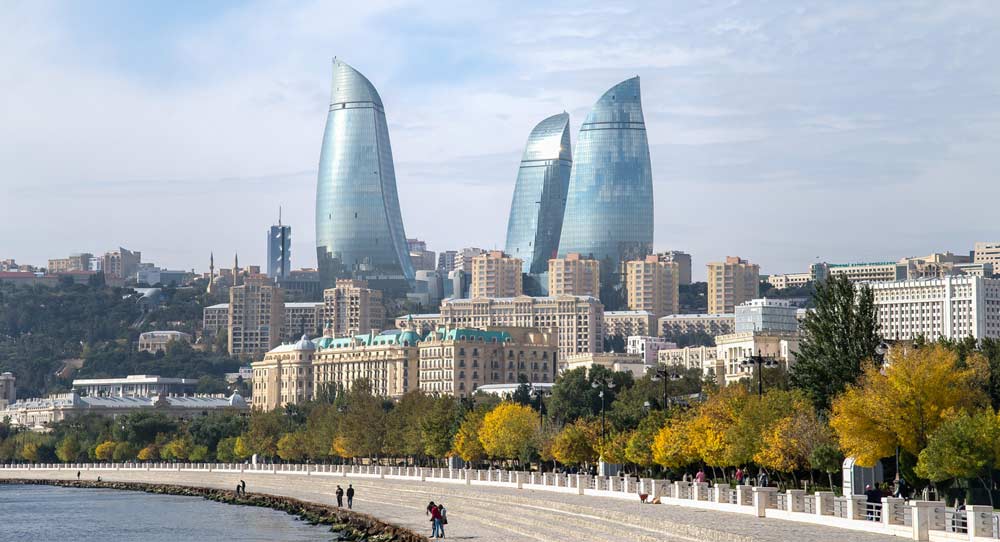
Source: Getty
Azerbaijan’s suspension from a coalition of energy-extracting countries will harm Baku’s international brand and image as a reliable place to invest.
Can a petrostate with a rent-seeking elite ever reform itself—or at least clean up its business practices?
That the answer could be “yes” was the idea that drove the founders of the Extractive Industries Transparency Initiative (EITI) in 2003. The initiative is a voluntary coalition of countries with energy- and mineral-extraction industries that pledge to make their transactions and sources of wealth transparent. The project took off and won support from international financing organizations, and at the start of 2017, the EITI had 51 implementing member countries.
As of March 9, it has one less. Azerbaijan, the Caspian petrostate on the eastern edge of Europe, announced it was quitting EITI after being suspended from the organization. The announcement came just as the groundwork was being completed for an expanded network of three pipelines scheduled to take Azerbaijani gas to European markets by 2020.
The EITI’s diagram of how an oil state should manage its revenues responsibly is a triangle with three sides: companies, governments, and civil society. At its March meeting in Bogotá, Colombia, the EITI declared that the Azerbaijani government was being suspended “because the country lacks an enabling environment for civil society.”
The Azerbaijanis probably miscalculated. They had already been downgraded from a full member of the EITI to candidate status in 2015, but they might have assumed that once a country is inside a respectable international organization, no one will kick it out—as has been the case for Azerbaijan and several other states in the Council of Europe. The government passed legislation in January 2017 making NGO registration easier. But it has not restored freedoms to civil society, having silenced or exiled almost all independent NGOs, media organizations, and critics of the government in the last few years.
In January, the EITI issue was raised by someone with a very personal stake in its outcome, political prisoner Ilgar Mammadov. Mammadov is the head of REAL, a pro-Western political party. He was arrested on dubious charges in 2013 a few months ahead of the last presidential election and is now serving a seven-year jail sentence. His January public letter, in which he called himself “an inmate of the Southern Gas Corridor,” a reference to the trio of pipelines from the Caspian to Europe, called on international investors to make their financing of Azerbaijani energy projects contingent on human rights.
Azerbaijan’s rulers could have ordered the freeing of Mammadov—as demanded by the European Court of Human Rights—and taken other steps to win compliance with the EITI and a cleaner image. That the country’s leaders did not do so shows how they perceive the current domestic and international environment.
Azerbaijani President Ilham Aliyev appears to believe total political control is the answer to burgeoning socioeconomic discontent in the form of a falling currency and rising prices. In February, the president announced that his wife, Mehriban Aliyeva, whose Pashayev family constitutes the most powerful network in the country, was becoming the country’s first vice president—a move that eliminated any lingering illusions that the country was an electoral democracy rather than a family dynasty.
In this context, shutting down all public debate evidently appeared more attractive to Baku than EITI membership. The Azerbaijani government seems to believe it can avoid getting hurt by EITI suspension. This is chiefly because almost all of the international financing for its first two gas pipeline projects—expansion of the South Caucasus Pipeline and of the Trans-Anatolian Natural Gas Pipeline in Turkey—is almost complete. The Greece–Italy Trans-Adriatic Pipeline (TAP) project also looks fairly secure, as long as a deal is made to guarantee the future of some ancient olive groves in southern Italy.
The European Bank for Reconstruction and Development (EBRD), which is one of the funders of TAP, had warned in 2016 that “the EITI is a bellwether mark that we look at very closely.” But according to a source I spoke to, the sum the bank is contributing to the pipeline is relatively small compared with the overall price tag of more than $40 billion for Azerbaijan’s Southern Gas Corridor, and the EBRD is equivocal about whether to suspend its funding. Instead, the financing is more likely to be postponed or reduced.
Azerbaijan’s EITI suspension hurts mainly the country’s international brand and image as a reliable place to invest. Here, too, the calculation in Baku may be that Azerbaijan can weather this storm and that the international context has changed in its favor since the election of U.S. President Donald Trump, who has also done business in Azerbaijan.
Amid all the confusing foreign policy signals from the Trump administration, one message has been sent out loud and clear: strong support for big oil, beginning with the appointment of a career oilman, Rex Tillerson, as U.S. secretary of state.
In February, the Trump administration repealed the hard-won Cardin-Lugar amendment, which required oil, gas, and mining companies to disclose payments above $100,000 to foreign governments—essentially preventing energy companies from doing dubious business with foreign petro-elites. It is a heavy blow to the effort of building an international culture of transparency, as envisaged by the EITI. The Azerbaijanis will have noted this U.S. move with approval and may believe that in this new context, the reputational damage they suffer from pulling out of the EITI will not be so severe.
At the moment, some of the unhappiest figures in this episode are Azerbaijani civil society activists who had lobbied for their government to make reforms, only to see it duck the issue by leaving the EITI altogether. Gubad Ibadoglu, a leading civil-society expert who had worked for many years to get Azerbaijan to live up to its EITI commitments, told me, “Unfortunately, Azerbaijan took a path in solving this problem by totally avoiding it.”
If this is to change, it will be primarily up to the EU, which will have a formal energy relationship with Azerbaijan when it starts to import gas from the country in 2020. There is an unresolved debate in Brussels as to whether to treat Azerbaijan as an autocracy that is a purely commercial partner—a Saudi Arabia on the Caspian—or to take seriously Baku’s membership of European organizations and use normative instruments to nudge it toward allowing some freedoms. An Azerbaijan that has shed the commitments to transparency it made in the EITI is a more difficult and unpredictable partner for Europe.

Senior Fellow, Carnegie Europe
Thomas de Waal is a senior fellow at Carnegie Europe, specializing in Eastern Europe and the Caucasus.
Recent Work
Thomas de Waal
Thomas de Waal
Carnegie does not take institutional positions on public policy issues; the views represented herein are those of the author(s) and do not necessarily reflect the views of Carnegie, its staff, or its trustees.

Mounting economic strain and battlefield losses will not necessarily make the Kremlin less dangerous. They could instead push Moscow toward a more aggressive hybrid campaign designed to test NATO’s Eastern flank, exploit allied hesitation, and fracture European resolve.

Maksym Beznosiuk
Far-right leader Marine Le Pen can—and will—run in France’s next presidential election. What does the outcome of her appeal against a 2025 embezzlement conviction mean for the country’s political future?

Catherine Fieschi
While Russia is not ready to sue for peace on Europe’s terms, it could still either seek a ceasefire in Ukraine or try escalation. Brussels needs to prepare for both and prioritize that preparation over normative discussions.
Kadri Liik
When Giorgia Meloni very publicly rebuked Donald Trump’s disparaging remarks about her, it surprised many who saw her as a European extension of Trumpism. Is the spat a sign of trouble in the radical right’s transatlantic axis?

Rym Momtaz, ed.
Western Europe’s dual-use infrastructure melted down during its latest heat wave. If a predicted hot weather event can take the continent by surprise, what chance does it have to withstand unexpected geopolitical crises?
Rym Momtaz