

Commentary
Judy Dempsey
{
  "authors": [
    "Judy Dempsey"
  ],
  "type": "commentary",
  "blog": "Strategic Europe",
  "centerAffiliationAll": "",
  "centers": [
    "Carnegie Endowment for International Peace",
    "Carnegie Europe"
  ],
  "collections": [],
  "englishNewsletterAll": "",
  "nonEnglishNewsletterAll": "",
  "primaryCenter": "Carnegie Europe",
  "programAffiliation": "",
  "programs": [],
  "projects": [],
  "regions": [
    "Europe",
    "Western Europe",
    "Germany"
  ],
  "topics": [
    "EU"
  ]
}
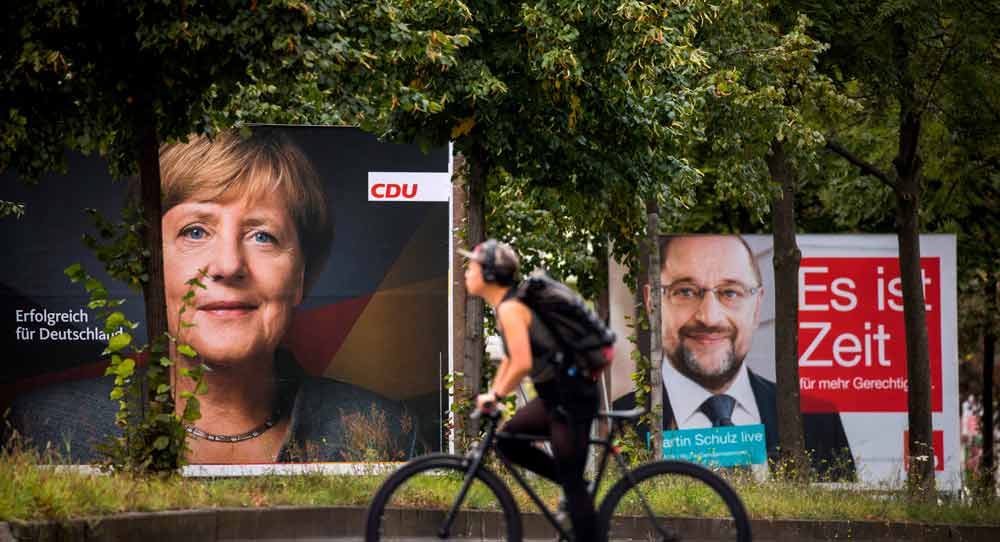
Source: Getty
The assumption is that Angela Merkel will be reelected as chancellor of Germany. The same cannot be said about the makeup of her next government.
By this time next week, September 25, Germans will know who will serve as their next chancellor.
Barring that any extraordinary developments take place in the meantime, the bets are that Angela Merkel remains in the “washing machine”—the nickname given to the box-shaped concrete chancellery. What is not at all clear is the composition of the next government. But one of the few things that is certain is that it will be a coalition one.
The other certainty in Germany’s election is that the next government needs a clear idea about Europe’s direction. Reform of the eurozone, migration, refugee and asylum policies, as well as security and defense issues, need to be urgently tackled.
Discussions about such issues were put on hold until after the May 2017 French presidential and parliamentary elections, and again put on hold until after the German elections. But the waiting is now about to come to an end. This will allow Paris and Berlin to work out together which aspects of integration of the EU as a whole, and the eurozone in particular, they fundamentally agree or disagree on. Germany will need a stable coalition to deal with these issues, regardless of who is elected chancellor.
The latest opinion polls show Merkel’s conservative bloc failing to win the all-important 40 percent of the vote that would give the conservative bloc a vantage point since it could make coalition building less complicated. Another spanner that has been thrown into the works during this election is the Alternative for Germany (AfD).
This nationalist, Eurosceptic, anti-Islam, anti-migration, and often anti-Semitic party is, if the opinion polls are proved right, poised to win 12 percent of the vote.
Despite the often vicious public disagreements in the party’s leadership style, the AfD continuously rammed home its anti-immigration and anti-Islam message, insisting that Merkel’s 2015 decision to give security and shelter to one million refugees—the majority from Syria and Iraq—was wrong for Germany and wrong for Europe. The fact that the party has gotten this far in the polls, and has won seats in regional elections, shows the AfD’s degree of resonance among voters.
Were the AfD to become the third biggest party in Germany, it would also show a radical shift in German domestic politics. A certain consensus about the political status quo, which for decades had been spread between right, center, and left, would have been broken.
Support for the AfD—at least so far—has coincided with the decline of Germany’s Social Democratic Party (SPD).
Martin Schulz, who is challenging Merkel, can’t seem to be able to turn around the voters. The former president of the European Parliament, while personable during election rallies, has been unable to home in on any issue that would have real traction. One day it’s about campaigning for social justice, another it’s about improving education, all of which are noble themes.
But the Social Democrats, who have been in coalition with Merkel’s conservative bloc since 2013, have been unable to explain to voters why they should vote for Schulz and not for Merkel. The latest ARD-DeutschlandTrend poll gives the SPD 20 percent. If confirmed on polling day, it would be the party’s worst showing in any federal election.
Trailing the AfD is the pro-business Free Democrats (FDP) led by Christian Lindner. After a spell out of parliament over the past four years, the FDP is confident the political wilderness is over and that it might win 10 percent, if not more, of the vote. Above all, the FDP is so confident that even party officials said they would strike a hard bargain with Merkel since this would be her natural coalition ally.
If only it were as simple as that.
Merkel and Lindner might not be able to muster enough votes to form the next coalition. There’s talk of a Jamaica government. The colors denote black for the conservative, yellow for the FDP, and green, for, well, the Greens. Just imagine the haggling involved about which party would get the all-important finance ministry and which one would get the foreign ministry. Not to mention the time it would take to draw up a coalition agreement.
When Merkel was first elected Chancellor back in September 2005, it took over ten weeks to agree a coalition agreement with her junior partners, the Social Democrats.
And don’t forget Die Linke, or the Left Party, which could win 9 percent of the vote.
The point is that these four parties, including the AfD, have fragmented the opposition. They are competing in the same space of between 7.5 percent and 12 percent, thus splitting the votes and complicating coalition-building for whoever becomes the next Chancellor.
Still, if Merkel were to lead such a Jamaica coalition it would show how far the Christian Democrats have moved to the center, if not to a soft left, under the chancellor’s leadership. Indeed, the ARD-DeutschlandTrend poll showed that 46 percent of conservative voters would prefer a Jamaica coalition, but only just; 45 percent want to retain the grand coalition.
In the SPD camp, 50 percent of their supporters want to stick to the grand coalition, while 46 percent would like the party to go into the opposition. Well, come 18:00 local time on September 24, Merkel, Schulz, and other party leaders will know where they stand. Part one of the waiting will have ended. Part two beckons.

Nonresident Senior Fellow, Carnegie Europe
Judy Dempsey is a nonresident senior fellow at Carnegie Europe
Recent Work
Judy Dempsey
Judy Dempsey
Carnegie does not take institutional positions on public policy issues; the views represented herein are those of the author(s) and do not necessarily reflect the views of Carnegie, its staff, or its trustees.
Trump is distracted and Ukraine wants Europe to step up. The continent’s leaders must find their voice and assert it in talks with Russia.
Alissa de Carbonnel
Mounting economic strain and battlefield losses will not necessarily make the Kremlin less dangerous. They could instead push Moscow toward a more aggressive hybrid campaign designed to test NATO’s Eastern flank, exploit allied hesitation, and fracture European resolve.

Maksym Beznosiuk
Over the past ten years, NATO has held almost as many summits as it did during the entirety of the Cold War. Are they still useful, or is it time to stop holding annual meetings?

Rym Momtaz, ed.
Nearly a year and a half after Europeans leaned into sucking up to Trump, the strategy has produced some benefits when it comes to Ukraine.
Rym Momtaz
Far-right leader Marine Le Pen can—and will—run in France’s next presidential election. What does the outcome of her appeal against a 2025 embezzlement conviction mean for the country’s political future?
Catherine Fieschi