

Commentary
Judy Dempsey
{
  "authors": [
    "Judy Dempsey"
  ],
  "type": "commentary",
  "blog": "Strategic Europe",
  "centerAffiliationAll": "",
  "centers": [
    "Carnegie Endowment for International Peace",
    "Carnegie Europe"
  ],
  "collections": [
    "Europe’s Eastern Neighborhood"
  ],
  "englishNewsletterAll": "",
  "nonEnglishNewsletterAll": "",
  "primaryCenter": "Carnegie Europe",
  "programAffiliation": "",
  "programs": [],
  "projects": [],
  "regions": [
    "Russia",
    "Europe",
    "Western Europe",
    "Germany"
  ],
  "topics": [
    "Foreign Policy",
    "EU",
    "Climate Change"
  ]
}
Source: Getty
The special relationship that the former German chancellor keeps with Vladimir Putin is doing neither his party nor his country any favors.
When Angela Merkel was first elected chancellor in September 2005, one of her first foreign policy tasks was to rebalance Germany’s relationship with Russia.
Seeped over the decades in “Ostpolitik,” successive chancellors’ forged economic and political ties with the Kremlin in the belief that this strategy would create a certain predictability, a certain security, and in the long term would pay off. Russia would move closer to Europe. Ostpolitik was a child of détente. It was based on engagement, not confrontation, with Russia—often regardless of the price when it came to human rights.
Merkel punctured Ostpolitik in several ways.
Unlike her predecessor, the Social Democrat Gerhard Schröder, who cultivated a close friendship with Russian President Vladimir Putin, at one stage calling him “an impeccable democrat,” Merkel was the opposite.
When she made her first official visit to Moscow in January 2006, Merkel reached out to Russia’s nongovernmental organizations and civil society activists. That was when Putin gave her a toy dog. It was one of his inimitable ways of trying to humiliate the German chancellor, who doesn’t like dogs. The other was having his big Labrador dog present during some of their meetings. Merkel, however, was not to be provoked.
Throughout her dozen years as chancellor, relations with the Kremlin steadily deteriorated. The main reason, as one of her aides confided, was that she didn’t trust Putin. That level of mistrust was deepened in February 2014, when, in one of her many telephone calls with the Russian president, she asked Putin if he was going to invade Crimea. According to chancellery officials, he denied it.
We all know what happened next. Merkel was convinced about the need to impose sanctions on Russia. Despite opposition from several EU countries, but also from within her then coalition partners, the Social Democrats, Merkel held sway. To this day, the sanctions have been rolled over.
But Ostpolitik, or rather a distorted kind of Ostpolitik, lingers on. It has been primarily led by Merkel’s predecessor and former SPD leader Gerhard Schröder. As soon as Schröder stepped down in 2005, he joined Nord Stream, a project led by the Russian state-owned energy giant Gazprom that began building a pipeline under the Baltic Sea to send gas to Germany. Moscow’s aim was to weaken its dependence on Ukraine as a major transit route for Russia’s gas exports to Europe. It would also increase Germany’s dependence on Gazpom.
Having Germany’s former chancellor aboard this project would help Russia obtain the various permissions, besides the economic and political support, to build the pipeline. Schröder was recently appointed chairman of Nord Stream 2, a second pipeline running parallel to the first one.
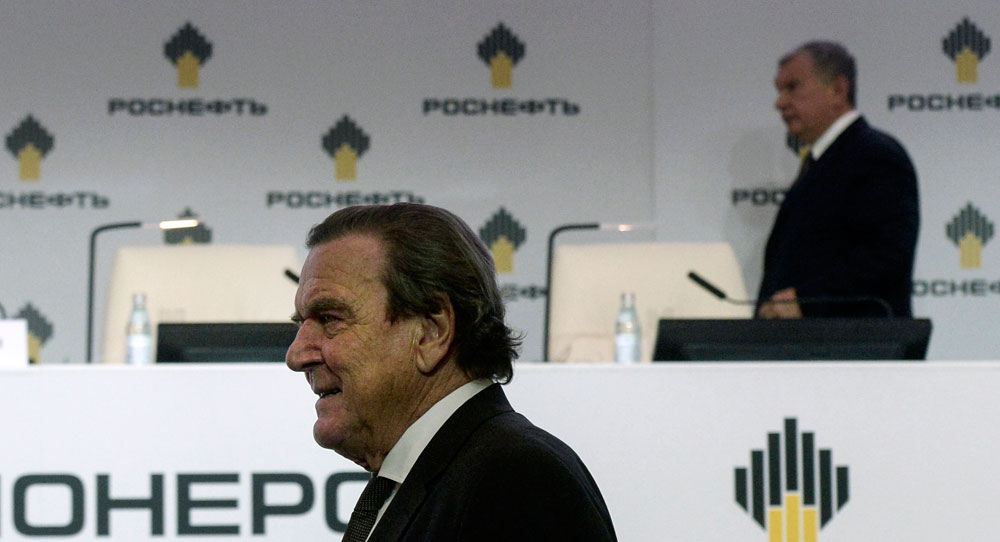
As if that was not enough lobbying for the Kremlin’s interests, on September 29 Schröder was appointed chairman of Rosneft, the Russian state-controlled oil producer and one of the world’s largest publicly listed producers of crude oil. Forget the fact that Rosneft is subject to western sanctions because of Russia’s annexation of Crimea.
Rosneft CEO Igor Sechin had, understandably, only praise for Germany’s former chancellor. “Schröder is a reputed and renowned politician who has persistently advocated strategic cooperation between Germany, Europe, and Russia,” Sechin said. “He is striving to improve Germany’s ties with Russia.” Perfect Ostpolitik-speak.
Schröder himself responded by repeating what he has stated so many times since sanctions were imposed on Russia. “I really regret that there are sanctions,” he said. “The talks must be about easing sanctions. I am not among those who support these sanctions. It is reasonable from the entire world to have a stable Russia from an economic and political point of view.”
Back in Germany, the Social Democrats, who are now in opposition after suffering heavy losses in the recent federal election, are embarrassed over the former chancellor’s appointment. Merkel chimed in as well, although she has never taken a stand on Nord Stream except to say it’s a purely commercial project.
Putin, however, may have miscalculated Schröder’s influence to shift the stance of Germany, in particular, and other EU countries on rolling over the sanctions. Because of his role and closeness to Putin, Schröder may have toughened the resolve of Merkel and her coalition partners to keep the sanctions in place.
“Schröder’s involvement won’t improve relations between Germany and Russia,” said Norbert Röttgen, chairman of the German parliament’s foreign affairs committee. “On the contrary, it will strain them. If he thinks he wants to ensure energy security in Germany, then I consider that a bad joke since he will be increasing Germany’s dependence on Russia,” Röttgen added. And that is how Russia viewed Ostpolitik.

Nonresident Senior Fellow, Carnegie Europe
Judy Dempsey is a nonresident senior fellow at Carnegie Europe
Recent Work
Judy Dempsey
Judy Dempsey
Carnegie does not take institutional positions on public policy issues; the views represented herein are those of the author(s) and do not necessarily reflect the views of Carnegie, its staff, or its trustees.

While the EU and European governments are embracing the much-lauded middle-power moment, this entails three difficult conundrums.

Richard Youngs

Much has been said of the changes Brussels is trying to make to the EU enlargement process. Here’s why gradual integration might—or might not—be the answer.

Dimitar Bechev

The European Commissioner for Trade is headed to China. But after President Xi’s bridge-building visit to Washington, can a more isolated EU overcome Beijing’s stranglehold on critical raw materials? Who will blink first?

Rym Momtaz, ed.

The domestic impacts of how long it is taking to end the war in Ukraine have pushed the French electorate to the political extremes and compromised the country’s diplomatic capacity.
Rym Momtaz

Before the next wave of EU enlargement takes place, the union needs to grapple with thorny questions of how power is distributed among its members.


Emil Sondaj Hansen, Ditte Brasso Sørensen