

Commentary
Judy Dempsey
{
  "authors": [
    "Judy Dempsey"
  ],
  "type": "commentary",
  "blog": "Strategic Europe",
  "centerAffiliationAll": "",
  "centers": [
    "Carnegie Endowment for International Peace",
    "Carnegie Europe"
  ],
  "collections": [
    "EU Integration and Enlargement",
    "Brexit and UK Politics"
  ],
  "englishNewsletterAll": "",
  "nonEnglishNewsletterAll": "",
  "primaryCenter": "Carnegie Europe",
  "programAffiliation": "",
  "programs": [],
  "projects": [],
  "regions": [
    "Europe",
    "Western Europe",
    "United Kingdom"
  ],
  "topics": [
    "Foreign Policy",
    "EU",
    "Security",
    "Political Reform"
  ]
}
Source: Getty
Once it leaves the EU, Britain wants a say on European foreign, security, and defense policy.
Carnegie Europe was on the ground at the 2018 Munich Security Conference, offering readers exclusive access to the debates as they unfold and providing insights on today’s most consequential threats to international peace.
*
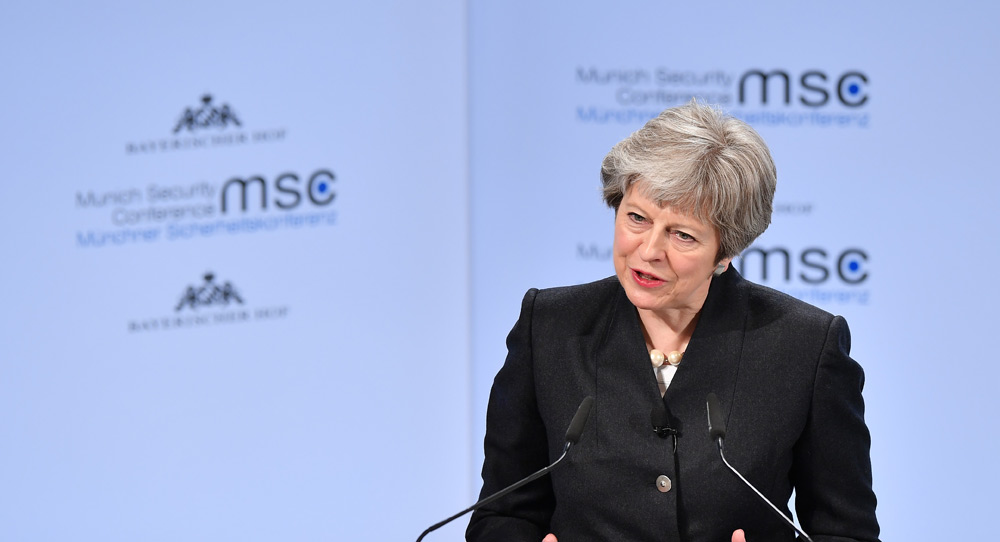
There wasn’t an empty seat in the elegant banquet hall when British Prime Minister Theresa May took to the podium during day two of the 2018 Munich Security Conference. There, she spelled out what kind of relationship her country wants with the EU once Britain quits the bloc.
And spell it out she did during a very focused thirty-minute speech that proposed what role Britain should have in shaping the EU’s security and defense policy.
Some in the MSC hall said that May wanted to have her cake and eat it. There she was, setting the agenda and the terms for a Britain that will soon lose its EU voting rights but somehow, as May said, still wants a say.
Others were more sympathetic. They said that May had presented a list of constructive proposals. Even if the devil was still in the detail, the audience now knew (at least for the moment), where Britain stood with the EU post-Brexit.
May’s key point—something she has often referred to when speaking to European leaders and diplomats—is that the security of Britain’s citizens is tied to the security of the EU. They both need each other. Because of the overriding need to “protect all European citizens wherever they are in the continent,” May said she would seek a special treaty with the EU. “Our ability to keep our people safe depends ever more on working together,” she said. The question is, how?
In practice, May said that Britain was open to continuing to send troops to EU military operations. Britain would also pay into EU foreign aid programs. It would develop weapons jointly and align with Europe on foreign policy, such as Russian sanctions. Furthermore, this special security partnership would envisage regular consultations on global challenges, as well as contribute to cyber and space capability development.
In short, May was making a convincing case for Britain and the EU to agree a special treaty on internal security cooperation post-Brexit. May even mentioned “unconditional interest” and respect for any European Court of Justice decision on issues covered by the agreement.
But then came the sting.
Without pulling her punches, May said she expected “to play an appropriate role” in shaping policies. And increasing the stakes in the Brexit negotiations, any failure to get a special deal over internal security, she argued, would have damaging effects for both sides. Indeed, without such cooperation, criminals and terrorists would benefit, she implied.
Extradition on arrest warrants would cease. There would be an end to the exchange of data and engagement with Europol. All that, she said, “would damage us both and would put all our citizens at greater risk.” Hence, May added, “There is no legal or operational reason why an agreement could not be reached in the area of internal security.”
At the same time, she asked the EU to respect Britain’s “unique status,” whether it concerned its strict data protection laws or its defense and security capabilities. The treaty “must have an ability to ensure that as the threats we face change and adapt… our relationship has the capacity to move with them. Nothing must get in the way of our helping each other in every hour of every day to keep our people safe.” And, she added, “We cannot delay discussions on this.”
After her speech, Wolfgang Ischinger, the chairman of the MSC, said the Brexit decision was regrettable. “Things would be so much easier if you stayed,” he told May. The prime minister hadn’t an ounce of doubt in her response: “We abide by the [Brexit] decision. We are leaving the European Union. There is no question of a second referendum.”

Nonresident Senior Fellow, Carnegie Europe
Judy Dempsey is a nonresident senior fellow at Carnegie Europe
Recent Work
Judy Dempsey
Judy Dempsey
Carnegie does not take institutional positions on public policy issues; the views represented herein are those of the author(s) and do not necessarily reflect the views of Carnegie, its staff, or its trustees.

The European Commissioner for Trade is headed to China. But after President Xi’s bridge-building visit to Washington, can a more isolated EU overcome Beijing’s stranglehold on critical raw materials? Who will blink first?

Rym Momtaz, ed.

The domestic impacts of how long it is taking to end the war in Ukraine have pushed the French electorate to the political extremes and compromised the country’s diplomatic capacity.
Rym Momtaz

Before the next wave of EU enlargement takes place, the union needs to grapple with thorny questions of how power is distributed among its members.


Emil Sondaj Hansen, Ditte Brasso Sørensen

A summer of escalation in the Black Sea has hurt Ukraine economically and is exacerbating world food security. A truce is needed—as is a broader reframing of Europe’s Ukraine strategy.

Thomas de Waal

Are Germany’s economic, industrial, and political struggles becoming a liability for the EU’s ability to rise to the geopolitical moment?
Rym Momtaz, ed.