

Commentary
The EU can impose sanctions but struggles to enforce them without the United States. With Washington increasingly disinterested in backing European interests, the bloc must now fend for itself.
Nicu Popescu, Tiago Antunes
{
  "authors": [
    "Claudia Major",
    "Christian Mölling"
  ],
  "type": "commentary",
  "blog": "Strategic Europe",
  "centerAffiliationAll": "",
  "centers": [
    "Carnegie Endowment for International Peace",
    "Carnegie Europe"
  ],
  "collections": [
    "EU Integration and Enlargement"
  ],
  "englishNewsletterAll": "",
  "nonEnglishNewsletterAll": "",
  "primaryCenter": "Carnegie Endowment for International Peace",
  "programAffiliation": "",
  "programs": [],
  "projects": [],
  "regions": [
    "Western Europe",
    "France",
    "Germany",
    "Europe"
  ],
  "topics": [
    "Security",
    "Military",
    "Foreign Policy",
    "EU"
  ]
}
Source: Getty
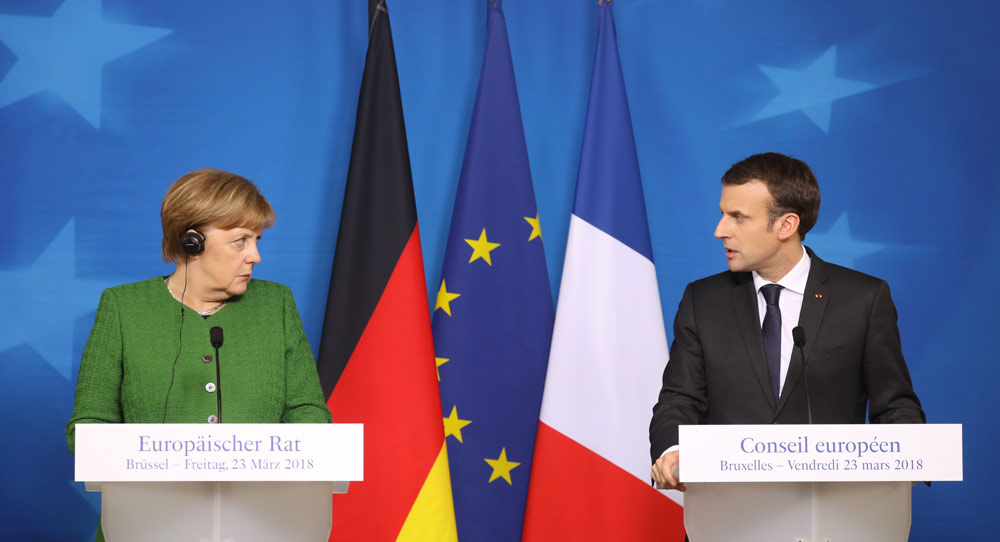
Failing to reach a compromise on EU defense policies not only affects relations between France and Germany, it jeopardizes European security.
When Emmanuel Macron and Angela Merkel finally met after the German chancellor’s reelection, most EU leaders were relieved. Europe’s Franco-German engine was back.
Once Merkel settled in again—so the hope went—Berlin could finally offer answers to the proposals about the future of Europe that Macron had laid out since his own election in May 2017. Implementing these plans depended on German support and Franco-German agreement.
As it stands, Germany is hesitant about Macron’s ideas on eurozone reform. As for defense, things seem to be getting worse. Instead of providing the engine for EU defense, the Franco-German couple is struggling to find the necessary compromises that would allow them to move on and other Europeans to follow. This is a risk. European defense—in the EU and in other formats—will only take off if France and Germany agree on the next steps and push them forward.
Paris and Berlin are the indispensable leaders of, and the backbone for, European defense. Beyond political gravitas, they represent about 50 percent of military and industrial capabilities within the EU after Brexit and about 40 percent of those in wider Europe. This is not to be scoffed at.
Several projects agreed upon bilaterally last summer (including to jointly develop a (including to jointly develop a next-generation fighter jet) will—if they succeed—shape the face of European defense more significantly than PESCO, France’s European Intervention Initiative, or other currently resurfacing fancy initiatives, like the Northern Group.
Alternatively, if Berlin and Paris do not agree on the direction of European defense, 50 percent of Europe’s political, military, and industrial energy will go in different directions. Failing to find a compromise not only affects France and Germany, it endangers European defense as a whole. EU ambitions will be undermined. The EU will struggle to improve its military capacity to act. Fragmentation in European defense might increase.
There has been important momentum in European defense in recent months, with the first results being mainly the launch of PESCO, allowing participating EU states to cooperate more closely, and the European Defence Fund, to finance joint research and procurement.
What are needed now, after the enthusiastic rhetoric, are results.
Yet the interregnum between September 2017 and March 2018, when Germany was trying to form a government, has harmed the Franco-German axis. Voices critical of Franco-German cooperation from within—for example, the armed forces—gained influence. National preferences came to the forefront and fueled controversies in two main areas for European defense: capabilities and industries.
The big intellectual issue is that Germany’s normative preference for EU-based developments needs to be reconciled with Paris’s pragmatic approach, which sees the EU as just one framework for delivery among many.
Because of German lobbying, PESCO turned into an inclusive, political endeavor with the typical EU procedures and institutions that allowed as many EU states as possible to participate, rather than a defense-driven exercise that focuses on capabilities.
France preferred the opposite: an exclusive club of those really able and willing to contribute forces to operations. Such an ambitious and exclusive PESCO would have offered valuable support to the country’s overstretched forces and to European security in the south.
Disappointed with a Germanized PESCO, Paris is now shaping its European Intervention Initiative outside the EU—which, ironically, has the side effect of involving the UK.
The upshot is that the Europeans are faced with two competing options: cooperating within the EU or outside of it. If all goes well, all formats will be mutually reinforcing. If not, and the capable and the willing act outside of EU frameworks, they risk devaluing the union.
The choice of framework has wide political implications. It is about having security and politics within a single framework—the EU—or having security distinct from it. Whether this has to take place necessarily within the EU depends on whether you want to deliver institutional coherence or security.
And there’s another issue. It is about how to ensure Europe’s defense industrial future. France and Germany make up about 40 percent of the defense industry in Western and Central Europe.1 This is a great potential to drive Europe towards more strategic autonomy in the industrial realm: agreed Franco-German procurement projects could be the catalyst for European projects and for an innovative and competitive defense industry in Europe.
But this process is currently stalling. Berlin and Paris don’t agree on how to export jointly constructed products, be it tanks or aircrafts.
Exports outside Europe are crucial for the success of every envisaged project because the European market is too small. Current products from defense industrial cooperation—such as KANT, a merger between French and German land warfare equipment producers, or a future European fighter jet—need export regulations that both countries can accept.
France and Germany have similar export rules and procedures, but Germany is much more cautious than France and—even worse—has become very unpredictable in its practices. This has gone so far that even NATO allies, who Germany is politically obliged to support, get a “No” when procuring in Germany, without any proper explanation. This happened to Lithuania when it wanted to buy kit to support NATO deterrence in the Baltics.
This unpredictability also distracts French industrial and political partners to financially and politically invest in joint projects. They see no reason to embark on the development of joint fighters and tanks if they cannot be exported.
The point is that the Franco-German axis has not developed from common worldviews but it has generated compromises that the EU member states could buy into.
This is the particular dynamic of the Franco-German couple. Having opposite viewpoints is neither new nor need it be a problem. But it is the lack of willingness to find a compromise that might make Europe miss the momentum— a lose-lose-lose situation for both Berlin and Paris, and for Europe as a whole.
Claudia Major is a senior associate for international security at the German Institute for International and Security Affairs (SWP) and a member of Women in International Security (WIIS) Berlin. Christian Mölling is the research director at the German Council on Foreign Relations (DGAP).
1Authors’ calculation based on data from M.L Chagnaud, C. Mölling, T. Schütz, and A. von Voss’s article, “Arming Europe: the State of the European Defence Technololgical and industrial Base,” published in Strategic Autonomy and the Defence of Europe. On the Road to a European Army?, Dietz-Verlag, May 2017.
Claudia Major
Christian Mölling
Carnegie does not take institutional positions on public policy issues; the views represented herein are those of the author(s) and do not necessarily reflect the views of Carnegie, its staff, or its trustees.

The EU can impose sanctions but struggles to enforce them without the United States. With Washington increasingly disinterested in backing European interests, the bloc must now fend for itself.


Nicu Popescu, Tiago Antunes

Russia is testing the waters of NATO’s mutual defense clause. What do strikes in Romanian territorial waters mean for the alliance’s posture toward Moscow?

Dimitar Bechev

With its public finances in shambles, the far right polling at 35 percent ahead of the 2027 presidential election, and a growing protest movement, is France’s crisis a threat to the EU’s geopolitical awakening?

Rym Momtaz, ed.

Ahead of a tough winter for Ukraine, Donald Trump’s swing back toward Russia bodes ill. But instead of panicking, Kyiv’s European allies are focusing on action.
Rym Momtaz

While the EU and European governments are embracing the much-lauded middle-power moment, this entails three difficult conundrums.

Richard Youngs