

Commentary
Judy Dempsey
{
  "authors": [
    "Judy Dempsey"
  ],
  "type": "commentary",
  "blog": "Strategic Europe",
  "centerAffiliationAll": "",
  "centers": [
    "Carnegie Endowment for International Peace",
    "Carnegie Europe"
  ],
  "collections": [
    "Europe’s Eastern Neighborhood"
  ],
  "englishNewsletterAll": "",
  "nonEnglishNewsletterAll": "",
  "primaryCenter": "Carnegie Europe",
  "programAffiliation": "",
  "programs": [],
  "projects": [],
  "regions": [
    "Russia",
    "Europe",
    "Western Europe"
  ],
  "topics": [
    "Foreign Policy",
    "EU"
  ]
}
Source: Getty
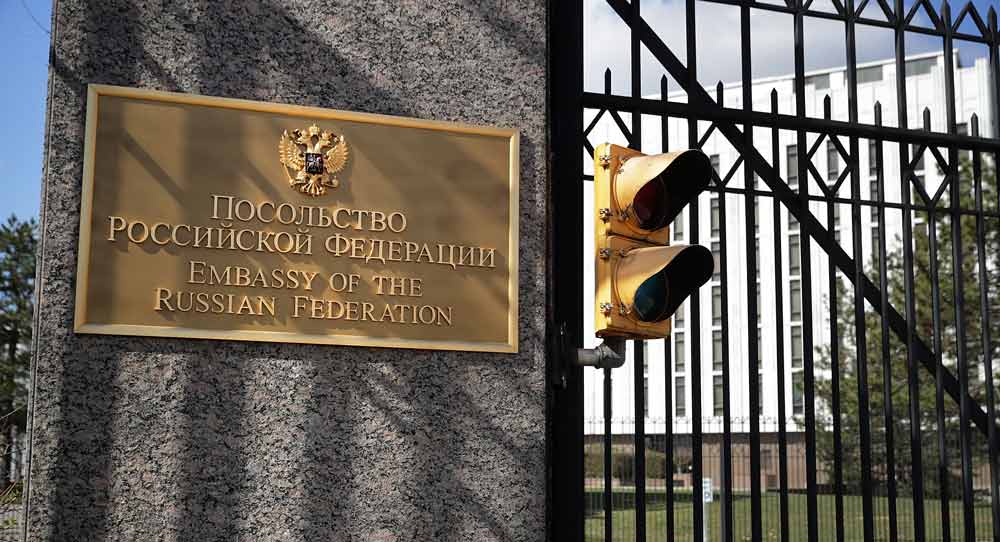
Expelling diplomats is not a way to deal with Russia.
As countries across the European Union, as well as Australia, Canada, and the United States began to expel Russian diplomats, British Prime Minister Theresa May was almost ecstatic. Solidarity had replaced the UK’s growing isolationism, which had increased after its decision to leave the EU.
What swung countries to rally behind London was the conviction that Russia—or rather the Kremlin—was responsible for the chemical attack in the English town of Salisbury on Sergei Skripal, a former Russian spy, and his daughter, Yulia. They are now in a critical condition in hospital. Scores of others are being treated as a result of the fallout from this highly poisonous nerve agent.May has yet to make public the evidence for her belief that Russia was behind this incident. But during a recent summit of EU leaders in Brussels, Russia was discussed for five hours. This was probably one of the most intense and more important debates EU leaders have had on Russia for a very long time.
Russia has always been an issue that unites and divides the EU. But since 2014, when Russia illegally annexed Crimea and then by proxy invaded parts of eastern Ukraine, Europe has demonstrated a rare unity in dealing with the Kremlin. Led by German Chancellor Angela Merkel, EU leaders have imposed a raft of sanctions on Russia.
These sanctions have been repeatedly rolled over every six months or so. Despite calls by some countries and prominent politicians to end them, Europe has remained united. And even though the recent attack in Salisbury is unconnected to Russia’s actions in Ukraine, the EU—with some exceptions by a few member states— is united over the Skripal affair.
Expelling diplomats, however, is not a policy. Yes, Putin might be surprised by the degree of unity. And no doubt he will retaliate by kicking lots of European diplomats out of Russia. But there is also every certainty that Moscow can easily compensate for the expulsion of its own officials. Russia’s embassies across Europe outmatch their European counterparts in terms of intelligence personnel, meaning spies.
And while May can bask in the solidarity she has received, Europe’s lack of a Russia policy has exposed its lack of resilience in several ways.
First is the nature of the chemical attack. British officials had been concerned that the so-called Islamic State, or ISIS, would try to carry out such an attack somewhere in the United Kingdom. Now that it has happened, with the blame firmly pinned on Russia, it begs many questions about the preparedness of European countries to these kinds of highly dangerous acts.
Apart from killing people, such attacks can inflict immense harm on infrastructure. Energy, water, transport, and health services are all easy targets for contamination. Entire towns and cities could be brought to a standstill.
The EU has any number of agencies to deal with crisis prevention and management. But in terms of reacting to a chemical attack on a bigger scale than the Skripal one shows why European countries have to take resilience seriously. Resilience is about how societies can quickly recover. Expelling diplomats is a symbolic response.
Second, and related in kind to a chemical attack, is an extraordinary ignorance by companies about how to deal with cyberattacks.
A recent survey by the UK government found that the country’s biggest 350 companies found more than two thirds of boards had not received training to deal with a cyber incident, despite more than half saying cyber threats were a top risk to their business.
One in ten FTSE 350 companies said they operate without a response plan for a cyber incident, and less than a third of boards receive comprehensive cyber risk information. Again, the damage inflicted on not only companies but the economy and society is immense. One wonders how they are prepared for any chemical attack.
The third is about communicating with the public. Local politicians and officials in Salisbury were highly critical about how little information was shared with civilians, in particular, about the incident.
Hamish de Bretton-Gordon, a former commander of the now disbanded Joint Chemical, Biological, Radiological, and Nuclear Regiment, criticized the government for its lack of preparedness, particularly after recent experiences dealing with chemical attacks in Syria.
In terms of the response, “If [the Russian president Vladimir] Putin is responsible, he probably doesn’t think anything’s going to happen because we haven’t done anything about chemical weapon use in Syria and Iran,” de Bretton-Gordon said. “We must reimpose the taboo, the red line, on the issue of chemical weapons, otherwise every dictator, despot, rogue state and terrorist is going to use this stuff.”
Fourth, the EU institutions and EU governments have to counter disinformation—which Russia excels at. The West managed this during the Cold War precisely because it was a war based on ideology. More than a quarter of a century since the collapse of the Soviet Union, thanks to social media and the huge resources deployed by Russia, the West is engaged in a more dangerous struggle that is testing its resilience and its values.
Finally, Britain, but also other countries, have built up a dependence on Russia, be it oligarchs parking their money in London or Germany increasing its energy dependence on Russia by building another Nord Stream gas pipeline. Both make a mockery of solidarity. Both run counter to resilience.

Nonresident Senior Fellow, Carnegie Europe
Judy Dempsey is a nonresident senior fellow at Carnegie Europe
Recent Work
Judy Dempsey
Judy Dempsey
Carnegie does not take institutional positions on public policy issues; the views represented herein are those of the author(s) and do not necessarily reflect the views of Carnegie, its staff, or its trustees.

Trump is distracted and Ukraine wants Europe to step up. The continent’s leaders must find their voice and assert it in talks with Russia.

Alissa de Carbonnel

Mounting economic strain and battlefield losses will not necessarily make the Kremlin less dangerous. They could instead push Moscow toward a more aggressive hybrid campaign designed to test NATO’s Eastern flank, exploit allied hesitation, and fracture European resolve.

Maksym Beznosiuk

Over the past ten years, NATO has held almost as many summits as it did during the entirety of the Cold War. Are they still useful, or is it time to stop holding annual meetings?

Rym Momtaz, ed.
Nearly a year and a half after Europeans leaned into sucking up to Trump, the strategy has produced some benefits when it comes to Ukraine.
Rym Momtaz
Far-right leader Marine Le Pen can—and will—run in France’s next presidential election. What does the outcome of her appeal against a 2025 embezzlement conviction mean for the country’s political future?
Catherine Fieschi