

Commentary
Thomas de Waal
{
  "authors": [
    "Thomas de Waal"
  ],
  "type": "commentary",
  "blog": "Strategic Europe",
  "centerAffiliationAll": "",
  "centers": [
    "Carnegie Endowment for International Peace",
    "Carnegie Europe",
    "Carnegie Russia Eurasia Center"
  ],
  "collections": [
    "Europe’s Eastern Neighborhood"
  ],
  "englishNewsletterAll": "",
  "nonEnglishNewsletterAll": "",
  "primaryCenter": "Carnegie Europe",
  "programAffiliation": "",
  "programs": [],
  "projects": [],
  "regions": [
    "Russia",
    "Europe",
    "Eastern Europe",
    "Caucasus",
    "Azerbaijan",
    "Armenia"
  ],
  "topics": [
    "Foreign Policy",
    "Democracy",
    "Political Reform",
    "Security",
    "EU"
  ]
}
Source: Getty
Armenia’s new prime minister has so far taken a tough stance on the unresolved Karabakh conflict with Azerbaijan. The moribund Karabakh peace process needs shaking up—but not too much.
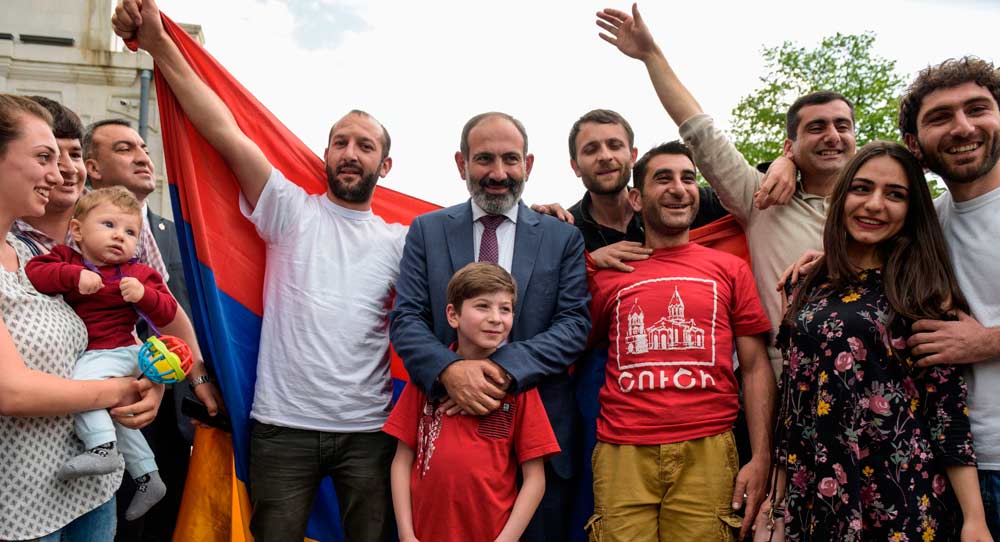
For the past month Armenia has coasted on a wave of popular emotion and international goodwill, ever since peaceful protests forced the resignation of veteran leader Serzh Sargsyan and brought to power opposition leader Nikol Pashinian.
Pashinian, who is 42, has appointed a new government even more youthful than himself. He has also promised to crack down on corruption and clean up the old oligarchic system. A country that many had characterized as isolated, stuck, and completely dependent on Russia has confounded stereotypes and now looks dynamic—trendy even. The revolution is still only half-finished, but for the first time in two decades, Armenia is a good news story.
Yet all this promise and hope could be swept away if Armenia’s new government gets one thing wrong: its stance on the unresolved Nagorny Karabakh conflict with Azerbaijan, now three decades old. The tired negotiating process could certainly do with some shaking up—but not too much.
In his first actions and comments on the conflict, Pashinian has certainly shaken things up. He has spoken more like a member of the crowd than a diplomat, saying that Karabakh “is an inseparable part” of Armenia. The day after being elected prime minister, Pashinian flew to Armenian-run Karabakh to take part in the annual victory ceremonies on May 9. There he insisted that the Armenians of Karabakh “should take a direct part in negotiations on the settlement of the conflict and sit at the negotiating table.”
The tough stance can in part be put down to domestic politics. Pashinian is following in the footsteps of two Karabakh Armenians who had fought in the conflict of the 1990s and ruled Armenia for the past 20 years. He evidently feels a need to assert his national security credentials and reassure the Karabakh Armenians that he stands for them as well. But he is probably also being quite sincere. Most Armenians share a “no compromise” outlook toward the region. In a 2016 radio interview, Pashinian said, “There is no land to hand over to Azerbaijan.”
The danger here is that if an Armenian leader openly asserts sovereignty over Nagorny Karabakh and says that the Azerbaijani lands around it, which Armenian forces captured in 1993-1994, cannot be returned, there is nothing left to negotiate about with Baku, and the two sides are back on the road to war. The Four-Day War of 2016, which claimed about 200 lives, is a recent grim reminder of how costly this can be. The ceasefire continues to be broken, with an Azerbaijani soldier reported killed on May 20.
For those who watch the conflict from afar, the contours of a workable Karabakh peace agreement are fairly clear. They approximate the Basic Principles document, drawn up by the mediators of the OSCE’s Minsk Group. There are two essential elements: that Azerbaijan recognizes the Karabakh Armenians’ right to self-govern; and that the Armenian side gives up the territory it controls around Karabakh, with the exception of a land corridor to Armenia. It also helps if the issue of the final status of Nagorny Karabakh—the question which kicked off the whole conflict in 1988—remains sufficiently ambiguous to allow the sides to try to agree on other issues first.
The ideas are sound—but few in the region still believe in them. That is because over the past fifteen years the process has become what one former diplomat called “kabuki negotiations.” Each side strikes poses and does just enough to keep the OSCE mediators in a job, but no serious work is done or real progress is made. The internationals also tend to go through the motions. The conflict has slipped way down the agenda of the United States—although, fortunately, the Trump administration resisted the temptation to abandon an American mediating role and appointed a new U.S negotiator, Andrew Schofer.
A new Armenian government with public legitimacy changes that cozy situation. So far, Azerbaijani president Ilham Aliyev—who is certainly capable of aggressive rhetoric against Armenia—has done the right thing by keeping quiet, leaving his defense minister to make some typically bellicose comments and the foreign ministry spokesman to object in a slightly more diplomatic manner.
But how long will the Azerbaijani president keep his vow of silence? In what could be a protracted election campaign, Pashinian and his comrades will not want to sound conciliatory on this issue for fear of having their patriotic credentials questioned. It could be many months before there is a new, consolidated Armenian policy on the conflict.
If the process survives in the short term, there are positive scenarios. New thinking is needed and may be provided by Armenia’s new foreign minister, Zohrab Mnatskanian, who replaces the hyper-cautious Eduard Nalbandian. Mnatskanian was a well-respected lead negotiator in the country’s Association Agreement talks with the European Union, curtailed at the last minute in 2013. The EU is one of several actors who can breathe some more life into this process, by playing a more active role to support the formal negotiators of the Minsk Group.
If political point-scoring can ever be left aside, the debate about how the Karabakh Armenians should take part in the talks is also a relevant one. After all, their homeland is the original subject of the dispute. They did take part until 1998, when Robert Kocharian, formerly the leader of the Karabakh Armenians, became president of Armenia and decided he could speak on their behalf. That suited Azerbaijan, which wants to frame the conflict as being only between Baku and Yerevan. But the voices of the Karabakh Armenians—as in a different way, those of the displaced Karabakh Azerbaijanis—do need to be heeded. Including them on the inside would also of course be a test of whether they have something constructive to contribute.
In short, a moribund peace process is in need of reinvigorating, but Armenia’s new leaders need to be careful how they use the legitimacy they have won from the street. The Karabakh negotiating process is a delicate structure. Its collapse would point only one way, toward new conflict.

Senior Fellow, Carnegie Europe
Thomas de Waal is a senior fellow at Carnegie Europe, specializing in Eastern Europe and the Caucasus.
Recent Work
Thomas de Waal
Thomas de Waal
Carnegie does not take institutional positions on public policy issues; the views represented herein are those of the author(s) and do not necessarily reflect the views of Carnegie, its staff, or its trustees.

The EU can impose sanctions but struggles to enforce them without the United States. With Washington increasingly disinterested in backing European interests, the bloc must now fend for itself.


Nicu Popescu, Tiago Antunes

Russia is testing the waters of NATO’s mutual defense clause. What do strikes in Romanian territorial waters mean for the alliance’s posture toward Moscow?

Dimitar Bechev

With its public finances in shambles, the far right polling at 35 percent ahead of the 2027 presidential election, and a growing protest movement, is France’s crisis a threat to the EU’s geopolitical awakening?

Rym Momtaz, ed.

Ahead of a tough winter for Ukraine, Donald Trump’s swing back toward Russia bodes ill. But instead of panicking, Kyiv’s European allies are focusing on action.
Rym Momtaz

While the EU and European governments are embracing the much-lauded middle-power moment, this entails three difficult conundrums.

Richard Youngs