

Commentary
Judy Dempsey
{
  "authors": [
    "Judy Dempsey"
  ],
  "type": "commentary",
  "blog": "Strategic Europe",
  "centerAffiliationAll": "",
  "centers": [
    "Carnegie Endowment for International Peace",
    "Carnegie Europe"
  ],
  "collections": [
    "Europe’s Eastern Neighborhood"
  ],
  "englishNewsletterAll": "",
  "nonEnglishNewsletterAll": "",
  "primaryCenter": "Carnegie Europe",
  "programAffiliation": "",
  "programs": [],
  "projects": [],
  "regions": [
    "Europe",
    "Eastern Europe",
    "Ukraine"
  ],
  "topics": [
    "EU",
    "Democracy",
    "Political Reform",
    "Security"
  ]
}
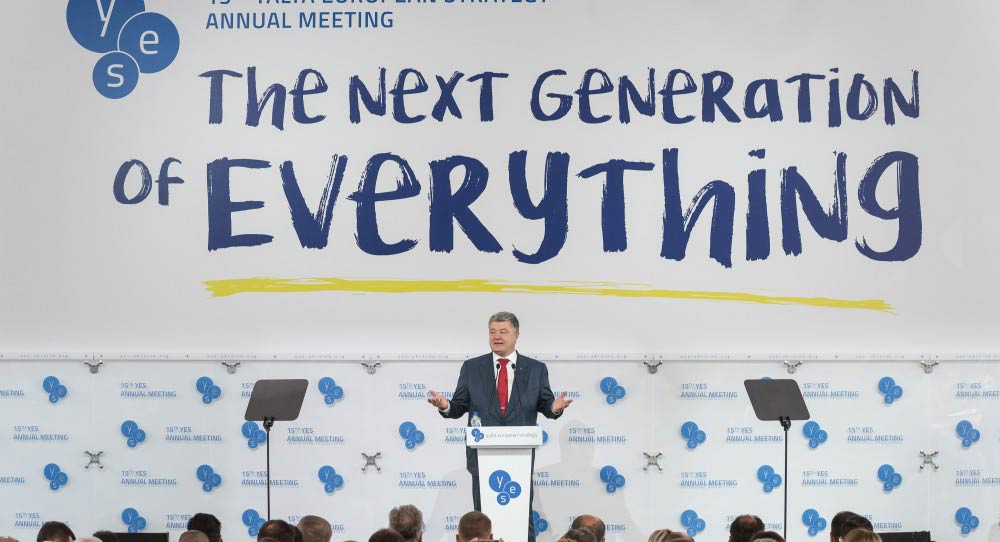
Source: Getty
The 2019 presidential and parliamentary elections in Ukraine are not about reform and ending corruption but about the influence of the oligarchs.
Ukraine has entered the election season. It was kicked off recently in Kiev by Petro Poroshenko, who has been president since 2014. In a speech full of rhetoric and promises delivered at this year’s YES conference, he loudly pledged that this annual gathering would convene “next year in Yalta.”
Poroshenko received a warm applause for such words. But who in the audience would believe that Russia was going to end its illegal annexation of Crimea and allow Ukraine to regain its territorial integrity?
If anything, the continuing conflict in eastern Ukraine gets little coverage these days in the Ukrainian media. Instead, it’s the persistent corruption coupled with the decline in living standards in the country that preoccupy the public. So much so that at least a fifth of the electorate have no idea who they will vote for. There’s a tiredness and cynicism about the old faces—Poroshenko and his arch rival, Yulia Tymoshenko, a former prime minister, are in the race.
About 17 percent of voters said they might opt instead for the singer Svyatoslav Vakarchuk or the satirical actor Vladimir Zelenskiy. There’s a longing for someone new, someone young, someone to complete the transformation of a country still dominated by the oligarchs.
The candidates who have thrown their hats into the ring are not equipped to take on this immense challenge. This is because the power of the oligarchs still remains too strong to break. It will only be persistent pressure from the Europeans and—in particular—from the International Monetary Fund that could end this toxic “poligarchy” that is impeding the modernization of Ukraine.
Yes, the war in Donbas is costly in human and financial terms and debilitating. This continuing conflict is a distraction to Russia’s benefit. And Russia is set to beef up its disinformation war in Ukraine as the election campaign intensifies.
But the enduring power and influence of the oligarchs also plays into Russia’s hand precisely because they want to protect their fiefdoms and hinder reforms that would dent their power. The last thing the Kremlin wants is an open, democratic, rules-based and prosperous Ukraine that is anchored to the Euro-Atlantic structures of the EU and NATO. The oligarchs and the old guard stand in the way of completing the transformation of Ukraine.
So far, the EU (particularly Germany) and the United States have stood behind Ukraine. But it has been the role of the International Monetary Fund that has often proved the most effective. The IMF has been unflinching in its criticism of the corruption, of the political interference in the courts, and of the weak rule of law in Ukraine. And it has immense clout to underpin that criticism: money. Ukraine needs the IMF’s approval for releasing more of its $17.5 billion bailout package. The IMF is set to unlock a tranche of $2 billion, only after Poroshenko finally agreed to establish what’s called the High Anti-Corruption Court.
The importance of the court cannot be underestimated. The judges are supposed to be completely independent and selected from a group of international experts. The court will also be ring fenced so as to prevent political interference or bribery.
Not that there hasn’t been any number of previous attempts to combat corruption through institutions. Each has succumbed to political interference from the highest levels or has fought to preserve their independence. Now, the IMF’s persistence and the structure of the new court may convince a skeptical public that the rule of law and accountability can take hold. But the court won’t yet break the hold the oligarchs—including Poroshenko—have over the media.
The president’s supporters recently tried to take over the highly popular news channel 112. When they failed, they established their own pro-presidential news outlet called Priamyi. In addition, financing for public television was cut off. “It stopped being biased in favor of the ruling powers following the Revolution of Dignity [in 2014], argued Tadeusz Iwański from the Center for Eastern Studies in Warsaw.
Other media outlets are also in the hands of oligarchs, such as Dmytro Firtash, Rinat Akhmetov, and Ihor Kolomoyskyi. In short, don’t count on fair and independent coverage of the elections.
More worrying for independent journalists is an attempt by the presidential administration to introduce legislation aimed (on grounds of security) at reining in criticism of the president and government. Young journalists told me that the administration wanted them to toe a kind of patriotic, uncritical line.
It’s hard to see how the new court can break this umbilical cord between politicians and oligarchs as long as the politicians protect the oligarchs and the oligarchs bankroll the politicians. It depends as much on the vibrancy of civil society, constant pushing by the West, and a younger, untainted generation to complete Ukraine’s transformation.
Photo Credit: YES © 2018. Photographed by Sergei Illin, Aleksandr Indychii and Aleksandr Pilyugin.

Nonresident Senior Fellow, Carnegie Europe
Dempsey is a nonresident senior fellow at Carnegie Europe
Recent Work
Judy Dempsey
Judy Dempsey
Carnegie does not take institutional positions on public policy issues; the views represented herein are those of the author(s) and do not necessarily reflect the views of Carnegie, its staff, or its trustees.
The far right failed to win big in France’s municipal elections. But that’s not good news for the country’s left wing, which remained disunited while the broader right consolidated its momentum ahead of the 2027 presidential race.
Catherine Fieschi
Donald Trump has demanded that European allies send ships to the Strait of Hormuz while his war of choice in Iran rages on. He has constantly berated NATO while the alliance’s secretary-general has emphatically supported him.

Rym Momtaz, ed.
The EU is structurally incapable of reacting to today’s foreign policy crises. The union must fold the EEAS into the European Commission and create a security council better prepared to take action on the global stage.

Stefan Lehne
The war in Ukraine is costing Russia its leverage overseas. Across the South Caucasus and Middle East, this presents an opportunity for Europe to pick up the pieces and claim its own sphere of influence.

William Dixon, Maksym Beznosiuk
The war in Iran proves the United States is now a destabilizing actor for Europe and the Arab Gulf. From protect their economies and energy supplies to safeguarding their territorial integrity, both regions have much to gain from forming a new kind of partnership together.
Rym Momtaz