

Commentary
Judy Dempsey
{
  "authors": [
    "Judy Dempsey"
  ],
  "type": "commentary",
  "blog": "Strategic Europe",
  "centerAffiliationAll": "",
  "centers": [
    "Carnegie Endowment for International Peace",
    "Carnegie Europe"
  ],
  "collections": [],
  "englishNewsletterAll": "",
  "nonEnglishNewsletterAll": "",
  "primaryCenter": "Carnegie Europe",
  "programAffiliation": "",
  "programs": [],
  "projects": [],
  "regions": [
    "Europe",
    "Western Europe",
    "Germany"
  ],
  "topics": [
    "EU"
  ]
}
Source: Getty
Just because she quit as party leader doesn’t mean that the German Chancellor has to be a lame duck.
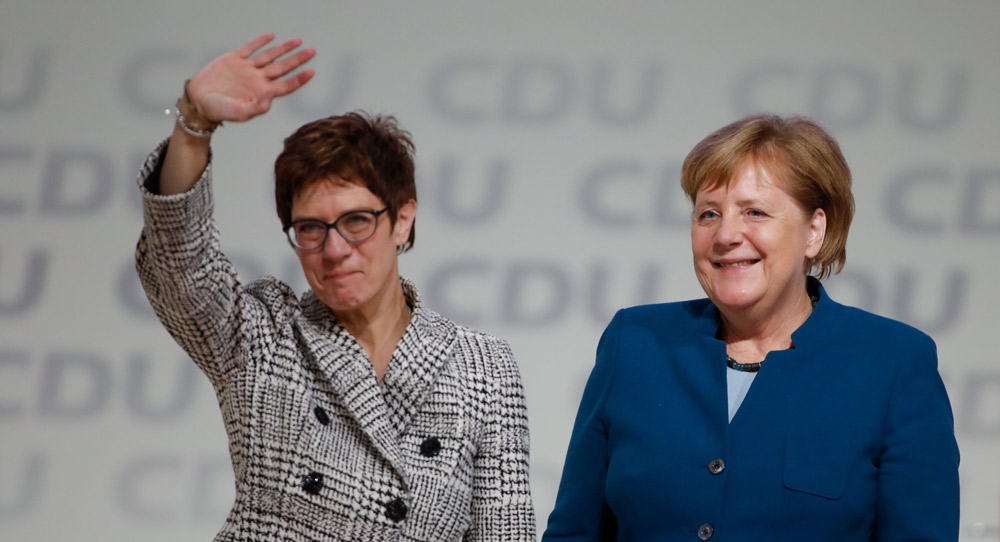
Annegret Kramp-Karrenbauer is the new leader of the Christian Democratic Union (CDU) party, a position that Chancellor Angela Merkel held for eighteen years. Merkel, who betrays little emotion in public, was visibly delighted when the results were announced during the party’s congress in Hamburg on December 7. Her preferred candidate won.
It was no shoo-in for Kramp-Karrenbauer. She clinched 52 percent of the vote. Her rival, Friedrich Merz, out of politics for several years after challenging Merkel’s authority, won 48 percent. The CDU is divided. “The party conference has indeed been polarized on an individual level,” Kramp-Karrenbauer said.
She has already been called, disparagingly, a “mini Merkel.” As in, things will continue as they are. Well, Germany and Europe could be in for a few surprises.First, AKK, as Kramp-Karrenbauer is known, is no pushover. Politics is in her blood. After holding several ministerial posts in the state of Saarland, she scooped up 40.7 percent of the vote in 2017 to be premier for a second consecutive time. She did it by reaching out to the public and by explaining her policies—tough on security, law, and order; conservative on same sex marriage; and determined to follow Merkel’s Mitte, or centrist, pro-Europe line.
Second, just like Merkel, AKK is not going to pander to the far-right Alternative for Germany (AfD). In her fiery speech in Hamburg, she insisted the party would be inclusive and would remain in the center. Merz, her rival, wanted to shift the party further to the Right to regain the tens of thousands of voters who defected to the AfD or the Greens in recent regional elections.
AKK’s commitment to the center is important. She wants to rebuild the CDU’s base. She wants it to regain its status as a “people’s party,” despite the trends across Europe in which the big post-1945 political parties are increasingly ceding ground to populist movements. This means AKK needs Merkel as much as Merkel needs AKK.
If it’s true that Merkel intends to see out her fourth term that expires in 2021—assuming, of course, that her coalition partners, the Social Democrats, won’t bolt before then—AKK and Merkel can play two distinct roles. AKK has to use her time to unite the party and strengthen the center. This means tackling digitization, education, housing, and investing in infrastructure. She has to debunk the AfD’s popularity that is based on protest, not policy.
As for Merkel, she is needed in Germany and Europe. She may be no strategist. But despite the pressures of realpolitik, she has consistently held a moral compass—be it on Russia, immigration, finding compromises among the EU’s bickering leaders, or holding the center. That compass is going to be needed more than ever over the coming, turbulent months, whatever happens with Brexit, France, the outcome of the European Parliament elections, and Ukraine.

Nonresident Senior Fellow, Carnegie Europe
Judy Dempsey is a nonresident senior fellow at Carnegie Europe
Recent Work
Judy Dempsey
Judy Dempsey
Carnegie does not take institutional positions on public policy issues; the views represented herein are those of the author(s) and do not necessarily reflect the views of Carnegie, its staff, or its trustees.

Russia is testing the waters of NATO’s mutual defense clause. What do strikes in Romanian territorial waters mean for the alliance’s posture toward Moscow?

Dimitar Bechev

With its public finances in shambles, the far right polling at 35 percent ahead of the 2027 presidential election, and a growing protest movement, is France’s crisis a threat to the EU’s geopolitical awakening?

Rym Momtaz, ed.

Ahead of a tough winter for Ukraine, Donald Trump’s swing back toward Russia bodes ill. But instead of panicking, Kyiv’s European allies are focusing on action.
Rym Momtaz

While the EU and European governments are embracing the much-lauded middle-power moment, this entails three difficult conundrums.

Richard Youngs

Much has been said of the changes Brussels is trying to make to the EU enlargement process. Here’s why gradual integration might—or might not—be the answer.
Dimitar Bechev