

Commentary
Judy Dempsey
{
  "authors": [
    "Judy Dempsey"
  ],
  "type": "commentary",
  "blog": "Strategic Europe",
  "centerAffiliationAll": "",
  "centers": [
    "Carnegie Endowment for International Peace",
    "Carnegie Europe"
  ],
  "collections": [
    "Transatlantic Cooperation"
  ],
  "englishNewsletterAll": "",
  "nonEnglishNewsletterAll": "",
  "primaryCenter": "Carnegie Europe",
  "programAffiliation": "",
  "programs": [],
  "projects": [],
  "regions": [
    "Europe",
    "Western Europe",
    "Germany"
  ],
  "topics": [
    "Security"
  ]
}
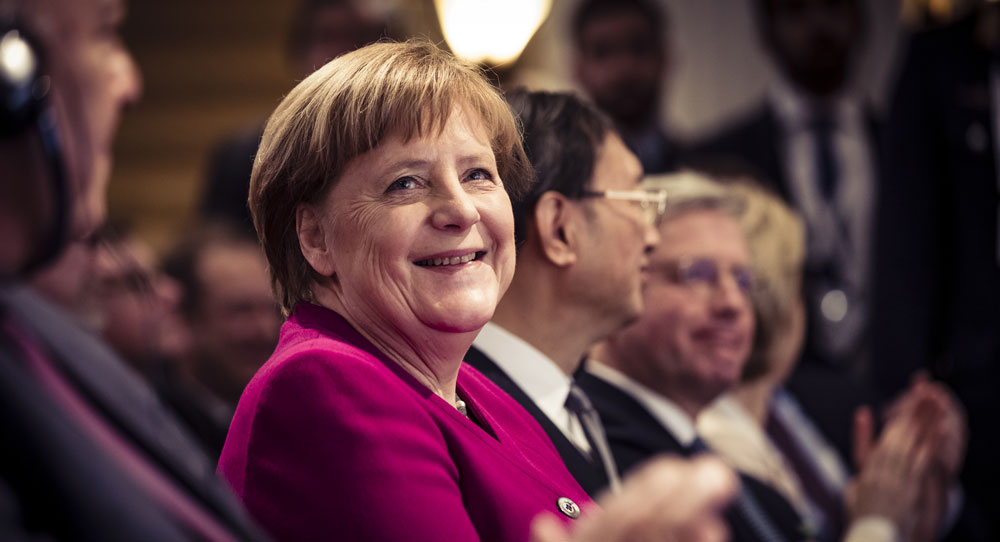
Source: Getty
The German chancellor discarded caution, discarded her notes, and discarded diplomatic niceties.
Carnegie Europe is on the ground at the 2019 Munich Security Conference, offering readers exclusive access to the debates as they unfold and providing insights on today’s immense threats to international peace and stability.
***
It’s not often that Angela Merkel shows some emotion.
But when she ended her cracking speech during day two of the Munich Security Conference, the participants, who were packed like sardines into the banqueting hall of the Hotel Bayerischer Hof, all stood up. They gave the German chancellor a long and loud applause. She really did have to fight back her tears.
It wasn’t a valedictory applause. Merkel has stepped down as leader of her governing Christian Democratic Union party and will not be running for a fifth term. Instead, it was an applause of acknowledgement and support. Here was a European leader who spelled out all the geostrategic issues she and her allies have to deal with. Her mantra: you can’t go it alone.Merkel has many dossiers on her desk and went through all of them in her 20 minute speech. They included: Washington’s decision to walk away from the Iran nuclear deal; the United States walking away from the Intermediate-Range Nuclear Forces (INF) Treaty; and President Donald Trump walking away from the post-1945 multilateral institutions.
Her speech was the contrary about walking away. It was about engaging, whether that be China or Russia, the Africa Union, or much closer to home, Germany’s EU and NATO allies, or the Germans themselves.
On Iran, she defended the nuclear deal on security and political grounds. But Merkel also said she has no illusions about Iran’s meddling in Syria and Yemen, nor Tehran’s support of Hezbollah in Lebanon and Hamas in Gaza.
So while the Trump administration has lost no opportunity to criticize the EU’s continuing support for the nuclear deal that is causing enough friction between allies, Merkel had her own response. Trump’s unilateral decision to pull out American troops from Syria would play into the hands of Iran, she said.
Nor was she impressed with Trump’s unilateral decision to pull out from Afghanistan, either— particularly since Germany and many other NATO countries signed up to that long, costly, and dangerous mission over seventeen years ago. That mission was never easy to explain to a skeptical German public. Merkel’s message was clear: alliance consultations matter for solidarity and trust.
Since security issues dominated her speech, Merkel used trade to, well, almost ridicule Trump’s claim that German car exports to the United States posed a national security threat. “BMW’s biggest car plant is in South Carolina,” she said, reminding her American interlocutors just how many jobs that amounted to. Some national security threat!
But what happens if the plant is forced to move production to China because of Trump’s threats to impose a heavy tax on German cars? Loss of jobs. What does that say about German jobs being a national security risk. Applause. Merkel wanted to press home the fact that the West faced real security dangers, not least, how, in six months time, the INF treaty may become an historical relic.
“The cancellation is bad news for Europe,” Merkel said. But in a view that is gaining some traction, she suggested that China should, in some way, be involved in arms control. In the meantime, she hopes that NATO could find some way to salvage the treaty. Time is very short.
There were several other issues Merkel touched upon. When she was asked what was her biggest achievement and her biggest regret, she was surprisingly frank about Germany’s role in Europe. “Many others lead the way. Sometimes we lag behind…Germany is a bit of a laggard…But once we decide, we are not shirking our responsibility…”
“During my term of office, Germany has become far more engaged than in the past. People say you have a special history and you don’t need to become engaged. But things have changed. We cannot simply remain sitting on the fence. That is what we understand by common responsibility.”
And when it came to arms control exports, here she said Germany was trying to take the lead (although for years, German arms manufacturers sold their weapons to authoritarian regimes.) “The one thing I am convinced about is our arms export policy. We will have to agree on a common line on arms exports,” she said.
Before she left the podium, Merkel was asked about her less than lukewarm response to French President Emmanuel Macron’s ambitious reform plans that have fallen from the wayside. Some blame Berlin for scuppering his proposals. Merkel had a different view.
“There are a lot of people who do no share our ideas for a European model,” she said. “You say I am beating around the bush… but Germany and France are not Europe alone. When I have an idea and the Netherlands and Finland are not in on this, then this isn’t enough, something we all share has to come out of this. We have to take everyone on board.” And with Britain on the way out, Merkel opined: “We have to fight for Europe. We have to fight for multilateralism.”
Oh, and by the way, Merkel had a parting shot. Referring to the MSC’s report, The Great Puzzle: Who Will Pick Up the Pieces? She replied, “All of us.”
Now that’s going to demand a major rethink of post-1945 multilateral institutions.
Image source: MSC / Kuhlmann

Nonresident Senior Fellow, Carnegie Europe
Judy Dempsey is a nonresident senior fellow at Carnegie Europe
Recent Work
Judy Dempsey
Judy Dempsey
Carnegie does not take institutional positions on public policy issues; the views represented herein are those of the author(s) and do not necessarily reflect the views of Carnegie, its staff, or its trustees.

As we close out another season of Strategic Europe, it is worth taking stock of the deep shifts underway.

Rym Momtaz
The EU had to compromise to adopt a twenty-first sanctions package against Russia, exposing growing cracks in the union’s resolve. Is this latest, weaker round worth it to keep pressure on Moscow?
Rym Momtaz, ed.

Trump is distracted and Ukraine wants Europe to step up. The continent’s leaders must find their voice and assert it in talks with Russia.

Alissa de Carbonnel

Mounting economic strain and battlefield losses will not necessarily make the Kremlin less dangerous. They could instead push Moscow toward a more aggressive hybrid campaign designed to test NATO’s Eastern flank, exploit allied hesitation, and fracture European resolve.

Maksym Beznosiuk

Over the past ten years, NATO has held almost as many summits as it did during the entirety of the Cold War. Are they still useful, or is it time to stop holding annual meetings?
Rym Momtaz, ed.