

Commentary
Thomas de Waal
{
  "authors": [
    "Thomas de Waal"
  ],
  "type": "commentary",
  "blog": "Strategic Europe",
  "centerAffiliationAll": "",
  "centers": [
    "Carnegie Endowment for International Peace",
    "Carnegie Europe",
    "Carnegie Russia Eurasia Center"
  ],
  "collections": [],
  "englishNewsletterAll": "",
  "nonEnglishNewsletterAll": "",
  "primaryCenter": "Carnegie Europe",
  "programAffiliation": "",
  "programs": [],
  "projects": [],
  "regions": [
    "Europe"
  ],
  "topics": [
    "EU",
    "Security",
    "Economy"
  ]
}
Source: Getty
Formal reunification talks in Cyprus are suspended. It is time to give a boost to some stalled confidence-building measures and enable Turkish Cypriot voters to vote freely in the European elections.
“To be honest, it feels like something has broken.”
Informal talks go on in Cyprus, but there are no formal negotiations. A special UN envoy, Jane Lute, visited the island last weekend to explore proposals on how to restart negotiations.
But this comment from a Greek Cypriot official was indicative of the mood. Since the last big push for a resolution in Crans-Montana in Switzerland in 2017, almost nothing has happened. Most of the talk has been around mechanics, not substance.Peace processes over protracted conflicts, like the Cyprus one, can become theological in their complexity. The Cyprus negotiations have produced documents running into hundreds of pages, sketching out fine distinctions over power sharing, troop withdrawal schedules, and the modalities of property compensation.
It’s vitally important work—but it can get as airless as a medieval monastery library. It’s equally vital not to forget that progress in Cyprus has come from below, from the street. If that momentum fades, then everything is lost.
When I visited Cyprus last week, my interlocutors unsurprisingly tended to dwell on the negative. The Greek Cypriot side is still excessively suspicious of Turkey—and those suspicions have only deepened since President Recep Tayyip Erdoğan’s authoritarian turn following the failed coup d’état of 2016. “Whatever you do, you are powerless in front of Turkey,” says the Greek Cypriot official.
On the Turkish Cypriot side, there is frustration that they have gained precious few rewards for being the party in the conflict more positive towards reunification since 2004, when Turkish Cypriots voted for the United Nations Annan plan and Greek Cypriots voted against. “After 2004, the Turkish Cypriots have proved that they are not secessionists,” affirms one Turkish Cypriot interlocutor. A group of Turkish Cypriots wondered aloud to me how long their de facto regime could continue voluntarily aligning itself with the EU “when there is no conditionality” from Brussels encouraging them to do so.
The Cyprus conflict dates back—at least—to 1963. For the past two decades, everyone has more or less agreed that a settlement should be based on a “bicommunal bizonal federation” that shares power between the two communities.
That idea drew sustenance from a peace constituency that flourished in the early 2000s. During 2003 and 2004 in particular, even though no political agreement was reached, much progress was made. The Green Line dividing the island opened. The Greek Cypriot-led Republic of Cyprus received EU membership and, although the acquis communautaire was suspended in the north, Turkish Cypriots received EU rights as individuals.
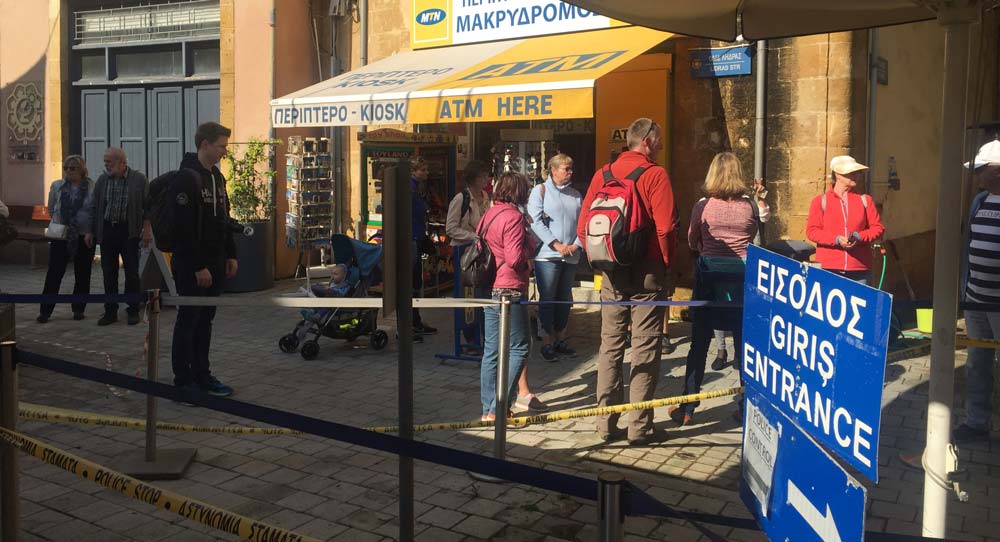
The peace constituency still scores occasional successes, such as the opening of two new crossing points across the Green Line last year. Cross-community activists still stage meetings and cultural events.
But if the cynicism around the process persists, it could all go into a negative spiral. Belief in a federal solution is ebbing. The two leaders have little to say to one another. Disputes over exploration of big gas fields offshore of the island could put Turkey and the Republic of Cyprus into direct confrontation.
To halt a downward slide, a few long-promised initiatives need greater international support. For years, the Turkish Cypriot leadership has had in its power to open up and eventually return the fenced city of Varosha, once a wealthy Greek Cypriot community and tourist center, which has been left abandoned since the Turkish invasion of 1974.
For a long time, the Greek Cypriots have dragged their feet over several deals that the European Commission has been pushing. One is an agreement on telecommunications, whereby the two sides would agree to eliminate mobile phone roaming charges. Another is an initiative, personally promoted by European Commission President Jean-Claude Juncker, to give Cypriot’s national cheese, known as halloumi in Greek and hellim in Turkish, a Protected Designation of Origin. Both these ideas, potentially win-wins for both sides, have stalled, mainly due to excessive legal caution on the Greek Cypriot side about granting too much status to the Turkish Cypriots.
A further area for cooperation could be around the status of the numerous universities and colleges in northern Cyprus. The default position in the south is to declare them all illegal. Many of them are poor quality and not worthy of having their status regularized. Several, however, are good quality and keen to collaborate with universities in the south. There should be room to explore compromise, building on the fact that the 1960 constitution declares education to be the competence of the two communities, not of central government.
Unfortunately, in a sterile political climate such as the present one, the parties to the conflict tend to see even issues of mutual public interest like these as “currency” in the overall negotiations, rather than as positive steps in and of themselves.
A test of goodwill is approaching very soon, with the European elections at the end of May. Several Turkish Cypriots, notably the university professor Niyazi Kızılyürek and the writer Şener Levent, are using their constitutional rights to run in the elections. In practice that means that tens of thousands of Turkish Cypriots who have taken up Republic of Cyprus—and therefore EU—citizenship will want to vote, and that will be a logistical challenge. They will need to be properly registered and allowed to cross the Green Line with ease to vote. Will the Republic of Cyprus authorities treat this as a confidence-building measure and do what they can to make this happen on polling day? Or will they seek to restrict the Turkish Cypriot voters because they want to see only Greek Cypriots elected?
The elections will be a test of whether cynicism or goodwill is in the ascendant, of how much oxygen there is still in the thinning atmosphere of the Cyprus process.
Photo credit: Thomas de Waal

Senior Fellow, Carnegie Europe
Thomas de Waal is a senior fellow at Carnegie Europe, specializing in Eastern Europe and the Caucasus.
Recent Work
Thomas de Waal
Thomas de Waal

While the EU and European governments are embracing the much-lauded middle-power moment, this entails three difficult conundrums.

Richard Youngs

Much has been said of the changes Brussels is trying to make to the EU enlargement process. Here’s why gradual integration might—or might not—be the answer.

Dimitar Bechev

The European Commissioner for Trade is headed to China. But after President Xi’s bridge-building visit to Washington, can a more isolated EU overcome Beijing’s stranglehold on critical raw materials? Who will blink first?

Rym Momtaz, ed.

The domestic impacts of how long it is taking to end the war in Ukraine have pushed the French electorate to the political extremes and compromised the country’s diplomatic capacity.
Rym Momtaz

Before the next wave of EU enlargement takes place, the union needs to grapple with thorny questions of how power is distributed among its members.


Emil Sondaj Hansen, Ditte Brasso Sørensen