

Commentary
Judy Dempsey
{
  "authors": [
    "Judy Dempsey"
  ],
  "type": "commentary",
  "blog": "Strategic Europe",
  "centerAffiliationAll": "",
  "centers": [
    "Carnegie Endowment for International Peace",
    "Carnegie Europe"
  ],
  "collections": [
    "Europe’s Southern Neighborhood",
    "Brexit and UK Politics"
  ],
  "englishNewsletterAll": "",
  "nonEnglishNewsletterAll": "",
  "primaryCenter": "Carnegie Europe",
  "programAffiliation": "",
  "programs": [],
  "projects": [],
  "regions": [
    "Middle East",
    "Europe",
    "Iran",
    "Western Europe",
    "United Kingdom"
  ],
  "topics": [
    "Foreign Policy",
    "Security",
    "Military",
    "EU"
  ]
}
Source: Getty
To deal with Iran and the Middle East, Britain needs EU support as much as the EU needs a serious defense and security policy. Neither will materialize when the summer pause ends.*
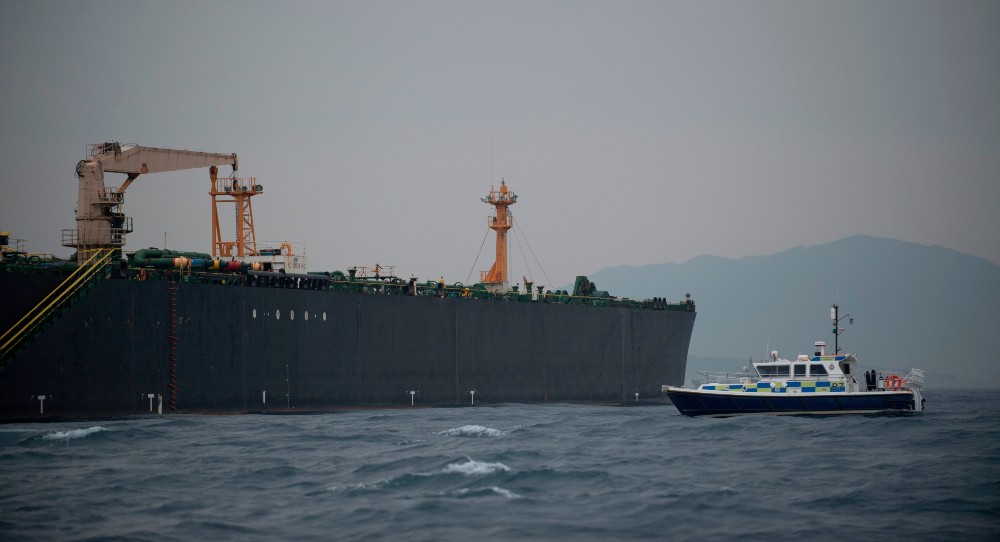
Summer vacations that close down Europe are almost a thing of the past. The recent standoff between the UK and Iran is a case in point. London was immersed in the contest to succeed Theresa May as Conservative leader and UK prime minister when, much to the delight of U.S. President Donald Trump’s administration, British forces on July 4 seized an Iranian tanker that was allegedly carrying oil to Syria in breach of U.S. sanctions. In retaliation, two weeks later, Iran seized a British-flagged tanker in the Strait of Hormuz.
This is not a simple bilateral spat between London and Tehran. It is a dispute that has exposed three weaknesses in British, European, and transatlantic policies. It is hard to see the UK’s new prime minister, Boris Johnson, or the new European Commission president, Ursula von der Leyen, capable of overcoming these weaknesses.The first is Britain’s delusions about Brexit. Too often, Johnson has said his country would be far better off outside the EU. Yet on July 22, outgoing UK Foreign Secretary Jeremy Hunt asked the Europeans (not the Americans or NATO) to lead a new maritime alliance to protect shipping in the Strait of Hormuz. How ironic—and a day before Johnson, who has promised to take Britain out of the EU with or without a deal, was elected by Conservative Party members to succeed May.
The British plea betrayed panic and a lack of strategic planning. Panic, because the UK has only one frigate in the Persian Gulf, and it is soon to be relieved. Hunt said Britain could not escort every vessel. He failed to mention that decades of deep cuts in the defense budget have decimated Britain’s armed forces.
The second weakness is the EU’s lack of strategic foresight. Recent incidents in the Gulf, including attacks on two oil tankers in the region, Iran’s shooting down of a U.S. drone, and Iran’s seizure of the British-flagged tanker, should have provided sufficient reasons for Brussels and London to protect the vital shipping and commercial lanes. They didn’t—even though they also know that one fifth of the world’s oil supply is transported through the Strait of Hormuz.
With few exceptions, including France and Denmark, Europe’s naval strength and strategic awareness have proved inadequate when it comes to protecting Europe’s economic and commercial interests. The dispute between London and Tehran confirms these shortcomings.
Britain’s weakness is likely to continue. Brexit will distance the country from the rest of Europe. The UK’s defense establishment will try to maintain as close as possible a relationship with France, but that’s going to demand a commitment by London to invest in the armed forces. And French President Emmanuel Macron, who is trying to revamp his defense forces, which had undergone cuts, needs more European coalitions of the willing to deal with Mali and the wider Sahel. It didn’t need the latest Iranian crisis to confirm that no one country in Europe can go it alone, or that so few countries are strategically prepared.
The third weakness concerns the United States, which can’t or doesn’t want to go it alone either. Trump’s national security adviser, John Bolton, is itching for some sort of conflict with Iran. Washington’s decision to walk away from the 2015 international deal on Iran’s nuclear program, its very close relationship with Israel, and its decision to impose new sanctions on Iran have put enormous strain on the transatlantic relationship. But Washington still needs allies to give it cover and legitimacy.
Those allies, however, are in a quandary. Despite Britain’s so-called special relationship with the United States, London still supports the Iran deal. Moreover, it does not want to be dragged by Washington into a war with Iran. No wonder Hunt was desperate to seek some diplomatic and security coverage from the UK’s European allies. But Britain and the EU are woefully unprepared to protect the Strait of Hormuz and politically not strong enough to save the nuclear deal.
These three issues—Britain’s weakness and preoccupation with Brexit, Europe’s lack of strategic foresight and defense capabilities, and a transatlantic relationship struggling to find common ground—will dominate von der Leyen’s foreign policy agenda when she takes office in November. Iran’s geostrategic influence and power have yet to be played out on the diplomatic, military, and economic fronts. A turbulent fall beckons.
*Dear Friends and Colleagues:
The Strategic Europe blog is taking its annual vacation. It will be offline from July 29 through to August 19. In the meantime, I want to thank you for all your wonderful support and wish you a very restful summer. ~Judy Dempsey

Nonresident Senior Fellow, Carnegie Europe
Judy Dempsey is a nonresident senior fellow at Carnegie Europe
Recent Work
Judy Dempsey
Judy Dempsey
Carnegie does not take institutional positions on public policy issues; the views represented herein are those of the author(s) and do not necessarily reflect the views of Carnegie, its staff, or its trustees.

Russia is testing the waters of NATO’s mutual defense clause. What do strikes in Romanian territorial waters mean for the alliance’s posture toward Moscow?

Dimitar Bechev

With its public finances in shambles, the far right polling at 35 percent ahead of the 2027 presidential election, and a growing protest movement, is France’s crisis a threat to the EU’s geopolitical awakening?

Rym Momtaz, ed.

Ahead of a tough winter for Ukraine, Donald Trump’s swing back toward Russia bodes ill. But instead of panicking, Kyiv’s European allies are focusing on action.
Rym Momtaz

While the EU and European governments are embracing the much-lauded middle-power moment, this entails three difficult conundrums.

Richard Youngs

Much has been said of the changes Brussels is trying to make to the EU enlargement process. Here’s why gradual integration might—or might not—be the answer.
Dimitar Bechev