

Commentary
Marc Pierini
{
  "authors": [
    "Marc Pierini"
  ],
  "type": "commentary",
  "blog": "Strategic Europe",
  "centerAffiliationAll": "",
  "centers": [
    "Carnegie Endowment for International Peace",
    "Carnegie Europe"
  ],
  "collections": [
    "Turkey’s Transformation",
    "Transatlantic Cooperation",
    "Europe’s Southern Neighborhood"
  ],
  "englishNewsletterAll": "",
  "nonEnglishNewsletterAll": "",
  "primaryCenter": "Carnegie Europe",
  "programAffiliation": "",
  "programs": [],
  "projects": [],
  "regions": [
    "Middle East",
    "Russia",
    "Europe",
    "North Africa",
    "Libya",
    "Southern, Eastern, and Western Africa",
    "Türkiye"
  ],
  "topics": [
    "Foreign Policy",
    "Security",
    "EU"
  ]
}
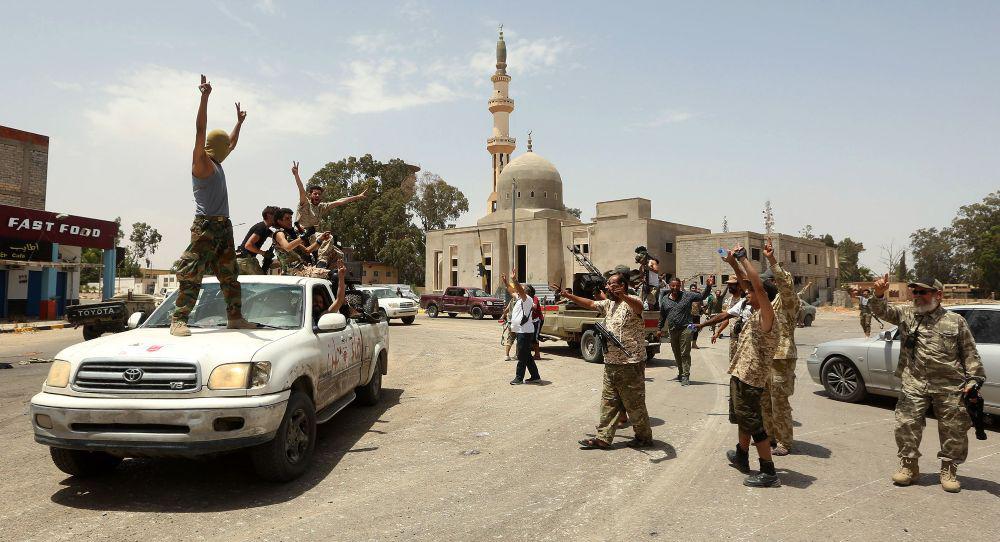
Source: Getty
EU leaders must either decide to act jointly as the European Union or leave Libya’s future in the hands of Russia and Turkey—with dangerous consequences for NATO and for Europe’s security.
The deadlock in Libya continues.
Over the past few years, international diplomatic efforts have failed to stop the fighting between the Government of National Accord (GNA) led by Prime Minister Fayez al-Sarraj in Tripoli and the forces supporting General Khalifa Haftar in the east of the country.
Today, foreign interventions are mostly those of Turkey in the west, supporting the GNA, and Russia, which supports Haftar and has drawn a line in the sand in the country’s center to stop the GNA’s advance. Egypt, another supporter of Haftar, has stated its willingness to defend its interests but hasn’t sent troops on Libyan soil.Russia’s support to Haftar is not new. It is part of a multipronged strategy in the Mediterranean basin aimed at reinforcing its military footprint, investing in energy resources, and being politically present in the EU’s neighborhood.
It involves using private military forces, such as the Wagner Group and Syrian militias, but also dispatching air force assets from its Hmeimim base in Syria, a stepping-stone facility conceived for the entire Middle East and North Africa—not just for the Syrian war.
Turkey’s military presence stems from multiple motivations and follows a November 2019 double deal with the GNA redefining the Turkish-Libyan maritime borders in the Eastern Mediterranean and putting in place a security cooperation agreement.
In geopolitical terms, this deal can be seen as a unilateral step taken by Ankara at a time when the GNA and its capital, Tripoli, were under extreme pressure from Haftar’s troops. Turkey’s military actions have rescued the GNA with substantial military supplies—including armed drones and short-range missiles—advisers, and Syrian militias. This operation, comparable to Russia rescuing the regime of Syrian President Bashar al-Assad from the brink of collapse in September 2015, is meant to bring tangible benefits to Ankara.
Irrespective of these recent developments, Libya still matters immensely for Europe.
With its 1,800-kilometer Mediterranean coastline and 4,000-kilometer land borders with Algeria, Chad, Egypt, Niger, Sudan, and Tunisia, Libya represents a huge land mass. It has traditionally hosted many European and American oil and gas operators as well as solid business interests, especially Italian (a gas pipeline runs between Melittah and Sicily).
During Colonel Muammar Qaddafi’s rule, well-equipped human trafficking networks were channeling irregular migrants from western and central Africa to the western Libyan coast and onward to Italy. On and off, Qaddafi used these networks to pressure Italy and the EU. Trafficking never stopped during the Libyan civil war, which began in 2011, and could increase massively at any time, depending on the political control—firm or loose—exerted on the traffickers.
A major novelty in the past few months has been the transfer by Russia and Turkey of several thousand jihadists from the Syrian Idlib province to Libya to be used as proxy fighters on both sides of the conflict. Even if peace is established in the future in Libya, these fighters could become a vector of terrorist activity against Europe, Algeria, Egypt, Tunisia, or the Sahel countries. In all cases, European and American security interests would be endangered.
A permanent use of air and naval bases in Libya by both Russia and Turkey would be a major game changer for Western Europe’s security and would have implications for NATO and the United States as well.
The al-Watiya air base, Misrata’s port, and Sirte—which has a port as well as Libya’s largest air base—are all located more or less halfway between Syria and Gibraltar and a mere 600–700 kilometers south of the Italian Sigonella air base in Sicily, which hosts several U.S. activities related to Southeastern Europe and the Mediterranean.
Despite such major stakes, most commentators see the European Union as marginalized, impotent, and disunited in its approach to Libya.
Indeed, the Lisbon Treaty’s first decade resulted in modest EU foreign policy achievements, whether in Ukraine (Crimea and Donbas), Iran, or Syria. Foreign affairs policymaking was moved to the level of the European Council, while a few states—especially the largest ones—have often acted on their own.
Questions abound: Confronted with such major stakes, will EU leaders wake up and decide to act jointly as the European Union, or will they be satisfied to leave Libya’s future in the hands of Russia and Turkey? Will the lessons of Russia’s annexation of Crimea or military footprint in Syria since 2015 be learned? Will it be considered innocuous for Europe’s security if Turkey undertakes a permanent military operation in Libya along the lines of its Syrian operations?
Will Russia and Turkey’s combined challenge to EU interests be ignored?
In case the EU wakes up, European leaders can immediately take three steps:
The three-pronged EU institutional leadership (European Council President Charles Michel, European Commission President Ursula Von der Leyen, and High Representative for Foreign Affairs and Security Policy Josep Borrell) should be at the center of this process, as a means to guarantee that EU interests are fully considered and that the EU toolbox is used in a comprehensive manner—including military, economic, trade, and financial tools; assistance to refugees; border protection; sanctions; and linkage with other issues in the Eastern Mediterranean.
These ideas may sound like old-fashioned wishful thinking. Yet, Libyan stakeholders and third parties may be inclined to listen more intently to an EU-wide position than to discordant voices from Berlin, Paris, and Rome.
A strong EU initiative on Libya could underpin German Chancellor Angela Merkel’s third priority for the German EU presidency: strengthening Europe’s ability to act beyond its borders. And not before time.

Senior Fellow, Carnegie Europe
Marc Pierini is a senior fellow at Carnegie Europe, where his research focuses on developments in the Middle East and Turkey from a European perspective.
Recent Work
Marc Pierini
Marc Pierini
Carnegie does not take institutional positions on public policy issues; the views represented herein are those of the author(s) and do not necessarily reflect the views of Carnegie, its staff, or its trustees.

While the EU and European governments are embracing the much-lauded middle-power moment, this entails three difficult conundrums.

Richard Youngs

Much has been said of the changes Brussels is trying to make to the EU enlargement process. Here’s why gradual integration might—or might not—be the answer.

Dimitar Bechev

The European Commissioner for Trade is headed to China. But after President Xi’s bridge-building visit to Washington, can a more isolated EU overcome Beijing’s stranglehold on critical raw materials? Who will blink first?

Rym Momtaz, ed.

The domestic impacts of how long it is taking to end the war in Ukraine have pushed the French electorate to the political extremes and compromised the country’s diplomatic capacity.
Rym Momtaz

Before the next wave of EU enlargement takes place, the union needs to grapple with thorny questions of how power is distributed among its members.


Emil Sondaj Hansen, Ditte Brasso Sørensen