

Commentary
Judy Dempsey
{
  "authors": [
    "Judy Dempsey"
  ],
  "type": "commentary",
  "blog": "Strategic Europe",
  "centerAffiliationAll": "",
  "centers": [
    "Carnegie Endowment for International Peace",
    "Carnegie Europe"
  ],
  "collections": [
    "Europe’s Eastern Neighborhood"
  ],
  "englishNewsletterAll": "",
  "nonEnglishNewsletterAll": "",
  "primaryCenter": "Carnegie Europe",
  "programAffiliation": "",
  "programs": [],
  "projects": [],
  "regions": [
    "Europe",
    "Eastern Europe",
    "Western Europe",
    "Belarus"
  ],
  "topics": [
    "EU",
    "Democracy"
  ]
}
Source: Getty
The European Union’s commitment to democratic values are close to shatters as Cyprus and the European People’s Party contribute to keeping autocratic or corrupt leaders in power.
They couldn’t be more different.
Belarus skirts the European Union’s north-eastern border. For twenty-six years, this country of 9.4 million inhabitants has been ruled by President Alexander Lukashenko. His autocratic style has exuded invincibility. He has skillfully played off Russia against the EU with the aim of guarding Belarus’s ambiguous sovereignty.
In the south-east of Europe, bordering the Black Sea, is Bulgaria. This country of 6.9 million is a member of NATO and the EU. It enjoys all the privileges of belonging to both organizations, receiving security guarantees and generous financial support.
Yet, for all these geopolitical and economic differences, the citizens of both countries have been protesting against their leaders.In Belarus, tens of thousands of people have taken to the streets each Sunday since the presidential election on August 9, 2020. They feel cheated by an election they insist was rigged. They want Lukashenko to resign. They want fair and free elections. They want democracy and freedom.
Despite the violence by the Belarusian security forces who have detained probably thousands of men and women by this stage, the people of Belarus have not given up. Individuals from every walk of life are bravely demonstrating peacefully for their rights.
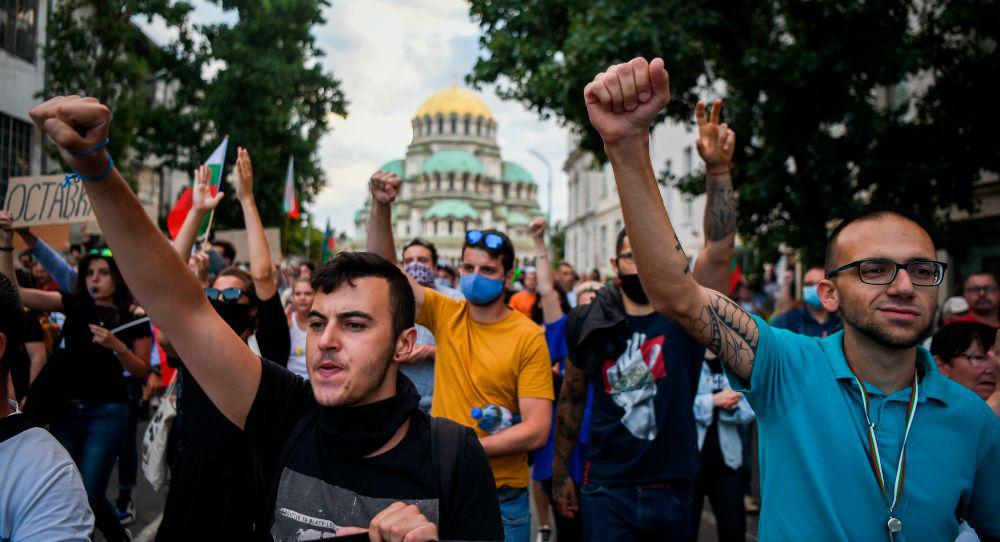
In Bulgaria, protestors have taken to the streets for over seventy days. They have had enough of the corruption and the style of leadership exercised by Prime Minister Boyko Borisov, the leader of several center-right governments since 2009. They want him to resign and hold new parliamentary elections instead of waiting until the planned election in March 2021.
One would have assumed that, in the case of Belarus, the EU would have reacted to the violence, beatings, and expulsions of leading opposition figures by quickly slapping sanctions on Lukashenko, other leading regime figures, and the security forces.
As for Bulgaria, a strong and united stance by all the EU institutions against corruption and the alleged money laundering might have sent a signal to the Borisov government.
Instead, in the case of both countries, the protestors have become hostage to special interest groups inside the EU. The upshot is that the bloc’s commitment to democratic values and freedom in Belarus and the upholding of the rule of law in Bulgaria have been thrown to the wind.
Cyprus, a country that joined the EU in 2004 but has since then repeatedly held the bloc hostage over a number of issues, was true to form on September 21. It again blocked attempts by EU foreign ministers to impose sanctions on Lukashenko and others involved in suppressing the demonstrations in Belarus.
“Today’s failure to agree on sanctions in support of Belarusians, suffering & fighting for democracy, undermine credibility of democratic values they are fighting for,” tweeted Linas Linkevicius, the indefatigable foreign minister of Lithuania and staunch defender of Belarus’s citizens. “Some colleagues should not link things that must not be linked,” he added.
Cyprus argues that the EU should impose sanctions on Turkey after Ankara has attempted to extend its drilling rights in the Eastern Mediterranean, which would affect Greek islands in the Aegean Sea, besides changing existing legal maritime boundaries.
“Our reaction to any kind of violation of our core basic values and principles cannot be à la carte. It needs to be consistent,” said Cypriot Foreign Minister Nikos Christodoulides.
Borisov is being left off the hook too.
Members of the European Parliament sent a list of questions to Borisov about corruption, allegations of money laundering, and misuse of EU funds. So far, except for dismissing his justice minister, Borisov is hanging on. The European Commission, which over the years has been monitoring Bulgaria’s attempts to reform the judiciary and end corruption, mildly rebuked the government’s attempts to end the protests by force.
Borisov’s political future could change if the European People’s Party (EPP), the European umbrella for center-right parties and movements, spoke out against corruption. But it’s not in its character to do so.
The EPP continues to turn a blind eye to Hungarian Prime Minister Viktor Orbán, whose Fidesz party is in the EPP and who has run roughshod over independent civil society organizations and ended the independence of several academic institutions and news media by either closing them down or bringing them under Fidesz’s control. And the EPP is taking a soft line on Bulgaria too.
“The EPP will have to make a choice and take a position over the scandals,” said Daniel Smilov, program director at the Centre for Liberal Strategies in Sofia.
But the group sees no reason to criticize Borisov. “For the moment we don’t have any sign that he is involved in corruption,” said Pedro López de Pablo, the EPP’s head of communications. “It’s a big campaign against Borisov. This is a country divided between the left and the right. There are some problems in the judicial system in all these countries,” he added.
Other Bulgarian analysts take a different view. “People are fed up with the persistent corruption,” said Radosveta Vassileva, lawyer and social advocate. “The transformation of the country [since 1989] never went deep.”
It is that transformation—based on democratic values—that the citizens of Belarus are attempting to begin and the citizens of Bulgaria are trying to complete. It couldn’t be clearer to the EU what’s at stake.

Nonresident Senior Fellow, Carnegie Europe
Judy Dempsey is a nonresident senior fellow at Carnegie Europe
Recent Work
Judy Dempsey
Judy Dempsey
Carnegie does not take institutional positions on public policy issues; the views represented herein are those of the author(s) and do not necessarily reflect the views of Carnegie, its staff, or its trustees.

The EU can impose sanctions but struggles to enforce them without the United States. With Washington increasingly disinterested in backing European interests, the bloc must now fend for itself.


Nicu Popescu, Tiago Antunes

Russia is testing the waters of NATO’s mutual defense clause. What do strikes in Romanian territorial waters mean for the alliance’s posture toward Moscow?

Dimitar Bechev

With its public finances in shambles, the far right polling at 35 percent ahead of the 2027 presidential election, and a growing protest movement, is France’s crisis a threat to the EU’s geopolitical awakening?

Rym Momtaz, ed.

Ahead of a tough winter for Ukraine, Donald Trump’s swing back toward Russia bodes ill. But instead of panicking, Kyiv’s European allies are focusing on action.
Rym Momtaz

While the EU and European governments are embracing the much-lauded middle-power moment, this entails three difficult conundrums.

Richard Youngs