

Report
- +9
Richard Youngs, Erik Jones, Dan Baer, …
{
  "authors": [
    "Rosa Balfour"
  ],
  "type": "commentary",
  "blog": "Strategic Europe",
  "centerAffiliationAll": "",
  "centers": [
    "Carnegie Endowment for International Peace",
    "Carnegie Europe"
  ],
  "collections": [
    "Transatlantic Cooperation"
  ],
  "englishNewsletterAll": "",
  "nonEnglishNewsletterAll": "",
  "primaryCenter": "Carnegie Europe",
  "programAffiliation": "",
  "programs": [],
  "projects": [],
  "regions": [
    "Europe",
    "North America",
    "United States",
    "Western Europe"
  ],
  "topics": [
    "Foreign Policy",
    "Security",
    "EU"
  ]
}
Source: Getty
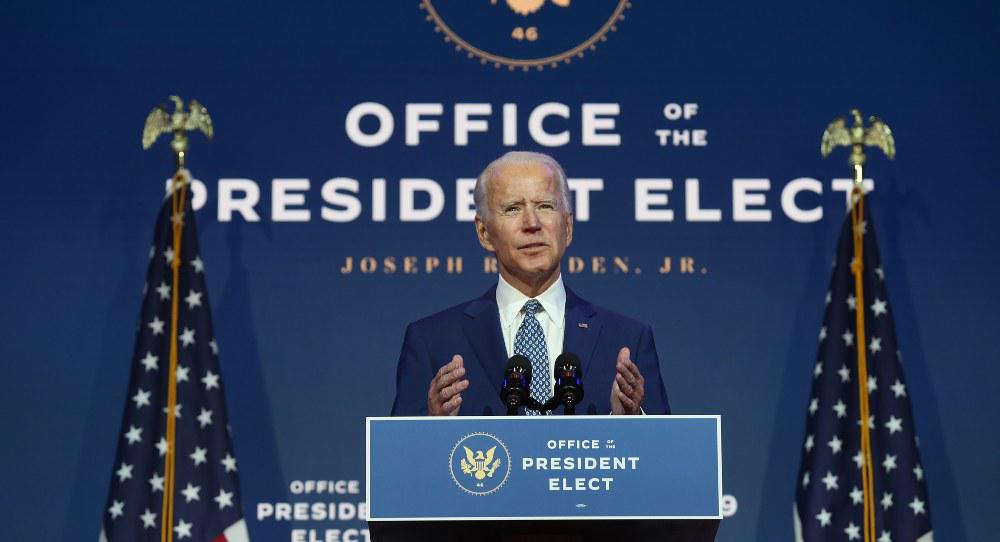
Joe Biden will be America’s next president, but relieved European leaders are deluded if they expect a return to the past for the transatlantic relationship.
Commenting on the jubilant celebrations that spilt into American cities upon the announcement on November 7, 2020, of Joe Biden winning the U.S. presidential election, activist and political commentator Van Jones spoke on CNN of the politics of joy.
The politics of anger has been such a defining feature of the past four years that imagining a politics of joy seems a revolutionary act.
The stream of congratulatory messages from European leaders betrayed just how deep the relief and how heartfelt the joy at America’s choice was. “Friendship,” “togetherness,” and “partnership” made their comeback as words marking the relationship between Europe and the United States.The joy and hope also betrayed high expectations and wishful thinking that EU-U.S. cooperation can be picked up where it left in 2016, when Donald Trump was elected U.S. president; “welcome back” and “rebuilding” also featured in the messages to U.S. President-elect Joe Biden, alongside recognition of the extraordinary achievement of U.S. Vice President–elect Kamala Harris.
Those who still hope for a return to the past will be disappointed. Biden perhaps will finally get this message across. However transatlantic his instincts, healing America’s deep divides while dealing with China will distract him from Europe’s woes.
The world too is changing. The relationship between the European Union and the United States remains unique—the deepest and strongest for both sides. But growing multipolarity requires investing on relations with a growing number of partners and allies.
Lazy transatlanticism in Europe has been an impediment to taking on more global responsibilities. Foreign and security policy circles and the think tank community in Europe have long enjoyed discussing the EU’s international role. When the abstract debate turns to politics, it gets stuck over whether more Europe means less transatlanticism—or vice versa.
There is, of course, no either-or; just a need for a more meaningful dialogue. And in these past four years, the EU has still done too little to match its ambition for “strategic autonomy” compatibly with the partnership with NATO.
The rhetoric is banal: the time to turn words into deeds has long come.
There are low-hanging fruits that the EU can focus on to demonstrate its willingness to step up to its call. The United States can help rein in some of the actors disrupting European security, such as Turkey’s ventures in the Eastern Mediterranean, but the EU will need to craft the response to protect its vital interests and sovereignty. Washington can call the bluff of leaders in the Balkans playing off Russia and China against the EU, but it is the EU that needs to provide a credible plan to end disputes in the region.
These are just two of the many close-to-home crises where the EU can no longer afford to underperform.
An early visit to Europe by the incoming Biden administration would signal America’s commitment to NATO and to its allies. The long list of areas where Europe and the United States can work better together is already there and includes the coronavirus pandemic, the climate crisis, and cooperation in multilateral institutions.
But this is just the beginning of a long road ahead. Behind Europe’s lazy transatlanticism, there is a host of issues where Europeans and Americans do not see eye to eye, from technology to dealing with China. These require an honest dialogue and confidence building to prevent scarring the relationship, at a minimum.
Looking forward, the bigger picture would warrant even greater ambition. The uniqueness of the transatlantic relationship is in the degree to which formidable challenges are shared.
As the climate crisis rages, both Europe and the United States will struggle with a pandemic-induced recession that will challenge the domestic organization of their economies as well as the conceptual underpinnings of the global economy. Hyper-globalization is questioned, with a green economy becoming the new demand of progressive politics.
Europe and the United States will both need to deal with world turmoil, the relative decline of their global power and influence while disruptive geopolitical actors undermine stability and cooperation, and a fraying international system.
The pandemic also risks overturning the achievements in reducing poverty in the lower-income countries, calling for a commitment of the richest to address global inequality. International institutions will receive a boost from Biden’s intention to return to the Paris Agreement on climate change, remain in the World Health Organization, and end the United States’ disruption of the World Trade Organization—but far more reform will be needed to save multilateralism.
Finally, Europe and the United States will need to focus on domestic democratic reform to protect their societies from the rise of authoritarianism and populism. The mobilization of 71.5 million Trump supporters in the 2020 election proves that the president’s defeat is not the end of Trumpism. Europe too has its own smaller-sized variants of populists who are long haunting democracy and the EU’s ability to act on the world stage.
Anyone still believing that the past four years were a parenthesis or aberration ought to think again. To fireproof our societies and the transatlantic relationship from another degeneration, the EU and the United States need to pursue ambitious reform, domestically and internationally. Now is the opportunity to do so side by side.
This blog is part of the Transatlantic Relations in Review series. Carnegie Europe is grateful to the U.S. Mission to the EU for its support.

Director, Carnegie Europe
Rosa Balfour is the director of Carnegie Europe. Her fields of expertise include European politics, institutions, and foreign and security policy.
Recent Work



Richard Youngs, Erik Jones, Dan Baer, …
Rosa Balfour
Carnegie does not take institutional positions on public policy issues; the views represented herein are those of the author(s) and do not necessarily reflect the views of Carnegie, its staff, or its trustees.

With its public finances in shambles, the far right polling at 35 percent ahead of the 2027 presidential election, and a growing protest movement, is France’s crisis a threat to the EU’s geopolitical awakening?

Rym Momtaz, ed.

Ahead of a tough winter for Ukraine, Donald Trump’s swing back toward Russia bodes ill. But instead of panicking, Kyiv’s European allies are focusing on action.
Rym Momtaz

While the EU and European governments are embracing the much-lauded middle-power moment, this entails three difficult conundrums.
Richard Youngs

Much has been said of the changes Brussels is trying to make to the EU enlargement process. Here’s why gradual integration might—or might not—be the answer.

Dimitar Bechev

The European Commissioner for Trade is headed to China. But after President Xi’s bridge-building visit to Washington, can a more isolated EU overcome Beijing’s stranglehold on critical raw materials? Who will blink first?
Rym Momtaz, ed.