

Commentary
With its public finances in shambles, the far right polling at 35 percent ahead of the 2027 presidential election, and a growing protest movement, is France’s crisis a threat to the EU’s geopolitical awakening?
Rym Momtaz, ed.
{
  "authors": [
    "David Cadier"
  ],
  "type": "commentary",
  "blog": "Strategic Europe",
  "centerAffiliationAll": "",
  "centers": [
    "Carnegie Endowment for International Peace",
    "Carnegie Europe"
  ],
  "collections": [
    "Europe’s Eastern Neighborhood"
  ],
  "englishNewsletterAll": "",
  "nonEnglishNewsletterAll": "",
  "primaryCenter": "Carnegie Europe",
  "programAffiliation": "",
  "programs": [],
  "projects": [],
  "regions": [
    "Russia",
    "Europe",
    "Eastern Europe",
    "Western Europe",
    "France"
  ],
  "topics": [
    "Foreign Policy",
    "Economy",
    "Political Reform",
    "Climate Change",
    "EU",
    "Security"
  ]
}
Source: Getty
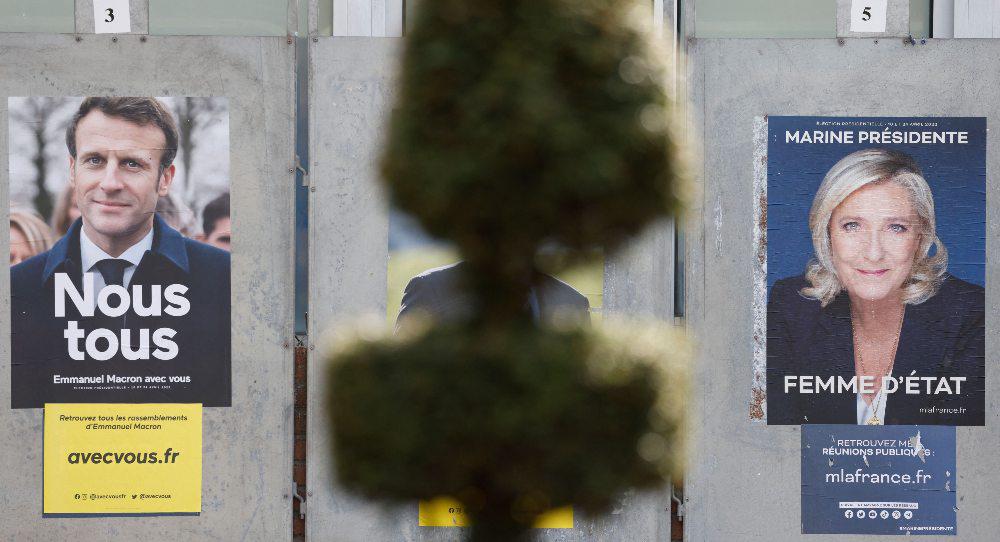
Contrary to expectations, the Russian invasion of Ukraine has not weakened Marine Le Pen’s electoral position. Nevertheless, the political context in which France’s Russia policy will be formulated has changed.
In France, as in any other European country, Russia’s war on Ukraine has been dominating the news and has shocked the public opinion.
In a poll from early April, 87 percent of French voters declared themselves “worried” by the war, while in another from mid-March about a third indicated that it will have an impact on their choice in the presidential election. The results of the first round provide initial indications as to the direction of this impact.
Initially, many expected that the geopolitical situation would benefit the president in office. Emmanuel Macron’s presidential stature and experience is seen as reassuring in anxiety-inducing times. A majority of the electorate—59 percent—regard him as being “up to the task” in dealing with this crisis, while the same cannot be said about the other candidates. Besides, several—such as far right’s Marine Le Pen and Éric Zemmour or far left’s Jean-Luc Mélenchon—had harbored pro-Russian positions in the past.
Yet, while Macron did obtain a relatively high score, so did Le Pen, who will face him in the second round on April 24. She was thus seemingly not affected by Russia’s war in Ukraine, despite her long-standing political, ideological, and financial proximity with the Kremlin.
This is probably explained by the fact that voters rarely cast their ballots based on foreign policy considerations. But it might also be linked to evolving perceptions about the war in Ukraine: while it stands among French voters’ top three current preoccupations, it is not the first—purchasing power is—and its salience has actually decreased in the past weeks. More crucially, the electorate’s worries about the war now seem to pertain more to its economic consequences than to risks of continental or nuclear escalation.
In this context, Le Pen has accused Macron of being absorbed by the high spheres of diplomacy while neglecting the situation of the French people. She has attempted to position herself as the purchasing power candidate and appear less radical and contentious. The contrast with the other far-right candidate, Zemmour, helped her soften her image, including on Ukraine. While Le Pen has opposed delivering weapons to Ukraine, Zemmour has opposed welcoming Ukrainian refugees.
If not voting patterns, the war has certainly affected how the candidates have attacked each other. This sheds light on the political context in which the next French president will be formulating his or her foreign policy.
Compilations of Le Pen’s—and Zemmour’s and Mélenchon’s—past statements on Russia have widely circulated during the campaign. Le Pen has done contortions to condemn the war, though without fundamentally altering her foreign policy vision and proposals. In her program, she still pledges to forge an “alliance” with Russia on European security matters once the war is over.
Conversely, Macron has not been attacked on Russia by any of its opponents, which a Le Monde editorial described as “curious.” After all, he is the incumbent, so there would be a record to potentially criticize. In addition, his past and current efforts aimed at maintaining a political dialogue with Russia have faced criticism in many European quarters since 2019.
If Macron has not been attacked on his Russia initiative, it is for two primary reasons.
First, it conveniently triangulated his political adversaries. In the 2017 campaign, François Hollande’s foreign policy record was attacked by all the other major candidates: François Fillon, Le Pen, and Mélenchon all charged him with having subserviently followed the United States, NATO, and the EU on the 2014 Ukraine crisis, and with having failed to established a dialogue with Moscow over Syria. In other words, they were accusing Hollande of doing away with France’s Gaullist foreign policy tradition.
By contrast, with his Russia initiative, Macron paid rhetorical tribute to the Gaullist imaginary yet without altering in any way France’s position within the EU or NATO—for example on sanctions or Eastern flank deployments.
In sum, while in 2017 we had oppositional candidates charging the incumbent with being anti-Russian, in 2022 we have the incumbent attacking the oppositional candidates for being pro-Russian.
Second, Macron has not been attacked on his Russia initiative because, regardless of the several distorted accounts in the French and foreign press, it was never a pivot or reset, let alone an embrace of Putin. Macron’s firm response to the Russian invasion has proven that. Rather, his posture toward Moscow was an attempt at diplomacy—not in the sense of mundane conversation, but of delivering tough messages, scrutinizing the other’s mindset, and attempting deescalation. It has not been successful in influencing Russia’s foreign policy behavior—what has, recently?—but still had to be attempted.
If he is reelected, Macron is likely to maintain the position of a firm, collective European response and of keeping a line of communication open with Moscow.
If Le Pen wins, France’s foreign policy toward Russia will be affected, but not overturned. Her room for manoeuver will be constrained by the fact that over the past months, the geopolitical context, the domestic political debate, and the stance of the public opinion have changed.
David Cadier is an assistant professor of European politics at the University of Groningen and an adjunct lecturer at Sciences Po.

David Cadier
University of Groningen
David Cadier is an assistant professor of international relations teaching at the University of Groningen, Sciences Po, and the College of Europe.
Carnegie does not take institutional positions on public policy issues; the views represented herein are those of the author(s) and do not necessarily reflect the views of Carnegie, its staff, or its trustees.

With its public finances in shambles, the far right polling at 35 percent ahead of the 2027 presidential election, and a growing protest movement, is France’s crisis a threat to the EU’s geopolitical awakening?

Rym Momtaz, ed.

Ahead of a tough winter for Ukraine, Donald Trump’s swing back toward Russia bodes ill. But instead of panicking, Kyiv’s European allies are focusing on action.
Rym Momtaz

While the EU and European governments are embracing the much-lauded middle-power moment, this entails three difficult conundrums.

Richard Youngs

Much has been said of the changes Brussels is trying to make to the EU enlargement process. Here’s why gradual integration might—or might not—be the answer.

Dimitar Bechev

The European Commissioner for Trade is headed to China. But after President Xi’s bridge-building visit to Washington, can a more isolated EU overcome Beijing’s stranglehold on critical raw materials? Who will blink first?
Rym Momtaz, ed.