

Commentary
Thomas de Waal
{
  "authors": [
    "Thomas de Waal"
  ],
  "type": "commentary",
  "blog": "Strategic Europe",
  "centerAffiliationAll": "",
  "centers": [
    "Carnegie Endowment for International Peace",
    "Carnegie Europe"
  ],
  "collections": [
    "Europe’s Eastern Neighborhood",
    "EU Integration and Enlargement",
    "Aso Tavitian Initiative"
  ],
  "englishNewsletterAll": "",
  "nonEnglishNewsletterAll": "",
  "primaryCenter": "Carnegie Europe",
  "programAffiliation": "",
  "programs": [],
  "projects": [],
  "regions": [
    "Russia",
    "Europe",
    "Eastern Europe",
    "Western Europe",
    "Moldova"
  ],
  "topics": [
    "Security",
    "Economy",
    "EU",
    "Climate Change"
  ]
}
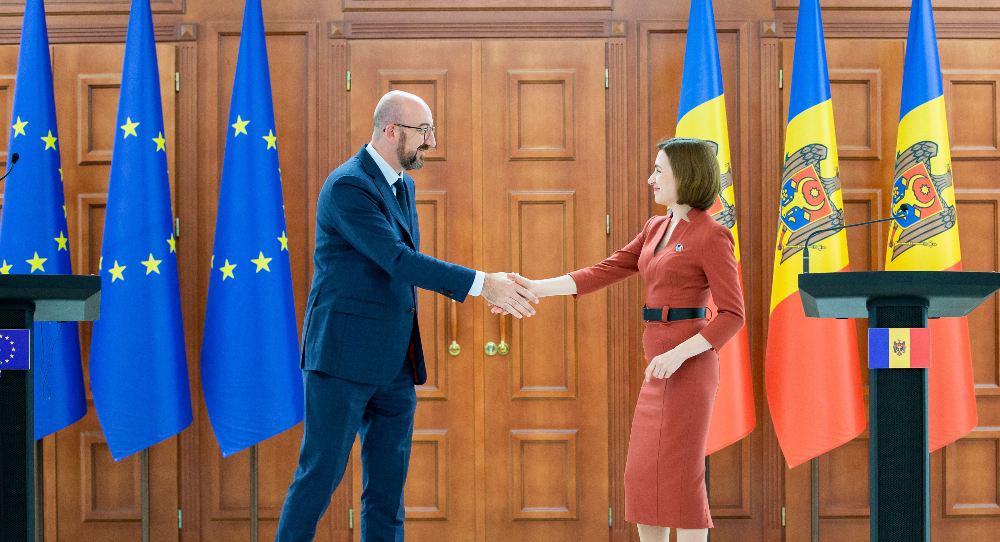
Source: Getty
Precariously located at the edge of the war in Ukraine, Moldova is thus far coping with Russian security threats. But the conflict’s socioeconomic fallout poses real dangers.
Moldova is in the news. A stream of high-level visitors, the latest being United Nations Secretary General António Guterres, have made their way to Chisinau in recent days.
The country deserves all the international attention it can get. It’s a small, poor country precariously located at the edge of Russia’s war with Ukraine. Since February 24 it’s had to cope with the influx of 450,000 Ukrainian refugees, 95,000 of whom have stayed.
Everyone agrees that Moldova is vulnerable and its admirable pro-European government—which officially applied for EU membership in March—needs support, but there’s much less clarity about what it requires most. After talking to various Moldovans over the last week, I concluded that there is a risk of overstating the military threat the country faces from Russia and underestimating the economic one.
The Russian military threat should never be fully discounted. On April 22 a senior general, Rustam Minnekaev, talked almost casually about Russia occupying southern Ukraine and forcing a “road out” to the breakaway region of Transdniestria, where he said, falsely, that Russian speakers faced persecution.
But this is a case where the Russian leadership’s imperial ambitions far outstrip its capacities—currently at least. The British embassy in Chisinau said last week, “we have no reason to believe that the Republic of Moldova is in imminent danger of military aggression.” A move against Transdniestria is only possible if the Russians were to manage to capture Odessa—hardly likely when the Russian army can barely advance in eastern Ukraine.
A second theoretical danger is of a flare-up of the conflict over Transdniestria, the Russophone separatist region on the eastern side of the Dniester river. Alone among the territorial disputes that broke out with the end of the USSR, Transdniestria has lived up to the term “frozen conflict.” There has been almost no violence since the war there ended thirty years ago, but the last month has seen an upsurge of violent incidents, with a series of mysterious explosions and attacks on infrastructure—mercifully without any casualties.
Both Chisinau and Tiraspol have used diplomatic channels to damp down tension. Ironically, the Moldovans have had to calm down some impetuous officials in Kyiv, who used much more inflammatory language about Transdniestria than they do, reiterating that they only seek a peaceful resolution of the conflict.
President Maia Sandu told the Economist, “We are trying to do our best to keep the country out of the war,” and that Moldova remains constitutionally neutral. Transdniestria’s de facto president Vadim Krasnoselsky has also been pacific. He said on May 6 that he still seeks recognition of Transdniestria’s independence but only by peaceful means through dialogue, adding that “no one needs war.”
Transdniestria’s military threat to Moldova is much less than meets the eye. Almost all the 1,500 soldiers there designated as “Russian” are in fact locals with Russian passports. The more than 7,000 “armed forces” in the territory outnumbers the much smaller Moldovan army on paper but it is mainly a part-time defense force.
Transdniestria’s (fairly open) secret is that most of its population of around 400,000 people—including those soldiers—now hold Moldovan passports and make use of Moldova’s visa-free travel to the EU. Many also have Ukrainian passports. The region is still closely politically and culturally affiliated with Russia, but in both its economy and geography its destiny lies with Moldova and Europe. The EU has played its cards well here, by incorporating Transdniestria into its Deep and Comprehensive Free Trade Area regime with Moldova. Last year 54 percent of its exports went to the EU and only 14 percent to Russia.
If the security threats are being handled well, Moldova’s domestic politics is still volatile and political polarization is still strong. The former governing party, the Socialists, led by former president Igor Dodon, is obviously seeking to exploit the current situation to its advantage. Dodon pointedly wore the St George’s ribbon—a Russian Victory Day symbol blessed by Vladimir Putin, which was banned by the Moldovan government—on a May 9 parade in Chisinau. Again, fortunately, confrontation was avoided.
Surely, the biggest issues that Moldova now has to deal with are economic. Bordering southern Ukraine, it suffers badly from Russia’s blockade of the Black Sea coast and of Ukraine’s biggest port, Odessa. Remittance payments are down, the country is struggling with refugees and the IMF says it is worried that the government is so “overburdened” by crisis management it will be diverted from the most vital piece of its reform agenda, the fight to root out systemic corruption.
The Transdniestria issue can’t be separated from this economic headache, as the two parts of Moldova, though politically disconnected, are economically a single, if dysfunctional, whole. Right-bank Moldova currently gets most of its electricity from a power plant in Transdniestria powered by Russian gas. In fact, Transdniestria’s business model relies on gas that it gets for free or almost nothing from Gazprom. It’s not a pretty situation but one that is hard to disentangle in the short term.
So if long-term economic assistance to Moldova is a strong EU priority, then some of the aid should go to Transdniestria as well. That means aid that helps to deepen the region’s integration with the rest of Moldova, facilitate a gradual transition away from reliance on Russian gas, and stave off the further impoverishment of what already qualifies as Europe’s poorest country.
To put it another way, Moldova (and of course Ukraine, too) could yet survive the war but still lose the peace as it slowly sinks under the weight of the socioeconomic problems the war has caused. It’s a scenario that needs planning against now.

Senior Fellow, Carnegie Europe
Thomas de Waal is a senior fellow at Carnegie Europe, specializing in Eastern Europe and the Caucasus.
Recent Work
Thomas de Waal
Thomas de Waal
Carnegie does not take institutional positions on public policy issues; the views represented herein are those of the author(s) and do not necessarily reflect the views of Carnegie, its staff, or its trustees.

The European Commissioner for Trade is headed to China. But after President Xi’s bridge-building visit to Washington, can a more isolated EU overcome Beijing’s stranglehold on critical raw materials? Who will blink first?

Rym Momtaz, ed.

The domestic impacts of how long it is taking to end the war in Ukraine have pushed the French electorate to the political extremes and compromised the country’s diplomatic capacity.
Rym Momtaz

Before the next wave of EU enlargement takes place, the union needs to grapple with thorny questions of how power is distributed among its members.


Emil Sondaj Hansen, Ditte Brasso Sørensen

A summer of escalation in the Black Sea has hurt Ukraine economically and is exacerbating world food security. A truce is needed—as is a broader reframing of Europe’s Ukraine strategy.
Thomas de Waal

Are Germany’s economic, industrial, and political struggles becoming a liability for the EU’s ability to rise to the geopolitical moment?
Rym Momtaz, ed.