

Commentary
Judy Dempsey
{
  "authors": [
    "Judy Dempsey"
  ],
  "type": "commentary",
  "blog": "Strategic Europe",
  "centerAffiliationAll": "",
  "centers": [
    "Carnegie Endowment for International Peace",
    "Carnegie Europe"
  ],
  "collections": [
    "Europe’s Eastern Neighborhood",
    "EU Integration and Enlargement"
  ],
  "englishNewsletterAll": "",
  "nonEnglishNewsletterAll": "",
  "primaryCenter": "Carnegie Europe",
  "programAffiliation": "",
  "programs": [],
  "projects": [],
  "regions": [
    "Europe",
    "Eastern Europe",
    "Western Europe"
  ],
  "topics": [
    "Foreign Policy",
    "EU",
    "Democracy",
    "Political Reform"
  ]
}
Source: Getty
The EU needs to plan now for a new policy toward its Eastern neighbors. It cannot wait for Russia to end its destruction of Ukraine or destabilize other countries in the region.
The approaching Europe Day provides a good opportunity to reflect on the future direction of the EU. It is needed. The war in Ukraine is changing Europe, even if some governments don’t want to recognize the upheaval that is taking place inside and outside the bloc.
Several changes are happening in ways that challenge how the EU functions.
The first is the eclipse of the Monnet process that set in train what is today’s EU. Briefly, this was a method based on the political integration and democratization of the EU that was anchored on the reconciliation between France and Germany after World War Two.
Over the years it has become technocratic and bureaucratic. Wrangling among the member states has marginalized strategic thinking and decisiveness. The destruction of Ukraine and Europe’s response to Russia’s aggression requires European leaders to develop a new mindset.
Second, the age of innocence about Russia is over—at least for several EU member states. Leaving aside Germany’s continuing ambiguity about Russia and lack of leadership under Chancellor Olaf Scholz, this shift is changing the EU’s center of gravity. Until recently, it was fixed on the Franco-German tandem. This is no longer a given.
In its place, France and Poland are taking center stage in a Europe where the Baltic and Central European countries—with the exception of Hungary—are finding their place in the bloc.
President Emmanuel Macron, fresh from his reelection, is now well placed to assume the leadership of the EU. Some Central European governments may balk at that role given Macron’s determination to keep some dialogue open with President Vladimir Putin. But Paris alone cannot change the EU. Together with Warsaw, they could shape a new agenda for Europe.
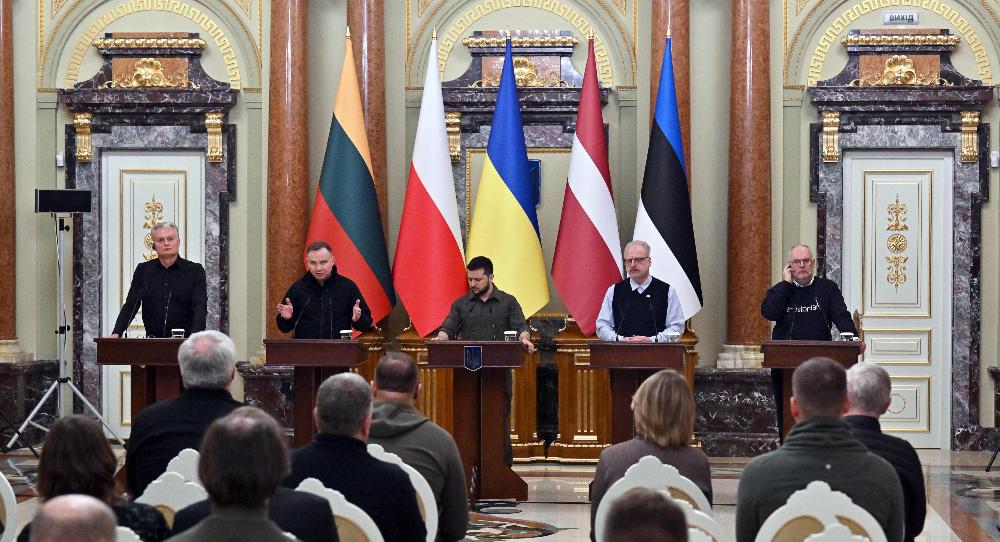
Poland, with the Baltic states, Slovakia, and the Czech Republic, could assume a special responsibility for revamping the EU’s relationship with Eastern Europe. These EU member states understand the difficulties of making the transition to democracy—and the Russian threat.
Furthermore, their empathy for Eastern Europe should be capitalized on, particularly since the war in Ukraine has made the EU’s Eastern Partnership almost obsolete. It is going to require immense political will and strategic imagination to integrate Eastern Europe as much as possible into EU structures.
The EU already has trade and visa liberalization accords with Moldova, Georgia, and Ukraine. But integration needs to be deeper and more systematic. While these countries have recently applied to join the EU—and since several member states are less than lukewarm about the idea (notably Germany)—much more can be done, whatever happens to their applications.
For example, why not give these countries a special status in the EU’s Political and Security Committee (PSC), even limited voting rights? As Russia’s war in Ukraine has shown, these countries are in desperate need of acquiring the tools of security, police training, and participating in EU crisis management missions.
Not only that. Their geographical proximity to Russia, their historical experiences, and the complexities of the transforming their societies would change the nature of the threat perception and security needs inside the EU itself.
As it is, Russia’s relentless destruction of Ukrainian cities and towns, has helped forge a common threat perception among most European governments. Eastern Europe’s participation in the PSC would sharpen and widen that perception. After all, these are countries that are highly vulnerable to Russia’s political ambitions, cyberattacks, and energy blackmail. The EU needs to understand the nature of the threat Eastern Europe faces, the security they need, and how instability in the region affects the stability of the bloc.
A third key issue is the role of the diaspora coupled with the ensuing brain drain. Both are robbing not only EU member states, especially the Baltic states and Central Europe, but also Eastern Europe of talent, not to mention the impact on demography.
To counter such trends, the EU could create a model influenced by the Erasmus program that has given so many young people across Europe the chance to study abroad.
In practice, why not find ways to persuade the diaspora to return home? That’s not an easy task, given low salaries, poor working conditions, corruption, and weak governance in the EU’s Eastern neighborhood. But if these countries are to strengthen the rule of law, create a middle class, and set up strong democratic institutions, they are going to need their own citizens to help build a civil service, build a health system, and build a vibrant civil society.
So what about the European Commission finding ways to finance the return of young, motivated, and well-educated individuals to their countries? Erasmus in reverse.
This wishlist may be seen unrealistic or even opposed by some member states. But this is about the EU recognizing that Russia’s war in Ukraine requires a new mindset to replace an anachronistic status quo. Waiting is not an option.

Nonresident Senior Fellow, Carnegie Europe
Judy Dempsey is a nonresident senior fellow at Carnegie Europe
Recent Work
Judy Dempsey
Judy Dempsey
Carnegie does not take institutional positions on public policy issues; the views represented herein are those of the author(s) and do not necessarily reflect the views of Carnegie, its staff, or its trustees.

Before the next wave of EU enlargement takes place, the union needs to grapple with thorny questions of how power is distributed among its members.


Emil Sondaj Hansen, Ditte Brasso Sørensen

A summer of escalation in the Black Sea has hurt Ukraine economically and is exacerbating world food security. A truce is needed—as is a broader reframing of Europe’s Ukraine strategy.

Thomas de Waal

Are Germany’s economic, industrial, and political struggles becoming a liability for the EU’s ability to rise to the geopolitical moment?

Rym Momtaz, ed.

European Commission President Ursula von der Leyen is about to give her annual address on the state of the EU. Here’s what she won’t—but should—say.
Rym Momtaz

The aftermath of the Ceuta crisis shows Europe has drawn the wrong lessons. Rather than doubling down on failed migration policies, the EU needs to address the underlying roots of such episodes.

Richard Youngs