

Commentary
Marc Pierini
{
  "authors": [
    "Marc Pierini"
  ],
  "type": "commentary",
  "blog": "Strategic Europe",
  "centerAffiliationAll": "",
  "centers": [
    "Carnegie Endowment for International Peace",
    "Carnegie Europe"
  ],
  "collections": [],
  "englishNewsletterAll": "",
  "nonEnglishNewsletterAll": "",
  "primaryCenter": "Carnegie Europe",
  "programAffiliation": "",
  "programs": [],
  "projects": [],
  "regions": [
    "Russia",
    "Türkiye",
    "Middle East",
    "Eastern Europe"
  ],
  "topics": [
    "Security",
    "Economy",
    "Climate Change",
    "Foreign Policy"
  ]
}
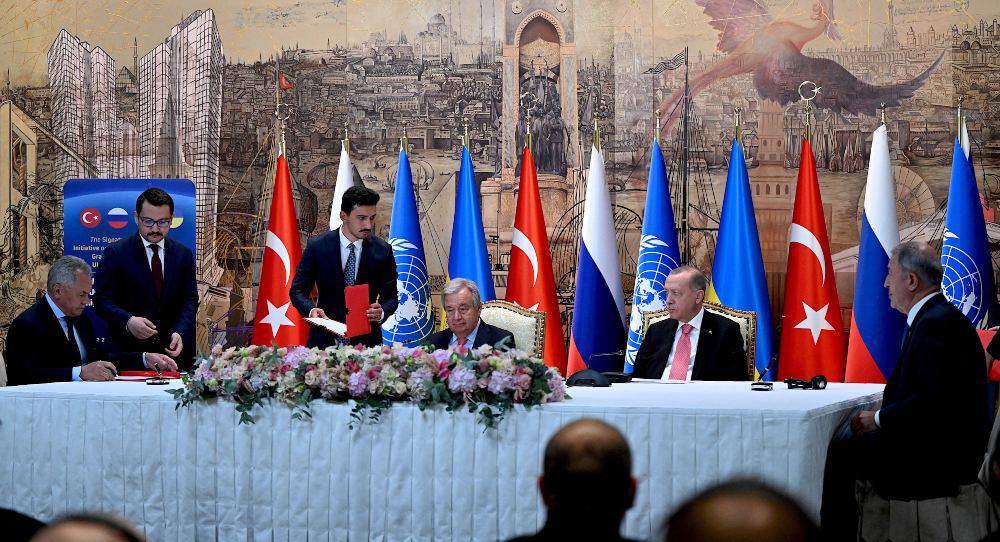
Source: Getty
Both Moscow and Ankara are benefiting from Turkey’s mediating role since Russia’s invasion of Ukraine. Strategically, however, Putin has the upper hand.
Since Russia’s invasion of Ukraine, Turkey has been pursuing a “balanced approach” to Moscow and Kyiv and is playing a key role in several ways.
It has condemned the invasion and closed the Turkish Straits. It is facilitating a dialogue between the belligerent parties. And it has nurtured and monitored a deal on grain exports together with the UN.
Turkey’s role is welcome as such in the tragic circumstances. Yet, such a balancing act is a costly gamble, not only for Ankara but for the international community as well.
President Recep Tayyip Erdoğan has spared no effort in trying to play a go-between when it comes to Russia and Ukraine: phone calls, visits, facilitation of meetings, grain deal negotiations—including running the deal’s monitoring center in Istanbul and naval escorts for the grain-carrying vessels.
A carefully crafted communication policy projects a positive image of the president’s role, which in turn is expected to help on the domestic political scene ahead of the June 2023 presidential and legislative elections. Even if Turkey’s efforts are somewhat inflated for domestic purposes, Western capitals take the view that every bit of goodwill is welcome and therefore praise Ankara’s efforts.
There are, however, two other angles to this diplomatic choreography: Turkey has considerable economic motives behind its peace efforts and Russia seeks important strategic gains for itself.
The added benefits of Turkey’s diplomatic efforts are noteworthy. For one, the fees for commercial vessels transiting through the Turkish Straits have just increased fivefold as maritime traffic is picking up again.
The number of Russian expatriates in Turkey, as well as their real estate investments and financial transfers to Turkish banks, have grown substantially. Furthermore, there is a suspicion that Russia is trying to circumvent some of the effects of Western sanctions via Turkey, in particular through the acquisition of stakes in Turkish oil businesses, as joint companies help to blur oil trade.
More importantly, Ukrainian experts have claimed that some of the cereals exported via the grain deal were actually stolen from Ukrainian facilities in the occupied Donbas region. Although hard to document, such dissimulation would not be a major surprise in the realm of international commercial sanctions.
Similarly, Turkey is trying hard to maintain and develop its relationship with the Ukrainian military industry, including through the continued sales and resupply of Bayraktar drones, with the ultimate goal of procuring aircraft engines from the Ukrainian aerospace industry for its own needs. Despite the risk of drawing the Kremlin’s ire, such a relationship is indispensable for the development of Turkey’s drone industry, which is currently more advanced than Europe’s.
Even more importantly, Turkey has entered a financial relationship with Russia.
Given the country’s dire economic situation, aggravated by an absurd interest rate policy, Ankara has been trying hard to secure financial facilities or currency swap agreements with partners such as China, Qatar, Saudi Arabia, and the United Arab Emirates.
Now, according to Bloomberg, a financial deal linked to the construction by Russia of the Akkuyu nuclear-powered electricity plant has resulted in a $15 billion advanced payment from the Russia nuclear operator Rosatom in order for its Turkish partner company to directly procure critical equipment for the plant construction and thus avoid possible sanctions. The hard currency influx over the next two-year period is a much welcome short-term improvement in the country’s depleted reserves.
Russia’s own benefits are not insignificant either.
First, the grain deal engineered by Turkey and the UN secretary general conveys the image of a conciliatory attitude on the part of Russia, when there were never any sanctions on food exports from Russia or occupied Ukrainian territory. The deal also involves Russian authorities in a multipartite monitoring mechanism located in Istanbul, therefore alleviating the perception of a diplomatically isolated Russia.
Second, the Rosatom financial arrangement is a not-so-secret way for Russia to implement a very difficult industrial deal with Turkey while avoiding predictable sanctions on critical equipment. By the same token, it provides Erdoğan with a much welcome financial breather—an exceptional gesture with potential electoral benefits for the incumbent president.
Third, by denying Ankara its green light for a new military operation in northeastern Syria, the Kremlin has obliged it to enter into a discrete dialogue with the Assad regime—whereas Erdoğan was so far voicing a firm opposition to Bashar al-Assad and even advocating for his removal from power.
Finally, and perhaps most importantly, by keeping Erdoğan on his side (despite multiple political and military disagreements), Russian President Vladimir Putin is consolidating his 2009 achievement, the delivery of S-400 missile systems to Turkey, which is driving a wedge among NATO partners.
The Kremlin’s policy is highly pragmatic: knowing that Turkey’s partners in NATO are keen to keep it in the North Atlantic Alliance and Ankara has every interest in staying within NATO, Putin’s goal remains anchoring Erdoğan more and more to Russia through a vast mesh of mutually beneficial operations in the fields of defense, energy, trade, and finance.
By doing this, Putin is comforting an embattled incumbent president and is openly bolstering Erdoğan’s position in the upcoming elections. More than the Turkish president abandoning his traditional Western partners, the world is witnessing the Russian president using Turkey for his own benefits.

Senior Fellow, Carnegie Europe
Marc Pierini is a senior fellow at Carnegie Europe, where his research focuses on developments in the Middle East and Turkey from a European perspective.
Recent Work
Marc Pierini
Marc Pierini
Carnegie does not take institutional positions on public policy issues; the views represented herein are those of the author(s) and do not necessarily reflect the views of Carnegie, its staff, or its trustees.
European leaders have now not only lost faith in Donald Trump’s U.S. presidency, but also in America’s hegemony as a whole. But short-term challenges make an immediate divorce unwise.

Rym Momtaz
Europe has an interest in supporting Armenian leader Nikol Pashinyan as he tries to make peace with neighbors and loosen ties with Russia. But it is depersonalized support in the long term, not quickfire flash, that will win the day.

Thomas de Waal
Following Ursula von der Leyen’s gaffe equating Turkey to Russia and China, relations with Ankara risk deteriorating even further. Without better, more consistent diplomatic messaging, how can the EU pretend to be a geopolitical power?

Sinan Ülgen
Closer EU-UK ties could help address urgent European concerns. But is the EU ready for rapprochement with the United Kingdom?
Rym Momtaz, ed.
Europe has been standing by while its Southern neighborhood is being redrawn by force. To establish a path to peace between Israel and Lebanon, it’s time for Europeans to get involved with hard power.
Rym Momtaz