

Commentary
The European Commissioner for Trade is headed to China. But after President Xi’s bridge-building visit to Washington, can a more isolated EU overcome Beijing’s stranglehold on critical raw materials? Who will blink first?
Rym Momtaz, ed.
{
  "authors": [
    "Kateryna Pishchikova"
  ],
  "type": "commentary",
  "blog": "Strategic Europe",
  "centerAffiliationAll": "",
  "centers": [
    "Carnegie Endowment for International Peace",
    "Carnegie Europe"
  ],
  "collections": [
    "Europe’s Eastern Neighborhood"
  ],
  "englishNewsletterAll": "",
  "nonEnglishNewsletterAll": "",
  "primaryCenter": "Carnegie Europe",
  "programAffiliation": "",
  "programs": [],
  "projects": [],
  "regions": [
    "Russia",
    "Europe",
    "Eastern Europe",
    "Ukraine"
  ],
  "topics": [
    "Foreign Policy",
    "Security",
    "Economy",
    "EU",
    "Climate Change"
  ]
}
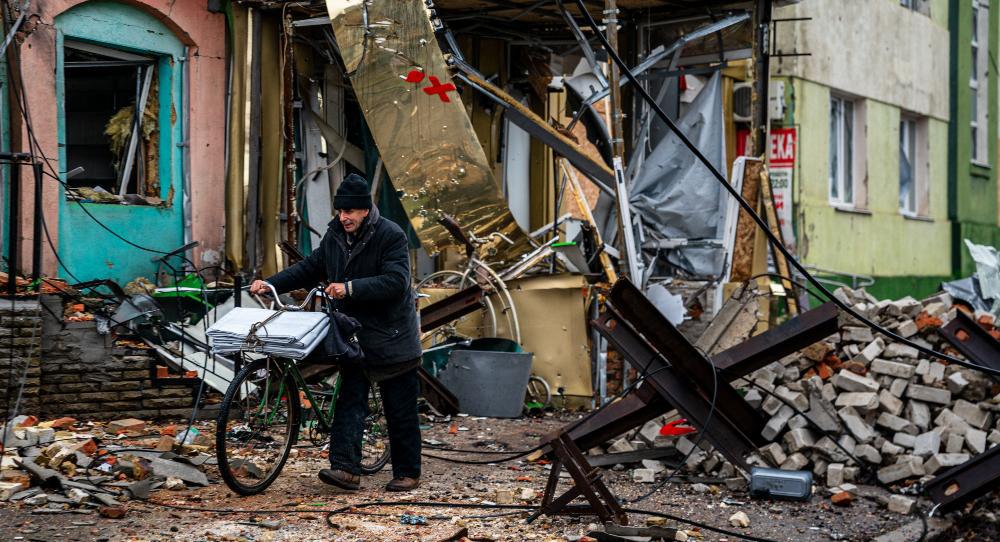
Source: Getty
As Russia’s brutal attack continues, it is becoming increasingly clear that the war will have no winners. The West must do more to help Ukraine end the human suffering, attain a just peace, and preserve its sovereignty.
Early in the war, one photo became quite popular. It was of a placard from a pro-Ukraine poster that read: “If Russia stops fighting, there will be no war. If Ukraine stops fighting, there will be no Ukraine.”
Almost a year later, this still holds true. It is also increasingly clear that there will be no winners in this war and that Ukraine’s future is ever more fragile.
After its initial plans for a blitzkrieg failed in March 2022, Russia shifted its strategy. A devastating war of attrition with indiscriminate bombings and violence against civilians became one of its key tactics.
Ukrainian counteroffensives in early September marked the beginning of an escalation phase, in which Russian attacks on the Ukrainian civilian population and infrastructure intensified, including through the use of Iran-supplied drones.
The amount of pain and damage that Russia can inflict on Ukraine, even during periods of military stalemate, at a relatively low cost and from a relatively safe distance is shocking.
According to several United Nations (UN) reports, the war toll on Ukraine by the end of last year was humongous: around 18,000 civilian casualties, up to 40 percent of total housing damaged, and 50 percent of Ukraine’s energy infrastructure destroyed or damaged.
About 16 million Ukrainians have had to leave their homes and up to 18 million people, or 40 percent of Ukraine’s population, will need some sort of humanitarian aid in the coming months.
According to the World Bank estimates, Ukraine’s economy contracted by 35 percent in 2022, and as many as 60 percent of Ukrainians are expected to end up below the poverty line. Massive destruction of industrial assets and heavy fighting produced disastrous levels of air, soil, and water pollution as well as damage to ecosystems and loss of biodiversity.
Ukraine’s resistance and its ability to use effectively all the military and intelligence support it gets helped compensate for a much smaller size of its military compared to Russia’s.
It has become clear that Russia can only win this war militarily through colossal military escalation. Many analysts believe it is preparing one for the coming spring. In the meantime, it will most likely continue to inflict damage on Ukraine.
Since Ukraine is readying itself to mount further resistance, the war may turn even more bloody. External pressure on Russia is a double-edged sword: it may convince the Kremlin to negotiate as much as it may raise the stakes and in turn Putin’s willingness to bet more and to employ more violent tactics.
Should the Kremlin judge further escalation too costly, it may still see greater benefit in a protracted quagmire than in a negotiated peace settlement.
Russian rhetoric as well as the way it has been fortifying its positions in the occupied territories show it has not diverted from its stated goal of subjugating Ukraine one way or another.
In a war so brutal and so prolonged there are no winners. The costs are unbearably high for both societies and the traumas, though hardly comparable, will have a lasting impact.
In so many ways, Russia has already lost. Whatever victory it hopes to claim, the costs will most likely outweigh the gains.
Yet, Russia’s defeat does not necessarily denote Ukraine’s victory. A savage and protracted war will destroy Ukraine that is losing its vast resources on a daily basis: its infrastructure, its vibrant, creative and diverse society, its industrial base, its natural and agricultural resources.
“Victory” is a political project. It is a narrative that pits the costs and the suffering against the hope for a better future. When Ukrainians talk about winning this war, they talk about their survival as a sovereign nation, a nation that is free to build its own future, as has been so eloquently argued by the Nobel Peace Prize laureate Oleksandra Matviichuk in her acceptance lecture.
Behind this inspiring narrative, however, there are impossible dilemmas. How to reconcile the responsibility to protect human life with the imperative to safeguard Ukraine’s statehood? At what point does resistance become suicide? What kind of compromise for the sake of peace may betray those who died to defend Ukraine’s sovereignty and Ukraine’s right to justice? What kind of sovereignty is possible in a case of compromised territorial integrity? What are the pillars for long-term security and how do we not lose sight of those in the fog of war today?
It is imperative to help Ukraine survive this winter and prepare for the likely new Russian offensive in the spring.
The collective West can and should do more in helping Ukraine define its own terms of victory, the terms that square the circle of stopping human suffering, attaining a just peace, and securing Ukraine’s survival as a sovereign nation.
Kateryna Pishchikova is an associate research fellow at the Istituto per gli Studi di Politica Internazionale (ISPI) and an associate professor of political science and international relations at the eCampus University in Italy.

Kateryna Pishchikova
ISPI
Kateryna Pishchikova is an associate research fellow at the Istituto per gli Studi di Politica Internazionale (ISPI) and an associate professor of political science and international relations at the eCampus University in Italy.
Carnegie does not take institutional positions on public policy issues; the views represented herein are those of the author(s) and do not necessarily reflect the views of Carnegie, its staff, or its trustees.

The European Commissioner for Trade is headed to China. But after President Xi’s bridge-building visit to Washington, can a more isolated EU overcome Beijing’s stranglehold on critical raw materials? Who will blink first?

Rym Momtaz, ed.

The domestic impacts of how long it is taking to end the war in Ukraine have pushed the French electorate to the political extremes and compromised the country’s diplomatic capacity.
Rym Momtaz

Before the next wave of EU enlargement takes place, the union needs to grapple with thorny questions of how power is distributed among its members.


Emil Sondaj Hansen, Ditte Brasso Sørensen

A summer of escalation in the Black Sea has hurt Ukraine economically and is exacerbating world food security. A truce is needed—as is a broader reframing of Europe’s Ukraine strategy.

Thomas de Waal

Are Germany’s economic, industrial, and political struggles becoming a liability for the EU’s ability to rise to the geopolitical moment?
Rym Momtaz, ed.