

Commentary
Marc Pierini
{
  "authors": [
    "Marc Pierini"
  ],
  "type": "commentary",
  "blog": "Strategic Europe",
  "centerAffiliationAll": "",
  "centers": [
    "Carnegie Endowment for International Peace",
    "Carnegie Europe"
  ],
  "collections": [
    "Turkey’s Transformation"
  ],
  "englishNewsletterAll": "",
  "nonEnglishNewsletterAll": "",
  "primaryCenter": "Carnegie Europe",
  "programAffiliation": "",
  "programs": [],
  "projects": [],
  "regions": [
    "Middle East",
    "Europe",
    "Türkiye",
    "Syria",
    "Western Europe"
  ],
  "topics": [
    "Foreign Policy",
    "EU",
    "Security"
  ]
}
Source: Getty
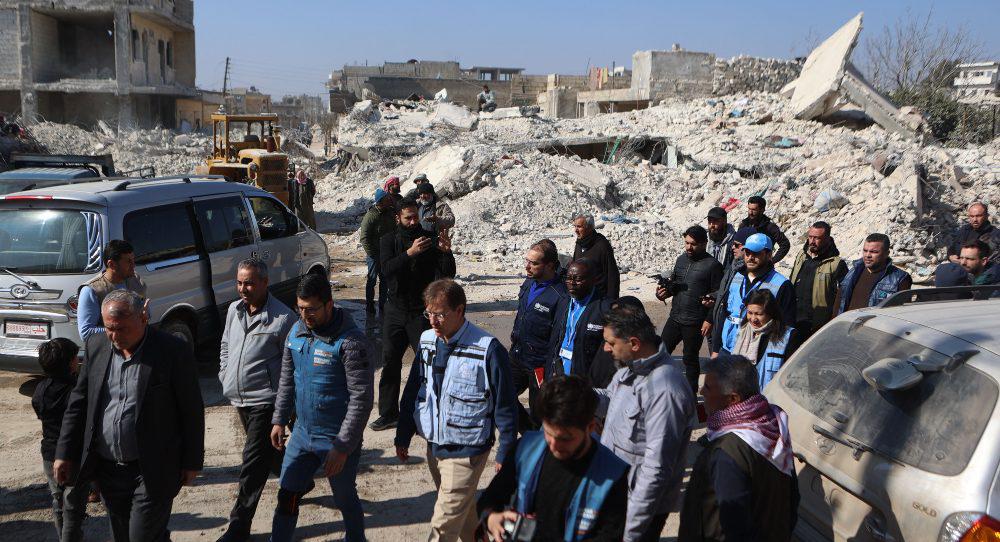
Ahead of the EU-led donors’ conference, the political ambitions of Syrian and Turkish leaders extend far beyond humanitarian aid. Western governments must tread a fine line between human solidarity and rough politics.
Merely a day after the earthquake, Ursula von der Leyen, president of the European Commission, and Ulf Kristersson, prime minister of Sweden, took the unexpected initiative to “host a Donors’ Conference (…) in support [of] the people of Türkiye and Syria.” The European Council endorsed the invitation. EU leaders should now make good on their promise without legitimizing Syria’s regime, nor giving an implicit acquiescence to Türkiye’s leadership amid a highly controversial election process.
In the wake of such an exceptional tragedy, visits at the political level have predictably taken place: no less than one head of state (Qatar), five foreign ministers (Armenia, Germany, Greece, Israel, and the United States), two European commissioners, two members of the European Parliament, NATO’s secretary general, and UN agencies’ leaders have toured Türkiye. Official visits to Syria, mostly comprised of UN officials, were far fewer.
Beyond solidarity, such visits elicit political appetites from these countries’ leaderships. With the upcoming donors’ conference, at least three questions arise, and they have no simple answers.
The guest list comes first. The conference will be technical in nature, and chaired by European Commissioner for Neighbourhood and Enlargement Olivér Várhelyi and Swedish Minister for International Development Cooperation and Foreign Trade Johan Forssell, who visited Türkiye this week. Apart from UN agencies and major international donors, a Turkish minister will be invited. Contacts with Syria being already strictly limited to humanitarian issues, the situation will not be different at the conference. Russia will not be invited due to its war on Ukraine and the ensuing sanctions. Internationally recognized non-governmental organizations (NGOs) already involved in the emergency phase must be invited, as well as NGOs specializing in urban planning and architecture, and municipal authorities in the affected regions.
Neutrality with regard to the Turkish elections is major imperative for the EU. Ankara will want donors to bless its plans for “reconstruction within one year,” an unrealistic but highly political objective announced by the country’s President Recep Tayyip Erdoğan. This is unlikely and would create immense resentment among Türkiye’s population. Yet, billions in aid will likely be presented as a triumph for Türkiye’s incumbent president. Given the uncertainties around when Türkiye’s elections will take place—the leadership has given conflicting signals—Western leaders should stay clear of politics.
Furthermore, some EU leaders could be tempted to see the conference as an opportunity to convince Türkiye to lift its opposition to Sweden’s accession to NATO, but this would on the contrary provide Ankara with an opportunity to raise the stakes once more. There is no reason to mix NATO’s enlargement with post-earthquake rehabilitation.
The second question revolves around priorities for action, with the customary debate between humanitarian, rehabilitation, and reconstruction projects.
An indicative list of priority needs should include: a controlled disposal of earthquake rubble in order to avoid massive long-term pollution of soils and underground waters by construction materials such as asbestos, chemicals, or cement; urban planning taking into account fault lines and anti-seismic norms, including strict control procedures for construction material and building permits; the rehabilitation of utilities such as water and sewage, electricity, transport and communications, and of social services such as schools, hospitals, civil registry, and sanitation; and finally, temporary housing projects and distribution of basic household equipment.
The continuation of support for Syrian refugees in Türkiye and for internally-displaced people (IDPs) in northern Syria is a particularly acute issue, given the stated willingness of a majority of Turkish political forces to send refugees back to Syria and the Syrian goal of regaining control of northern regions despite the absence of an agreed-upon framework for ending the civil war. The donors’ conference must not result in any reduction in support for Syrian refugees and IDPs. Currently, three border posts are open to international humanitarian convoys from Türkiye to northern Syria: this achievement must be guaranteed for one full year.
Finally, the third question relates to the framing of the conference’s outcome. Given the prevailing situation, the conference will hardly be able to adopt formal conclusions of a political nature. At best, it will result in a list of pledges addressing the needs outlined by the inviting parties in an initial concept note. In the follow-up, each donor will implement its pledge according to its operational procedures and, most probably, its political preferences.
There is little doubt that Gulf countries will have no qualms about channelling billions worth of aid to Syria’s Bashar al-Assad regime, and that Qatar will generously aid Türkiye. Western donors will help Syrian victims through the UN system and NGOs, and support Ankara through a variety of institutions, thus avoiding their commitments being channelled exclusively through the government. This means no blank checks or budgetary support, as strict financial and technical controls are imperative.
Predictably, Syrian and Turkish leaders will try to garner as many political benefits as possible while issues such as environmental and construction standards will likely be pushed aside. Damascus will want to create the impression that Syria has achieved political normalization, a goal opposite to that of Western countries.
In parallel with the conference, Syria will probably stress its view that Turkish forces currently present on its territory must depart and leave them in control of all borders, and hence reconstruction—a position supported by Russia. For the EU, support for affected people should remain the utmost priority, leaving no room for political quarrelling.
The European Commission and Sweden have issued a spectacular invitation. They must now remain focused on humanitarian issues.
Senior Fellow, Carnegie Europe
Marc Pierini is a senior fellow at Carnegie Europe, where his research focuses on developments in the Middle East and Turkey from a European perspective.
Recent Work
Marc Pierini
Marc Pierini
Carnegie does not take institutional positions on public policy issues; the views represented herein are those of the author(s) and do not necessarily reflect the views of Carnegie, its staff, or its trustees.
While the EU and European governments are embracing the much-lauded middle-power moment, this entails three difficult conundrums.
Richard Youngs
Much has been said of the changes Brussels is trying to make to the EU enlargement process. Here’s why gradual integration might—or might not—be the answer.

Dimitar Bechev
The European Commissioner for Trade is headed to China. But after President Xi’s bridge-building visit to Washington, can a more isolated EU overcome Beijing’s stranglehold on critical raw materials? Who will blink first?

Rym Momtaz, ed.
The domestic impacts of how long it is taking to end the war in Ukraine have pushed the French electorate to the political extremes and compromised the country’s diplomatic capacity.
Rym Momtaz
Before the next wave of EU enlargement takes place, the union needs to grapple with thorny questions of how power is distributed among its members.
Emil Sondaj Hansen, Ditte Brasso Sørensen