

Commentary
Judy Dempsey
{
  "authors": [
    "Judy Dempsey"
  ],
  "type": "commentary",
  "blog": "Strategic Europe",
  "centerAffiliationAll": "",
  "centers": [
    "Carnegie Endowment for International Peace",
    "Carnegie Europe"
  ],
  "collections": [
    "Transatlantic Cooperation",
    "EU Integration and Enlargement"
  ],
  "englishNewsletterAll": "",
  "nonEnglishNewsletterAll": "",
  "primaryCenter": "Carnegie Europe",
  "programAffiliation": "",
  "programs": [],
  "projects": [],
  "regions": [
    "Russia",
    "Europe",
    "North America",
    "Eastern Europe",
    "Ukraine"
  ],
  "topics": [
    "Foreign Policy",
    "Security",
    "Democracy",
    "EU"
  ]
}
Source: Getty
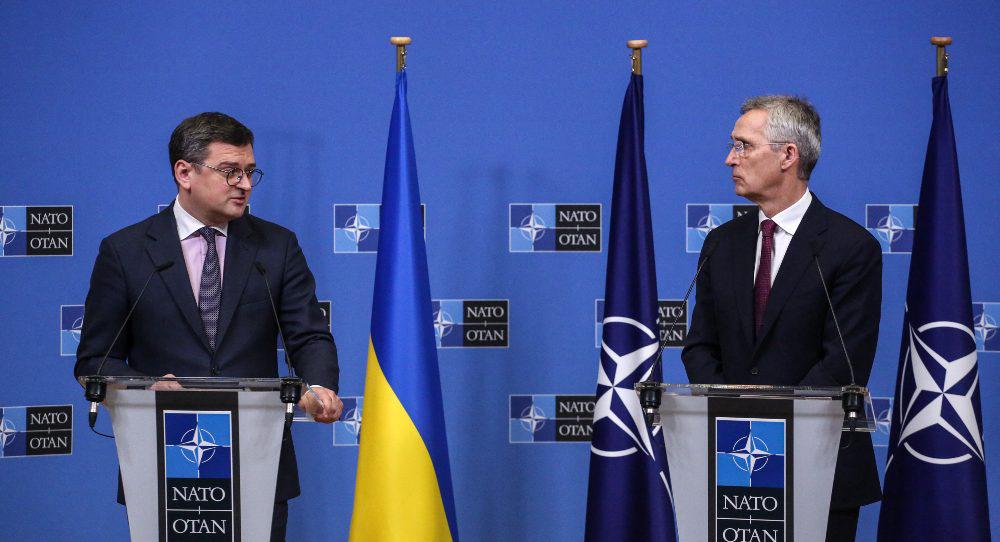
Russia’s war is about preventing Ukraine from completing its transition to modernity. The West can stop this by offering Kyiv a NATO membership road map at the approaching summit.
NATO will hold its annual summit this July in Vilnius. The location is important. Lithuania, along with its Baltic neighbors and Poland, has been a staunch supporter of Ukraine’s efforts to defeat Russia.
What happens during the summit will determine what the alliance is prepared to offer Ukraine. Whatever the result, any decision by the U.S.-led military organization will have a fundamental and long-lasting impact on Ukraine and the region.
Just as the European Union’s June 2022 move to grant Ukraine candidate status that would anchor it economically, socially, and politically to Europe, a decision by NATO to invite Ukraine to join the alliance would complement the EU’s offer. It would be one more element of strengthening the Euro-Atlantic architecture. It would be one more element in making Europe whole and free.
But more than that.
Without a comprehensive package of security measures and security guarantees offered by the West, Ukraine will not be able to complete its transformation to modernity. A country striving to build democracy needs security to underpin and protect such an immense and ambitious project.
That is why the summit in Lithuania is crucial for Ukraine’s future. It is about stopping Russia from stopping Ukraine from becoming a modern, open, and democratic country. If anything, Vladimir Putin’s war against the people of Ukraine is about Russia turning its back on modernity. It is a war that is de-modernizing Russia, and, in the process, trying to de-modernize Ukraine.
A step back is needed to put this modernization in context. Under the communist system, modernization was introduced at an extraordinary and often brutal pace. The middle classes and bourgeois structures were obliterated. The rural populations were in most cases radically uprooted and used to speed up the industrialization of their countries.
Over time, the Kremlin could use its vast resources of energy to finance this modernization, to finance its security and ventures abroad, and to finance the Cold War.
When the Soviet Union collapsed in 1991, the old form of modernization was not replaced despite attempts to introduce reforms. The latter failed for several reasons. One was that any economic reforms needed political reforms rooted in basic freedoms, the rule of law, and clear property rights.
Instead, under Putin, Russia continued to rely on energy and raw materials for economic growth while stifling politics. Even as the urgency to address the degradation of the climate, diversify away from fossil fuels and upgrade infrastructures became priorities for the EU in particular, Putin’s Russia chose not to modernise.
As Alexander Etkind argues in his forthcoming book Russia Against Modernity, “Putin’s war was a ‘special operation’ against the Ukrainian people, their statehood and culture. It was also a broader operation against the modern world of climate awareness, energy transition and digital labor.”
In essence, it was and is a war about preventing the modernization of Ukraine.
Most NATO countries understand this. Yet in preparation for the summit, there is still a reluctance to offer Ukraine a road map—the Membership Action Plan—to join NATO.
Germany among other countries oppose such an offer—just as Germany and France did to Ukraine and Georgia at the Bucharest summit in 2008. Such a move, they argued, would upset Russia.
NATO’s 2008 refusal gave Putin the green light to invade Georgia later that year, and Ukraine in 2014 and again in 2022.
The United States and its allies have long turned their backs on the 1994 Budapest Memorandum in which Ukraine agreed to give up its nuclear weapons in return for security guarantees. Russia was party to that deal aimed at ensuring respect for Ukraine’s territorial integrity.
Former U.S. president Bill Clinton, who negotiated the tripartite agreement between Russia, Ukraine, and Washington, and the Budapest Memorandum, recently conceded it was a wrong decision.
“I feel a personal stake because I got them [Ukraine] to agree to give up their nuclear weapons. And none of them believe that Russia would have pulled this stunt if Ukraine still had their weapons,” he told the Irish public television network, RTE.
This time around, any ambiguity or fudging at Vilnius would prolong the war and prolong Ukraine’s path to modernization. And it would play into Putin’s hands. He could conveniently but disingenuously blame NATO for starting the war in an attempt to legitimize his attack on Ukraine.
The coming weeks will be dominated by many arguments about the alliance’s relationship with Ukraine. Maybe the allies should remember how Henry Kissinger was so adamantly opposed to Ukraine joining NATO for fear it would antagonize Russia—but has changed his mind.
“Before this war, I was opposed to membership of Ukraine in NATO because I feared it would start exactly the process that we have seen now. Now that that process has reached this level, the idea of a neutral Ukraine under these conditions is no longer meaningful,” he said.
He added: “I believe Ukrainian membership in NATO would be an appropriate outcome.”
And that would help resist Putin’s de-modernizing agenda.

Nonresident Senior Fellow, Carnegie Europe
Judy Dempsey is a nonresident senior fellow at Carnegie Europe
Recent Work
Judy Dempsey
Judy Dempsey
Carnegie does not take institutional positions on public policy issues; the views represented herein are those of the author(s) and do not necessarily reflect the views of Carnegie, its staff, or its trustees.

The European Commissioner for Trade is headed to China. But after President Xi’s bridge-building visit to Washington, can a more isolated EU overcome Beijing’s stranglehold on critical raw materials? Who will blink first?

Rym Momtaz, ed.

The domestic impacts of how long it is taking to end the war in Ukraine have pushed the French electorate to the political extremes and compromised the country’s diplomatic capacity.
Rym Momtaz

Before the next wave of EU enlargement takes place, the union needs to grapple with thorny questions of how power is distributed among its members.


Emil Sondaj Hansen, Ditte Brasso Sørensen

A summer of escalation in the Black Sea has hurt Ukraine economically and is exacerbating world food security. A truce is needed—as is a broader reframing of Europe’s Ukraine strategy.

Thomas de Waal

Are Germany’s economic, industrial, and political struggles becoming a liability for the EU’s ability to rise to the geopolitical moment?
Rym Momtaz, ed.