

Commentary
Judy Dempsey
{
  "authors": [
    "Judy Dempsey"
  ],
  "type": "commentary",
  "blog": "Strategic Europe",
  "centerAffiliationAll": "",
  "centers": [
    "Carnegie Endowment for International Peace",
    "Carnegie Europe"
  ],
  "collections": [
    "Europe’s Eastern Neighborhood",
    "EU Integration and Enlargement"
  ],
  "englishNewsletterAll": "",
  "nonEnglishNewsletterAll": "",
  "primaryCenter": "Carnegie Europe",
  "programAffiliation": "",
  "programs": [],
  "projects": [],
  "regions": [
    "Europe",
    "Eastern Europe",
    "Western Europe"
  ],
  "topics": [
    "EU",
    "Security",
    "Democracy"
  ]
}
Source: Getty
Admitting countries from Eastern Europe and the Balkans would complete the European project. But before further enlargement, the union has to ensure the rule of law and security inside the bloc.
The lure of the European Union is something special.
For countries bordering the bloc, becoming a member is an aspiration that cannot be underestimated. Those who wrapped themselves in the EU flag during the huge anti-regime protests in Kyiv ten years ago and those who today wave the European flag in Moldova or Georgia do so because they believe joining the EU gives them a democratic future. It brings them to Europe. As if Europe is their final destination.
Yet if Brussels is going to open accession negotiations with Ukraine, Moldova, Bosnia and Herzegovina, and grant Georgia the status of a candidate country, the EU in its current form is unprepared. It cannot defend itself. And it is ambiguous about defending the rule of law in its member states.
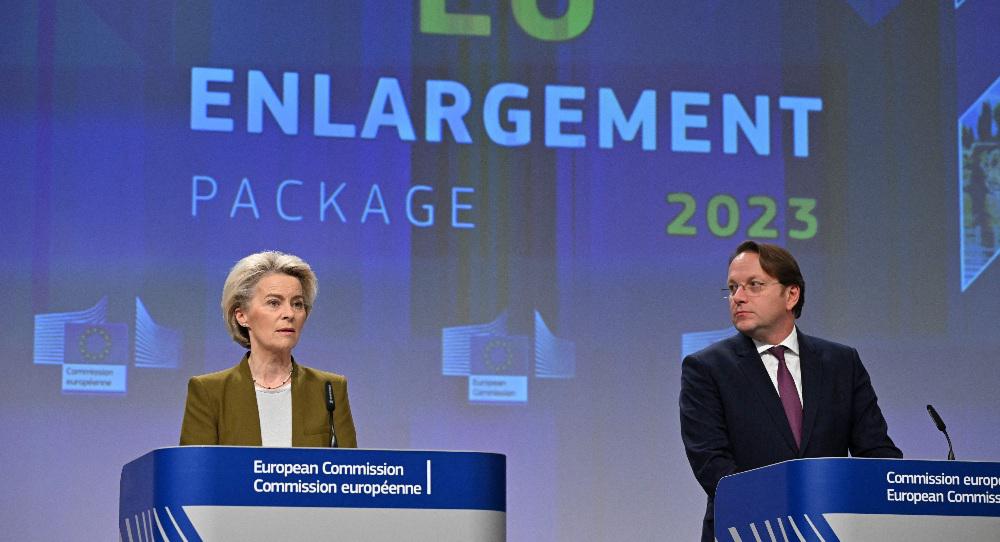
When making the announcement on November 8 about the 2023 Enlargement Package, European Commission President Ursula von der Leyen avoided any mention of the EU having to deal with its shortcomings before its borders widen. It may be that the commission’s recommendations will meet resistance by some member states at the European Council summit next month. Whatever the outcome, the reality is that the European Union’s project is not finished. Future enlargement needs to be the catalyst that will complete it.
Looking back, the EU was built as a peace project. The wars in the former Yugoslavia during the 1990s should have jolted the EU out of a certain complacency or assumption that that peace didn’t need to be defended. The bloc did establish the Common Foreign and Security Policy (CFSP) in 1993. But it lacked teeth, ambition as well as the capabilities needed to defend that peace project.
With Russia’s war on Ukraine, first in 2014 and then a full-scale one launched in February 2022, European governments came to the realization that Ukrainians were not only defending their country, independence, and sovereignty but also safeguarding the security of Europe. That is why this next enlargement has to change the profile—indeed the raison d’ être—of the EU in two major ways.
First, the peace project needs to be defended. This entails the EU recognizing that its future is in jeopardy if it doesn’t take its security seriously. This is not about competing with NATO or duplicating capabilities. It is about acknowledging that the bloc’s safety and security depends on the transatlantic alliance and that Europeans need to strengthen their side of that relationship.
As it is, Europe is grappling—and badly—with the post–Cold War era. It needs to bolster the transatlantic alliance by modernizing it. To do that, Brussels needs to recognize that peace requires more than soft power; it requires hard-power capabilities. If Russia’s war on Ukraine won’t change the mindset of the EU and its member states, then the union will have failed to finish what should have been a natural evolution to a security and defense player.
The second challenge facing the EU as it considers further enlargement is how to deal with its internal flaws when it comes to the rule of law and corruption.
The way in which Hungary and Poland have undermined the rule of law and the judiciary, polarized their respective societies, not to mention the corruption and abuse of EU funds, particularly in the case of Hungary, have given enlargement a bad name. The leaders of the EU institutions and member states have only themselves to blame.
Over the years, when it became clear how the Fidesz government in Budapest and the Law and Justice-led government in Warsaw were running rough-shod over the rule of law, the EU tried to use the treaties to stop the erosion of judicial independence and other basic elements of democracy.
But the lack of political will, member states’ ability to use their veto to block decisions, and, even worse, the use of blackmail—Hungary threatening to withhold another EU financial package to Ukraine unless the EU released billions of euros of post-Covid recovery funds to Budapest—has undermined the EU’s commitment to upholding democratic values in its own house.
Now that a new enlargement is on the agenda, the EU needs to be consistent, consequent, and courageous in dealing with current member states—and then new ones. Strict conditionality should be applied to incoming members to avoid the mistakes the EU has made with regard to its own members. Conditionality should not be negotiable. And the institutions cannot be give into blackmail.
In short, the EU has unfinished business to attend to—and now. It is about defending, literally, the peace project and preserving democracy inside the bloc. That is what the Ukrainians at Maidan square were demonstrating for a decade ago, and what they are fighting for today.

Nonresident Senior Fellow, Carnegie Europe
Judy Dempsey is a nonresident senior fellow at Carnegie Europe
Recent Work
Judy Dempsey
Judy Dempsey
Carnegie does not take institutional positions on public policy issues; the views represented herein are those of the author(s) and do not necessarily reflect the views of Carnegie, its staff, or its trustees.

The European Commissioner for Trade is headed to China. But after President Xi’s bridge-building visit to Washington, can a more isolated EU overcome Beijing’s stranglehold on critical raw materials? Who will blink first?

Rym Momtaz, ed.

The domestic impacts of how long it is taking to end the war in Ukraine have pushed the French electorate to the political extremes and compromised the country’s diplomatic capacity.
Rym Momtaz

Before the next wave of EU enlargement takes place, the union needs to grapple with thorny questions of how power is distributed among its members.


Emil Sondaj Hansen, Ditte Brasso Sørensen

A summer of escalation in the Black Sea has hurt Ukraine economically and is exacerbating world food security. A truce is needed—as is a broader reframing of Europe’s Ukraine strategy.

Thomas de Waal

Are Germany’s economic, industrial, and political struggles becoming a liability for the EU’s ability to rise to the geopolitical moment?
Rym Momtaz, ed.