

Commentary
Dimitar Bechev
{
  "authors": [
    "Dimitar Bechev"
  ],
  "type": "commentary",
  "blog": "Strategic Europe",
  "centerAffiliationAll": "",
  "centers": [
    "Carnegie Endowment for International Peace",
    "Carnegie Europe"
  ],
  "collections": [
    "EU Integration and Enlargement"
  ],
  "englishNewsletterAll": "",
  "nonEnglishNewsletterAll": "",
  "primaryCenter": "Carnegie Europe",
  "programAffiliation": "",
  "programs": [],
  "projects": [],
  "regions": [
    "Russia",
    "Europe",
    "Western Europe",
    "Western Balkans"
  ],
  "topics": [
    "Foreign Policy",
    "Democracy",
    "Political Reform",
    "EU"
  ]
}
Source: Getty
The opening of EU accession talks marks an important milestone for Bosnia, where ethnic tensions run high. But progress on the EU track is no remedy for the chronic crisis besetting the country’s politics.
Bosnia finally has some good news. On March 21, the European Council gave the country the green light to start membership talks with the EU.
Andrej Plenković, Croatia’s prime minister, called it a historic day. Bosnia’s state-level Prime Minister Borjana Krišto from the nationalist Croatian Democratic Union (HDZ), an affiliate of Plenković’s party, agreed. German Chancellor Olaf Scholz said the decision would send a positive message to the entire region.
With Bosnia, five of the six Western Balkan countries are negotiating their accession to the EU, Kosovo being the exception. Already part of the EU-sphere in economic and even human terms, given their sizeable diasporas, local countries are seeking formal membership.
Most of the region was engulfed in a war that began in the early 1990s and culminated in 1999 with the intervention of NATO to end ethnic cleansing in Kosovo.
The scars still run deep. Bosnian politics in particular remains polarized across ethnic lines. And many see the power-sharing Dayton Peace Accords as entrenching division.
The EU’s role in the region has been far from stellar. It has failed to broker a settlement of the Serbia-Kosovo dispute or prevent creeping authoritarianism across the region. For years, its enlargement policy was on life support. Russia and China exploited this vacuum.
That changed with Russia’s full-scale invasion of Ukraine in February 2022. Bosnia has become a beneficiary of the geopolitical reshuffle. In December 2022, it was granted EU candidate status. A year later, the European Council decided to open talks should Bosnia fulfil eight benchmarks, including on the issues of the fight against corruption, judicial reform, and improving migration management. In March 2024, the European Commission ruled that Sarajevo had fulfilled or made substantial progress on these priorities. Notably, Bosnia received praise for aligning with EU sanctions against Russia.
Yet the Commission’s recommendation and the subsequent decision of EU member states’ leaders would have not come had accession talks not been opened with Ukraine and Moldova last December. The concern that Bosnia was being left behind weighed on policymakers. In November 2023, Austrian Foreign Minister Alexander Schallenberg urged the EU not to look at the Western Balkans “with a magnifying glass and with rose-tinted glasses to Ukraine.” As a result, Brussels decided to lower the bar for Bosnia: it required a commitment to meeting some benchmarks as opposed to implementation.
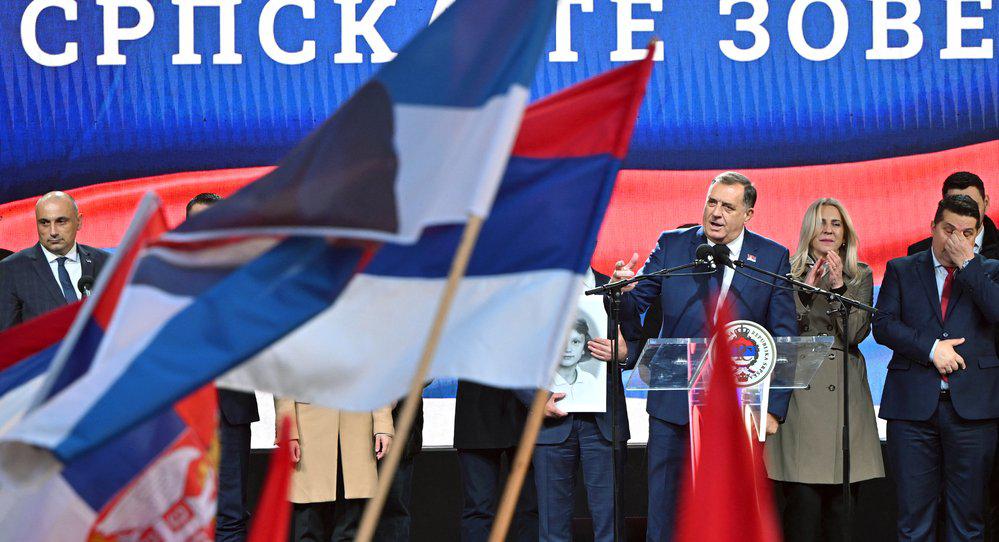
Progress on the EU track is no remedy for the chronic crisis besetting Bosnian politics, which is a legacy of the Yugoslav war. Milorad Dodik, president of Republika Srpska (RS), Bosnia’s Serb-majority entity, is a real thorn in the side of Christian Schmidt, the international community’s high representative, and of the West.
On April 19, the RS’s lower house passed a law setting up a separate electoral authority, which could undermine the constitution and unity of Bosnia. The RS National Assembly also endorsed a law on referendums as well as legislation enabling cash payments to civil servants—a move to bypass U.S. and UK sanctions that have led to the freezing of Dodik’s and his associates’ bank accounts.
Schmidt will likely use his extraordinary powers to strike down the laws as he did in the past. Dodik is already on trial for undermining the Bosnian constitution by refusing to implement decisions. Undeterred, he is leading a charge against a resolution on commemorating the 1995 Srebrenica genocide due to be voted by the UN General Assembly.
Despite Western pressure, a cashflow problem, and his pending court case, Dodik can bank on external support—first and foremost, from Russia. The Speaker of the RS assembly, Nenad Stevandić, was feted by Russian legislators in March. Dodik met with President Vladimir Putin in September 2022, ahead of the Bosnian elections, and in February. However, Russia is unwilling to pay RS bills. The entity’s fiscal balance is in trouble, especially now that EU and German money has been halted. Dodik is being bailed out by Hungary. Prime Minister Viktor Orbán received a hero’s welcome in Banja Luka on April 5. Hungarian flags were still on display on the city’s main street when I visited a week ago. Hungary is blocking the imposition of EU sanctions on Dodik.
Then there’s Serbia. There is no love lost between Dodik and Serbian President Aleksandar Vučić. However, they both need each other. Voters bussed in from RS helped sway the local election in Belgrade in December 2023. The Serbian government sent not just Ana Brnabić, Serbia’s Assembly speaker and former prime minister, but also citizens to the anti-Srebrenica rally held in Banja Luka on April 18. As much as he wishes, Vučić cannot take full control of RS. But he can cut deals with Dodik, cementing a partnership of convenience.
Last but not least, Dodik is in cahoots with the Bosnian Croat leader Dragan Čović and, indirectly, Croatia. Concerned about dwindling Croat numbers in Bosnia, the HDZ has been pushing for an overhaul of electoral rules if not the constitution as a whole that would see the Croat member of the tripartite presidency elected predominantly by Croat voters.
These internal politics aside, Bosnia has made strides toward the EU. However, its internal politics are fiendishly complicated. RS is drifting apart. Neighbors are meddling. The EU and the United States are disunited in how to respond to Dodik. Washington—as well as London—believe that sanctions and pressure is the way forward. Many EU members, and not just Hungary, prefer engagement.
As for Bosnia’s reform agenda, it is piecemeal and could soon hit roadblocks. Even if a major outbreak of violence does not ensue, the country is suffering from chronic instability. That is why the EU should not drop the ball on Bosnia. It should push back against Dodik. And it should leverage the accession negotiations to encourage positive change at all levels of government.

Senior Fellow, Carnegie Europe
Dimitar Bechev is a senior fellow at Carnegie Europe, where he focuses on EU enlargement, the Western Balkans, and Eastern Europe.
Recent Work
Dimitar Bechev
Dimitar Bechev
Carnegie does not take institutional positions on public policy issues; the views represented herein are those of the author(s) and do not necessarily reflect the views of Carnegie, its staff, or its trustees.

The European Commissioner for Trade is headed to China. But after President Xi’s bridge-building visit to Washington, can a more isolated EU overcome Beijing’s stranglehold on critical raw materials? Who will blink first?

Rym Momtaz, ed.

The domestic impacts of how long it is taking to end the war in Ukraine have pushed the French electorate to the political extremes and compromised the country’s diplomatic capacity.
Rym Momtaz

Before the next wave of EU enlargement takes place, the union needs to grapple with thorny questions of how power is distributed among its members.


Emil Sondaj Hansen, Ditte Brasso Sørensen

A summer of escalation in the Black Sea has hurt Ukraine economically and is exacerbating world food security. A truce is needed—as is a broader reframing of Europe’s Ukraine strategy.

Thomas de Waal

Are Germany’s economic, industrial, and political struggles becoming a liability for the EU’s ability to rise to the geopolitical moment?
Rym Momtaz, ed.