

Commentary
Rym Momtaz, ed.
{
  "authors": [
    "Rym Momtaz"
  ],
  "type": "commentary",
  "blog": "Strategic Europe",
  "centerAffiliationAll": "",
  "centers": [
    "Carnegie Endowment for International Peace",
    "Carnegie Europe"
  ],
  "englishNewsletterAll": "",
  "nonEnglishNewsletterAll": "",
  "primaryCenter": "Carnegie Europe",
  "programAffiliation": "",
  "programs": [],
  "projects": [],
  "regions": [
    "Western Europe",
    "United States",
    "Germany",
    "France",
    "United Kingdom"
  ],
  "topics": [
    "Foreign Policy",
    "Security"
  ]
}
Source: Getty
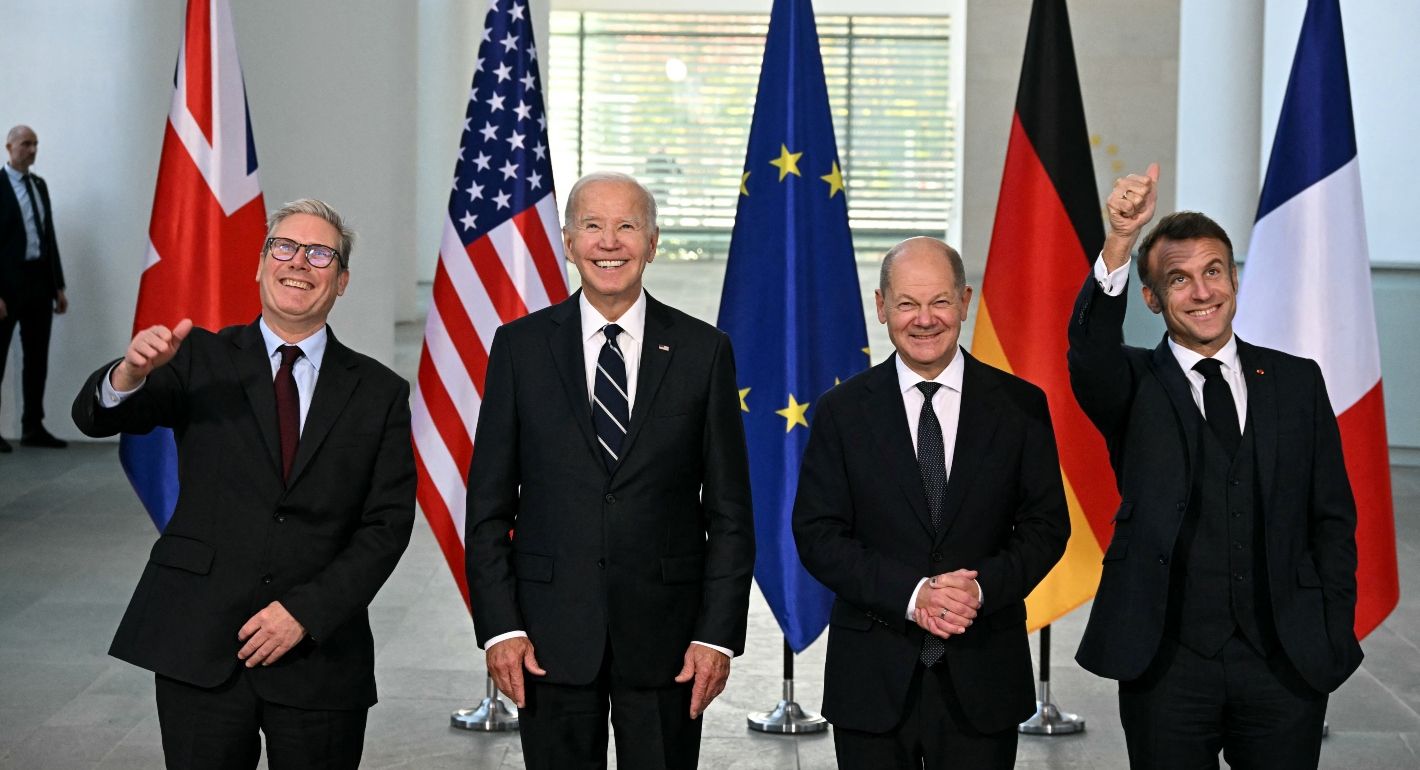
Last week, the leaders of France, Germany, the UK, and the United States met to discuss support for Ukraine and other security issues. But is this format still relevant and representative of the key actors in today’s geostrategic context?
Director of the European Values Center for Security Policy
Discussing European defense without Poland is like debating military plans without generals in the room. Poland is the regional leader of the Northern-Central-Eastern European area. It is strategically the most important supporter of Ukraine and has the best European military.
Western European states spent years appeasing Russia, which led its leadership to think Europe would not push back if Russia attempted to massacre Ukraine. Poland, alongside its regional allies, has taken the Kremlin threat seriously for years. That is why European defense relies on these Central European allies.
The long-standing disappointment among Central Europeans over the weak Russia policies of Western and Southern Europeans is why most French or German-led EU defense plans are not fully trusted by the NATO Eastern frontline states. Therefore, if there is any European or Euro-American talk about defense issues or Ukraine, at least Poland should be present.
If Donald Trump wins the U.S. presidential election, the wider Central European region will align with him, including on a hawkish China policy. This will likely create a major split with Western and Southern European countries, which are not particularly afraid of Russia and do not feel the existential need to keep U.S. military forces in Europe.
Visiting fellow in the Center on the United States and Europe at the Brookings Institution
While the UK, France, Germany, and the United States remain key when it comes to European security, it is also clear that the grouping must be extended to reflect a more adequate balance of power inside Europe. As such, southern Europe, Poland, and the Baltic states should be included in a restricted format.
The Baltic states are on the frontlines of Russia’s war of aggression against Ukraine, and increasingly worried of spillover. Poland, which made a comeback on the European scene after a change in government last year, must also be closely associated with these talks for two reasons. First, it is the member state with the highest defense spending—4 percent of its GDP—in the EU. And secondly, it has difficult and complex historical relations with Ukraine. If Europe is serious about getting Ukraine into the EU as soon as possible, Polish support will be essential.
Unity and domestic resilience throughout the EU will be indispensable to maintaining support for Ukraine, especially as Kyiv moves forward on its EU accession negotiations.
Finally, the upcoming U.S. presidential election also begs the question of whether a future U.S. president would still be keen in taking part in the European Quad.
Senior strategist at FIPRA International
No. Quads are not obsolete.
Any serious issue in global or regional—not bilateral—diplomacy is solved by discussion in multiple parallel settings. In trade policy and elsewhere, there are numerous four-sided meetings of different countries, all labeled quads.
This particular quad is important to the defense of the Ukraine, and needs to meet. But no one would claim that it can be the only or the leading forum.
So quads yes. Also other stuff: an EU Defence Council, NATO, and so on. But let’s focus on the goals, not the tables.
Senior research fellow in the Europe program at Chatham House
The European Quad format has historical roots in NATO and made sense once upon a time. Three countries are both nuclear weapons state and on the UN Security Council, and Germany is Europe’s largest economy and host of U.S. troops.
But times have changed. France’s President Macron has articulated a strategic vision for European security—but struggled to bring it to life. Germany has been one of Ukraine’s most important providers of military aid, but Chancellor Olaf Scholz’s leadership has been weakened in recent elections. The UK is still looked to as a leader on security and defense, but the new government has a black hole in the budget. The United States will continue to struggle to provide support to Ukraine through what will likely continue to be a divided congress after the U.S. elections.
Convening these countries no longer reflects the political realities.
Further east, Poland, while by no means out of trouble domestically, is emerging as a leader on European security and defense. Convening the quad without Poland delegitimizes the group as a forum for discussions on European security, and Ukraine specifically, thereby sending a positive signal to Russia.
Europe simply cannot rely on the current quad countries alone to provide the vision, leadership, capabilities, and budget needed to ensure European security.
Deputy director at the Foundation for Strategic Research
At first glance, nothing smacks of a cold war more than an ageing U.S. president, a veteran of East-West confrontation, meeting with his British, French, and German counterparts to discuss European security. The quad format is a legacy of the years when regular consultations happened between these four and nothing could happen without them being in agreement.
Indeed, how could one discuss Ukraine without Poland, or the Balkans without Italy?
But any minilateral format is by definition exclusive. Whenever the E3—France, Germany, and the UK—meet to discuss Iran, Rome or Madrid complains. Furthermore, Berlin, London, and Paris are still the three largest economies and one of the three biggest military spenders in Europe. The four powers also discuss the Middle East, Asia, and non-proliferation issues. These are the reasons why the Barack Obama and then the Joe Biden administrations actually sought increased ministerial and even presidential-level quad meetings.
Overall, though, the old quad does not really make sense. If the idea is to discuss European defense, then Poland needs to be in the room. If it is about major crises and conflicts in the world, then it makes better sense to convene the “P3”—the three Western permanent members of the UN Security Council, which are also nuclear powers.
Acting research director at the Polish Institute of International Affairs (PISM)
Simply put, the times when the United States could speak to chosen European allies and consider them “fixers” of European matters are long gone.
No political vehicle aimed at stopping hostilities between Russia and Ukraine will truly work if it does not involve nations from Central and Eastern Europe (CEE). These countries took the biggest risk in enabling assistance to Ukraine and are also the most vulnerable to potential Russian aggression in the future. Hence the almost allergic—and widespread—reaction to the recent quad consultations in Berlin.
Failure to include CEE countries will send two disastrous strategic signals: First, to the entire Eastern flank of NATO it will suggest that they still do not have agency in strategic European matters. Second, to Russia it will signal that Moscow’s differentiation between “categories” of European states has not been discarded by the collective West. Both of these messages could lead to catastrophic developments, to say the least.
While Germany did change through its Zeitenwende, there has also been a shift elsewhere in Europe. The CEE countries, who had been sidelined but are now praised for properly understanding the Russian threat, do not want a return of the old days when dealings with Russia were conducted above their heads.
Former NATO deputy assistant secretary general
Why should anyone be led by you? I doubt this question has ever crossed the minds of the quad members. They seem to believe that their role as a power engine of the transatlantic community is cast in stone. But it isn’t.
They’ve also failed to defend the rules-based order against the nuclear-armed, criminal regime in Moscow, to define the desired end-state in Ukraine, to create the political space in NATO to facilitate Ukraine’s membership, and to discuss a long-term strategy toward China and Russia.
U.S. President Joe Biden and German Chancellor Olaf Scholz remain hooked in their “escalation avoidance” corner, French President Emmanuel Macron proposes grand ideas but hardly ever follows up, and British Prime Minister Keir Starmer has perhaps the clearest idea of the stakes, but the UK has limited means.
Given the quad’s underperformance, some NATO members have started to organize themselves in alternative ways—in the Bucharest Nine (B9), the Nordic Five (N5), the Nordic-Baltic Eight (NB8)—or as participants of the Joint Expeditionary Force. These groups don’t just coordinate their Ukraine aid; they discuss the broader strategic picture and seek to align their national objectives.
It seems like Russian President Vladimir Putin did not only annex Ukrainian territory in 2014; he also managed to annex the strategic brainpower and political stamina of some leading NATO members.
Director of the Multinational Development Policy Dialogue at the Konrad Adenauer Foundation
For a meaningful discussion on European security, the presence of the European Quad is necessary but not sufficient. As the host, Germany should have extended invitations to at least Poland, and possibly Italy. Not doing so was a missed opportunity. Both countries hold significant political weight, and Poland’s inclusion in particular would have enhanced the credibility of the meeting in the eyes of other European capitals.
Including Poland would have also reflected that the European side of the transatlantic security architecture is not solely governed by Western European states, and that Central and Eastern European perspectives form an integral part of discussions on European defense.
That said, calling the European Quad obsolete is an overstatement. Any format that brings together the United States, the UK, and key EU countries will remain valuable in the future. Such formats are particularly critical in addressing challenges such as relations with China, the Indo-Pacific, the Middle East, and the Horn of Africa, and in reinforcing a rules- and values-based multilateral order.
To better reflect the diversity within the EU, however, the format could evolve into a “European Quad + 1”, with the additional European country varying based on the issue or region under discussion.

Editor in Chief, Strategic Europe
Rym Momtaz is the editor in chief of Carnegie Europe’s blog Strategic Europe. A multiple Emmy award-winning journalist-turned-analyst, she specializes in Europe and the Middle East and the interplay between those two spaces.
Recent Work
Rym Momtaz, ed.
Rym Momtaz
Carnegie does not take institutional positions on public policy issues; the views represented herein are those of the author(s) and do not necessarily reflect the views of Carnegie, its staff, or its trustees.

The EU can impose sanctions but struggles to enforce them without the United States. With Washington increasingly disinterested in backing European interests, the bloc must now fend for itself.


Nicu Popescu, Tiago Antunes

Russia is testing the waters of NATO’s mutual defense clause. What do strikes in Romanian territorial waters mean for the alliance’s posture toward Moscow?

Dimitar Bechev

With its public finances in shambles, the far right polling at 35 percent ahead of the 2027 presidential election, and a growing protest movement, is France’s crisis a threat to the EU’s geopolitical awakening?
Rym Momtaz, ed.

Ahead of a tough winter for Ukraine, Donald Trump’s swing back toward Russia bodes ill. But instead of panicking, Kyiv’s European allies are focusing on action.
Rym Momtaz

While the EU and European governments are embracing the much-lauded middle-power moment, this entails three difficult conundrums.

Richard Youngs