

Commentary
Rym Momtaz
{
  "authors": [
    "Rym Momtaz"
  ],
  "type": "commentary",
  "blog": "Strategic Europe",
  "centerAffiliationAll": "",
  "centers": [
    "Carnegie Endowment for International Peace",
    "Carnegie Europe"
  ],
  "englishNewsletterAll": "",
  "nonEnglishNewsletterAll": "",
  "primaryCenter": "Carnegie Europe",
  "programAffiliation": "",
  "programs": [],
  "projects": [],
  "regions": [
    "Europe",
    "United States"
  ],
  "topics": [
    "Foreign Policy",
    "Security",
    "NATO",
    "Defense"
  ]
}
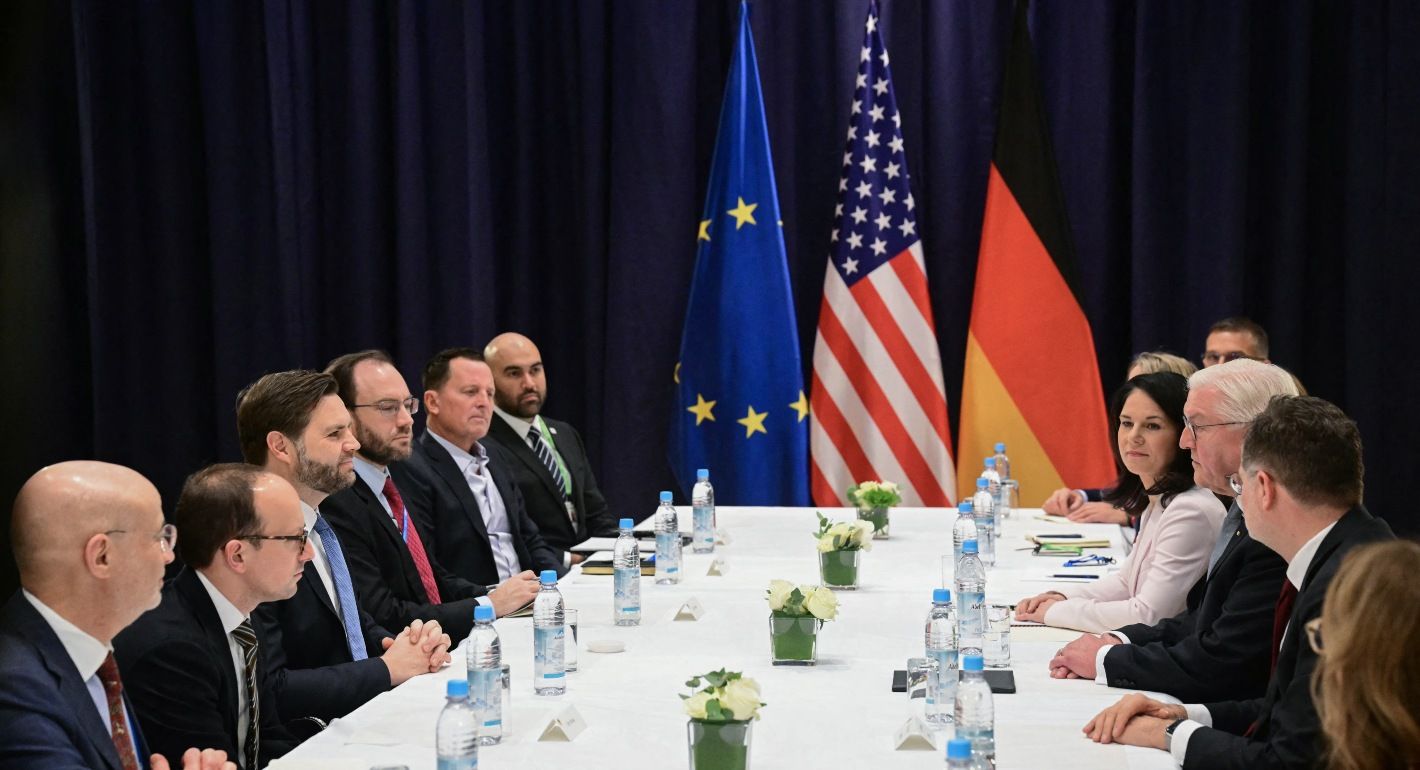
Source: Getty
The Trump administration’s rhetoric and actions have placed transatlantic ties under unprecedented strain. Yet despite the tensions, Europe and the United States have an opportunity to reimagine their alliance and secure mutual benefits.
There are legitimate reasons to question whether today’s European and North American leaders are worthy heirs of the alliance built on their forefathers’ blood, treasure, and vision after World War II.
The spectacle that unfolded at the Munich Security Conference (MSC) over the weekend certainly makes a strong case that they are not. Each stakeholder is failing the collective.
The transatlantic relationship has been knocked off its axis. The Ukraine case shows that NATO’s security and Europe’s security are no longer one and the same. And the most important ally—the United States—is led by a president who doesn’t believe in alliances but rather in bilateral relationships and spheres of influence.
At the same time, a revision and update of the transatlantic bargain is long overdue and the two sides should seize this opportunity. As Albanian Prime Minister Edi Rama put it, “America without Europe is just an island; Europe without America is a peninsula.”
The United States should be able to shift many of its resources away from Europe to tackle the other strategic challenges it deems more urgent. But doing this by making a grand bargain with Russia and withdrawing U.S. troops from NATO’s Eastern flank while endorsing a Russian sphere of influence in Europe would be self-defeating for Washington.
If Trump is set on securing America’s status as the undisputed champion of the world, its alliance with Europe is indispensable. A Europe ablaze fighting off Russian aggression and on its knees economically because of U.S. tariffs drags America down with it, given the depth of the economic, financial, and military ties between them.
Trump may not believe in the NATO construct, the alliance, but what he can appreciate from his real estate days is a consortium. From the latin consors: shared in property. The United States and Europe have shared ownership—though unequal—of global leadership. It is time for both sides to formulate a new consortium agreement.
Transactionality has always been an integral part of the transatlantic relationship, but it was never at the expense of the values that underpinned it: democracy, integrity, rule of law, and fact-based debate. With U.S. Vice President Vance’s speech at the MSC, the Trump administration has crossed that Rubicon. Vance attacked European democracy along the lines of Russia’s destabilization campaigns and called on Germany to get rid of its firewall against neo-Nazis, the heirs to the very political movement 416,800 American soldiers died to defeat in World War II.
But not all is bleak.
Despite some of the disturbing public statements its principals have made, the Trump administration is not totally disengaging from Europeans—at least for now. It is asking for their input on Ukraine scenarios and has not mentioned walking away from NATO or completely withdrawing from Europe. None of this was a given under Trump. And some of the statements could present opportunities.
U.S. Defense Secretary Pete Hegseth told Europeans the United States “will prioritize empowering Europe to own responsibility for its own security.” Europeans could seize on this to build up their defense industrial capacities, creating lucrative and secure jobs in addition to giving themselves the means of their sovereignty while becoming more useful allies to Washington.
Europeans possess agency and capability, provided they shed their self-doubt and quit free riding on the U.S. security guarantee. Getting their populations, which are increasingly supportive of far-right populist sovereignism, to accept potential troop casualties in Ukraine, without full American cover, to preserve their freedom, sovereignty, and prosperity should not be such an impossible task. It might even help mainstream parties call the populists’ bluff.
Ukraine offers a remarkable model. Even while fighting for their survival, Ukrainians have imposed strategic choices on their partners—from obliterating Russia’s Black Sea fleet to occupying Russian land in Kursk. They have also displayed the courage to reject the Trump administration’s extractive demand for their rare earths despite risking a complete end to U.S. support.
Europeans are not facing such immediate vital threats, but the U.S.-Russia negotiations over Ukraine present them with a double challenge: containing Russia in Ukraine to prevent a future attack on them while fortifying their own borders in case Ukraine collapses—a scenario that would stretch Europe’s resources and potentially further divide it. This dilemma may also push some of the most exposed EU member states to pursue nuclear proliferation as the ultimate security trump card in a world of spheres of influence and great power competition. That would be the final nail in the post–World War II order.
It is then time for European leaders to shut up or put up. The continued refusal of countries like Germany, Italy, or Poland to commit to providing credible security guarantees to Ukraine with little U.S. backstop indicates that for all their panic, they are not panicked enough to actually help themselves.
There is a scenario in which the United States not only trades its presence on NATO’s Eastern flank, but also opposes the deployment of European troops to Ukraine. It may not be the likeliest today, but with Trump, nothing can be ruled out.
Both Europe and the United States have epochal choices to make. Does the United States put the Chinese fox in the hen house with the European goose and its golden eggs? Does Trump join the ranks of Barack Obama and Joe Biden and preside over a new Russian invasion of a sovereign European country? Do Europeans think they can save their economies while sacrificing their security?
One thing is clear: The transatlantic alliance is in a Gramscian crisis—the old is dead and the new is struggling to be born.

Editor in Chief, Strategic Europe
Rym Momtaz is the editor in chief of Carnegie Europe’s blog Strategic Europe. A multiple Emmy award-winning journalist-turned-analyst, she specializes in Europe and the Middle East and the interplay between those two spaces.
Recent Work
Rym Momtaz
Rym Momtaz, ed.
Carnegie does not take institutional positions on public policy issues; the views represented herein are those of the author(s) and do not necessarily reflect the views of Carnegie, its staff, or its trustees.

European Commission President Ursula von der Leyen is about to give her annual address on the state of the EU. Here’s what she won’t—but should—say.
Rym Momtaz

The aftermath of the Ceuta crisis shows Europe has drawn the wrong lessons. Rather than doubling down on failed migration policies, the EU needs to address the underlying roots of such episodes.

Richard Youngs

An overwhelming victory by a far-right-wing party in a small state in eastern Germany will have major repercussions for Chancellor Friedrich Merz’s coalition.

Judy Dempsey

Canadian Prime Minister Mark Carney has twice inspired praise for standing up to U.S. President Donald Trump: at the 2026 World Economic Forum in Davos and on Canada-U.S. trade negotiations. Is Carney showing a third way better than the EU has in dealing with the Trump administration?
Rym Momtaz, ed.

The EU’s responses to two recent incidents expose the gulf between European perceptions and capabilities. Unless the union can bridge that gap, it will never become a real geostrategic power.
Rym Momtaz