

Commentary
Rym Momtaz, ed.
{
  "authors": [
    "Rym Momtaz"
  ],
  "type": "commentary",
  "blog": "Strategic Europe",
  "centerAffiliationAll": "",
  "centers": [
    "Carnegie Endowment for International Peace",
    "Carnegie Europe"
  ],
  "collections": [
    "EU Integration and Enlargement"
  ],
  "englishNewsletterAll": "",
  "nonEnglishNewsletterAll": "",
  "primaryCenter": "Carnegie Europe",
  "programAffiliation": "",
  "programs": [],
  "projects": [],
  "regions": [
    "Europe",
    "United States",
    "Ukraine"
  ],
  "topics": [
    "Foreign Policy",
    "Military",
    "Security"
  ]
}
Source: Getty
The coalition of the willing has raised unrealistic expectations about its support for Ukraine, setting itself up for failure. To build a credible deterrent and contain Russia, Europeans and partners must revise their approach and help Trump strengthen his negotiating position.
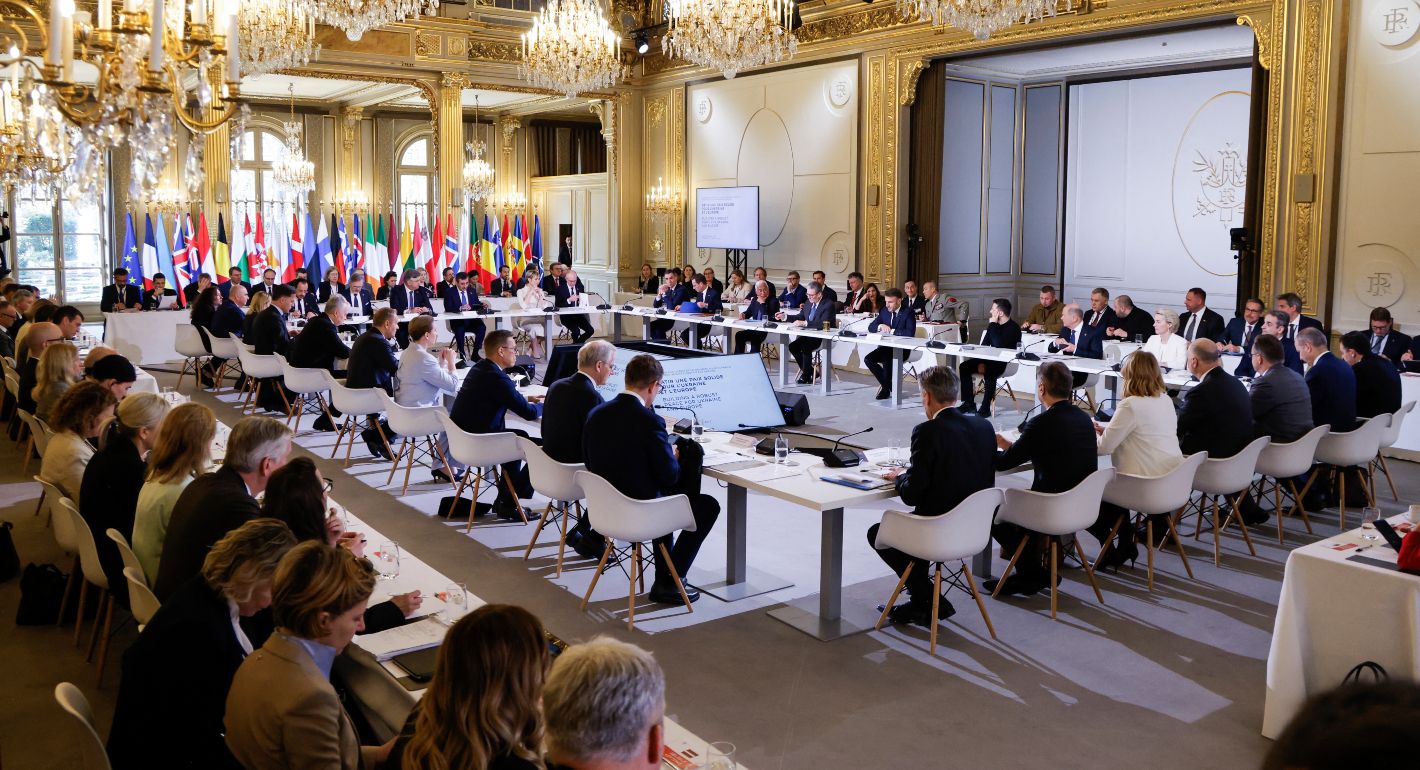
A core group of European leaders has stepped up in recent weeks to ensure the continent’s security isn’t steamrolled in a United States-Russia settlement in Ukraine.
The flurry of meetings of this so-called “coalition of the willing” has defined a three-pronged approach to Ukraine: supercharging the Ukrainian military’s ability to defend against Russian aggression, reaching a ceasefire with a verification mechanism, and deterring any additional or future Russian attacks.
This European strategy for Ukraine has been the result of UK-French leadership. And the talks have stood out because of their speed and intensity as well as their unprecedented format—discussing European security without the United States coordinating.
But, at this stage, the numbers don’t add up and statements by leaders have dangerously raised expectations, setting themselves up for failure. As currently defined, each of the three objectives laid out by Europeans for bolstering their and Ukraine’s security remain out of reach.
The Europeans can’t impose a ceasefire in Ukraine, but have made it a prerequisite for their deterrent in-country deployment. Even leaders as influential with U.S. President Donald Trump as French President Emmanuel Macron, UK Prime Minister Keir Starmer, or Italian Prime Minister Georgia Meloni are struggling to shape negotiations over Ukraine and don’t have a clear understanding of Trump’s dealbreakers.
Europe’s industrial ramp-up is still subpar and ill-adapted to the continent’s new security needs. Most European leaders remain unwilling to level with their populations about the ultimate price to pay for their own security, which includes exposing soldiers to possible death and prioritizing defense in national budgets.
Their plans for deploying a force inside Ukraine, not to engage in a war with Moscow but rather to preserve peace and deter future Russian aggression, keep getting downgraded.
To send a credible deterrent signal, which is the Europeans’ core objective, this force needs to strike a delicate and still-elusive balance between mobilizing mass capabilities, setting robust rules of engagement, and maintaining a strategic ambiguity to avoid tempting Russia with red lines that would lead to an escalation many Europeans would shirk from. The Russians are watching closely and not seeing much that should worry them at this stage. Most Europeans still require an explicit—albeit unlikely—American commitment to back them up if they take fire.
As military discussions have gotten more and more detailed, what started as a pie-in-the-sky concept of a 50,000-troop deployment behind the ceasefire line to assist Ukrainians in securing major cities and infrastructure installations has been watered down to several lesser options. The possibilities currently range from a 25,000-troop force to the lightest footprint of a sea and air deterrent force, with a small training contingent on the ground inside Ukraine. A final decision is not close, and that is problematic.
It has also been misleading to present the thirty-one countries that have participated in the larger coalition meetings for Ukraine as all “willing and able.” Most came out of a fear of missing out, rather than a resolve to take concrete action.
The more concrete discussions have taken place in a group of eleven countries. Apart from France and the UK, Belgium, Canada, Denmark, Lithuania, Luxembourg, the Netherlands, Norway, Sweden, and Turkey have indicated varying degrees of readiness to contribute to a European strategic deterrent force in Ukraine.
Finland, Germany, and Poland could reinforce the core group down the line.
Europeans are now up against two ticking clocks: Trump’s goal of reaching a ceasefire within 100 days of his inauguration—we are on day seventy-one—and the first thirty days after a ceasefire goes into effect—if it is ever reached.
Europeans have less than twenty-nine days to leverage Moscow’s slow rolling of the ceasefire and help harden the Trump team’s bargaining position. They can do this by sharing what they’ve learned from their failed attempts, since 2022, to establish a Black Sea grain route or secure a ceasefire around Zaporizhzhia’s nuclear power plant and other infrastructure. Additionally, they could discuss specific U.S. capabilities asks in support of actions to bolster peace.
If Europeans succeed and a ceasefire goes into effect, giving Trump his political win, they will then need to harden their strategic deterrent signals in the first thirty days to ensure it sticks. Neither is a given, but both are feasible.
The good news is that, objectively, Europeans do have the means to deter and contain Russia. Moscow is not a military or economic superpower. It should be no match for the combined capabilities of Europeans, with Turkey and Canada. Political and military leaders should start acting like it.
Europeans and their willing partners can build a credible deterrent signal, but they need to change track and recalibrate expectations. An effective in-country reassurance force is a long shot, but it has become the improbable yard stick European action is being measured against.
Europeans could arguably be more effective and credible through a combination of other components.
The ceasefire could be monitored with European surveillance means and a complementary U.S. civilian tech involvement. That would provide a lucrative nonmilitary buy-in for the United States. It would also provide sourcing for proof of potential Russian infractions that would be difficult for the Trump administration to dismiss.
By leveraging Europeans’ far superior air and naval capabilities, air and sea exclusion zones could be implemented with a minimal footprint.
Concomitantly, Europeans could implement their own Operation Warp Speed to meet all of Ukraine’s weapons needs while beefing up NATO plans on the Eastern flank.
The cost of European inaction, or failure, is now higher than the risks associated with acting. There is a world where the United States and Russia make a transactional deal based on rare earths and Ukraine’s neutrality, showcasing a public defeat of Western support to Kyiv. That would be the most substantive weakening of European security in recent times.

Editor in Chief, Strategic Europe
Rym Momtaz is the editor in chief of Carnegie Europe’s blog Strategic Europe. A multiple Emmy award-winning journalist-turned-analyst, she specializes in Europe and the Middle East and the interplay between those two spaces.
Recent Work
Rym Momtaz, ed.
Rym Momtaz
Carnegie does not take institutional positions on public policy issues; the views represented herein are those of the author(s) and do not necessarily reflect the views of Carnegie, its staff, or its trustees.

Russia is testing the waters of NATO’s mutual defense clause. What do strikes in Romanian territorial waters mean for the alliance’s posture toward Moscow?

Dimitar Bechev

With its public finances in shambles, the far right polling at 35 percent ahead of the 2027 presidential election, and a growing protest movement, is France’s crisis a threat to the EU’s geopolitical awakening?
Rym Momtaz, ed.

Ahead of a tough winter for Ukraine, Donald Trump’s swing back toward Russia bodes ill. But instead of panicking, Kyiv’s European allies are focusing on action.
Rym Momtaz

While the EU and European governments are embracing the much-lauded middle-power moment, this entails three difficult conundrums.

Richard Youngs

Much has been said of the changes Brussels is trying to make to the EU enlargement process. Here’s why gradual integration might—or might not—be the answer.
Dimitar Bechev