

Article
Thomas de Waal
{
  "authors": [
    "Thomas de Waal"
  ],
  "type": "commentary",
  "blog": "Strategic Europe",
  "centerAffiliationAll": "",
  "centers": [
    "Carnegie Endowment for International Peace",
    "Carnegie Europe"
  ],
  "englishNewsletterAll": "",
  "nonEnglishNewsletterAll": "",
  "primaryCenter": "Carnegie Europe",
  "programAffiliation": "",
  "programs": [],
  "projects": [],
  "regions": [
    "Europe",
    "United States"
  ],
  "topics": [
    "EU",
    "Foreign Policy",
    "NATO",
    "Security"
  ]
}
Source: Getty
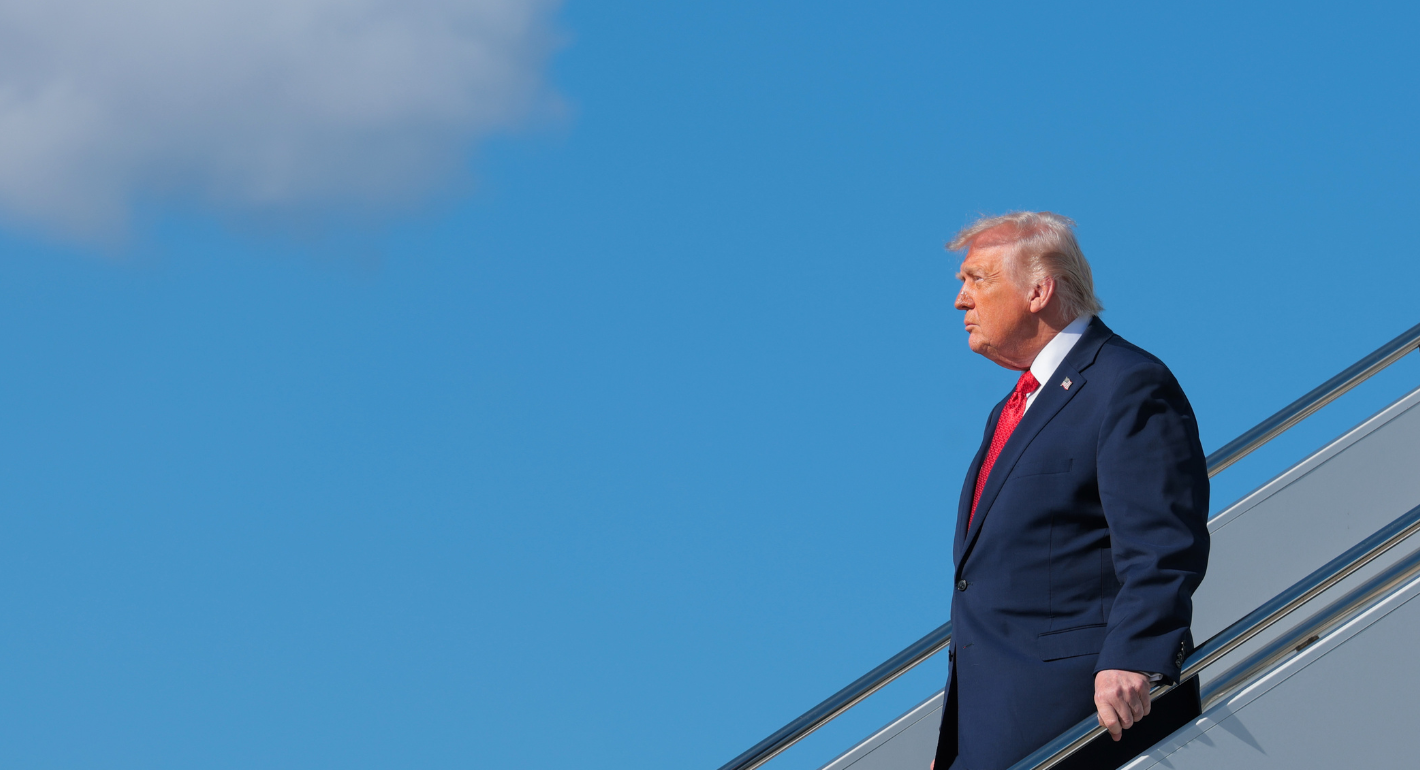
The hyper-personalized new version of global sphere-of-influence politics that Donald Trump wants will fail, as it did for Russia. In the meantime, Europe must still deal with a disruptive former ally determined to break the rules.
The leader of the global superpower, nominally Europe’s largest ally, is directly threatening Europeans in Greenland. That much is obvious and dangerous—but what is much less clear is whether U.S. President Donald Trump actually has a plan.
One version has it that Trump harks back to an age of imperialism and sphere-of-influence politics where America is unconstrained: His intervention in Venezuela and threat to Greenland are his bid to relaunch the Monroe Doctrine and make himself emperor of the Western hemisphere.
The renowned scholar Fiona Hill, who worked as an adviser in the first Trump administration, says that the president she knew yearned to live in a world where he could sit down in a room with the Russian and Chinese leaders, Vladimir Putin and Xi Jinping, and divide the globe into zones of control. Washington would presumably get to control the Americas, while Moscow and Beijing would be given power in Eastern Europe and Asia respectively.
Yet the world is not as Trump imagines it, and the threat he now poses—and which Europeans are scrambling to respond to in Brussels and Davos this week—is principally one of chaos. Calling the challenge a new Monroe Doctrine is only partly the answer: It’s more like a Gone-Rogue Doctrine.
The two-century-old strategy championed by then president James Monroe asserted a U.S, sphere of influence in its Americas, but was declared dead in the 1990s. Under Trump, it has certainly made a comeback: the president himself has joked about the “Donroe” doctrine. What we are seeing, however, is both more and less than this old idea.
The doctrine evolved radically from when it was first articulated in 1823 up until the 1980s.
Monroe was inspired by his fellow founding father, third U.S. president Thomas Jefferson, who wished for the then new country to be an “empire of liberty.” In a letter to Monroe in October 1823 Jefferson urged him “never to entangle ourselves in the broils of Europe,” but to pursue a geographically bounded foreign policy in which “our endeavor should surely be to make our hemisphere that of freedom,” in short, a wider American zone defended against European colonialism.
In the speech made five weeks later, on December 2, 1823, Monroe fleshed out Jefferson’s ideas, promising American ambition but also restraint: “With the existing colonies or dependencies of any European power we have not interfered and shall not interfere.”
Fast-forward to the current threats against Denmark in Greenland, and we see a break with Monroe’s pledge. Taking the Arctic territory not only interferes in Europe but fails to enhance U.S. security or boost its economy—goals it could have achieved with old-fashioned diplomacy.
Yet Trump’s actions—thus far at least—also fail to follow the script of the more aggressive twentieth century iterations of the Monroe Doctrine. From Theodore Roosevelt in Panama to Ronald Reagan in El Salvador, U.S. presidents intervened far and wide to shape and own the futures of Latin American countries.
By that measure, today’s White House is less serious. Top Republican Party officials have already backed away from the claim that the United States would “run” Venezuela—the administration has decided instead to do a deal with the vice president of the regime he had decapitated. In Greenland he covets an almost empty territory without any obvious plan.
Trump’s personal ambition and self-aggrandizement seem to be the only key to this puzzle. It is dangerous but also performative. If this is imperialism, then it is a peculiar made-for-television version in which the perception is as important as the truth.
The bigger reality here is that in the twenty-first century—a world of crowded geopolitics, digital connections, global trade, and rising middle powers—it’s just not possible to build the old kind of sphere of influence. In fact, Trump needs reminding that he has the modern variety already: a friendly alliance stretching from Vancouver to Kyiv that he is now losing.
Russian President Vladimir Putin, a failed imperial overlord by any calculation, has already demonstrated the folly of this mindset. One reason why Moscow launched its catastrophic war in Ukraine was the failure of its post-Soviet integrationist projects, from the Commonwealth of Independent States to the Eurasian Economic Union. Rejecting this, Ukraine saw a better future for itself in partnership with Europe.
Four years on from Russia’s full-scale invasion, it is clear that Moscow can inflict huge damage on Ukraine but it will never own it, or indeed any of its post-Soviet neighbors. Putin’s war has pushed the neighbors that Russia used to call its “near abroad” even further away. Even countries that have better relations with Moscow, such as Georgia and Kazakhstan, are situational friends, who hedge their bets and actively seek other partners—from China and Turkey to the EU—to preserve their sovereignty and identity
Of course, none of this means that Trump, like Putin, cannot badly break things, disrupt, and destroy. Like Russia, the United States can use hybrid tactics to interfere in European elections and weaken NATO. The example of impunity may have a ripple effect, encouraging norm-breaking and destabilization across the world.
As world leaders meet for the annual summit of the World Economic Forum in Davos this week, the country to watch is the third member of that putative world-sharing trio: China. It is an economic superpower that is already projecting military power in its neighborhood. President Xi Jinping could treat the actions of Trump, and Putin before him, as an invitation to be another bad boy and escalate claims against Taiwan and others.
Beijing may also opt to play a longer game and claim the moral high ground, however, presenting itself as an international norm-setter, a global economic powerhouse that values global supply chains more than new flags in the ground.
In a world where the United States is starting to go rogue and Russia has already done so, Europe may have to start talking much more seriously to China, whether it likes it or not.

Senior Fellow, Carnegie Europe
Thomas de Waal is a senior fellow at Carnegie Europe, specializing in Eastern Europe and the Caucasus.
Recent Work
Thomas de Waal
Thomas de Waal
Carnegie does not take institutional positions on public policy issues; the views represented herein are those of the author(s) and do not necessarily reflect the views of Carnegie, its staff, or its trustees.

European Commission President Ursula von der Leyen is about to give her annual address on the state of the EU. Here’s what she won’t—but should—say.

Rym Momtaz

The aftermath of the Ceuta crisis shows Europe has drawn the wrong lessons. Rather than doubling down on failed migration policies, the EU needs to address the underlying roots of such episodes.

Richard Youngs

An overwhelming victory by a far-right-wing party in a small state in eastern Germany will have major repercussions for Chancellor Friedrich Merz’s coalition.

Judy Dempsey

Canadian Prime Minister Mark Carney has twice inspired praise for standing up to U.S. President Donald Trump: at the 2026 World Economic Forum in Davos and on Canada-U.S. trade negotiations. Is Carney showing a third way better than the EU has in dealing with the Trump administration?
Rym Momtaz, ed.

The EU’s responses to two recent incidents expose the gulf between European perceptions and capabilities. Unless the union can bridge that gap, it will never become a real geostrategic power.
Rym Momtaz