

{
  "authors": [
    "Franco Frattini",
    "Ashley J. Tellis",
    "Fabrice Pothier"
  ],
  "type": "event",
  "centerAffiliationAll": "",
  "centers": [
    "Carnegie Endowment for International Peace",
    "Carnegie Europe"
  ],
  "collections": [],
  "englishNewsletterAll": "",
  "nonEnglishNewsletterAll": "",
  "primaryCenter": "Carnegie Endowment for International Peace",
  "programAffiliation": "",
  "programs": [],
  "projects": [],
  "regions": [
    "North America",
    "United States",
    "East Asia",
    "Japan",
    "Caucasus",
    "Russia",
    "Western Europe",
    "United Kingdom",
    "France",
    "Germany"
  ],
  "topics": [
    "Political Reform",
    "Economy",
    "Security",
    "Foreign Policy"
  ]
}
Italy's G8 Presidency: Priorities and Global Challenges
Mon, February 23rd, 2009
Brussels
The Italian Presidency of the G8 takes place at a very delicate time in international affairs. Not only do the financial crisis, non-proliferation, instability in the Middle East, climate change and the situation in Afghanistan and the surrounding region demand urgent global attention, but the structures created to tackle these problems are in need of review.
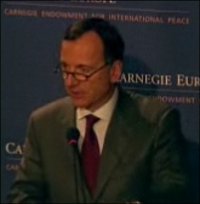
Italy's Minister for Foreign Affairs, Franco Frattini, outlined the priorities of the G8 under the Italian Presidency. Ashley J. Tellis, Senior Associate at the Carnegie Endowment for International Peace, responded. Fabrice Pothier, Director of Carnegie Europe, chaired the discussion.
Highlights included…
- Frattini highlighted the idea that there is currently a global ‘governance gap.’ To help fill that void, existing global governance structures should be revised which aim to not only include developing countries in the decision making process, but that also allow them to share some of the responsibility, even the burden, of global governance. In the longer term, Frattini called for a review of the out-of-date Bretton-Woods project.
- Frattini recognized not only the importance of the war in Afghanistan, but also the significance of the surrounding region by explaining that the G8 will need to focus on improving Afghan institutions, creating regional security, and civilian reconstruction. Tellis added that it is essential for the West to acknowledge the importance of the war in Afghanistan to homeland security.
- Frattini praised current Western leadership in its handling of domestic and international backlash against globalization as the financial crisis deepens. Formulating ways in which protectionism can be avoided and regulated against is crucial for maintaining global stability and will be high on the agenda of the G8 under an Italian presidency.
Carnegie does not take institutional positions on public policy issues; the views represented herein are those of the author(s) and do not necessarily reflect the views of Carnegie, its staff, or its trustees.
Event Speakers
Franco Frattini
Former Senior Fellow
Ashley J. Tellis was a senior fellow at the Carnegie Endowment for International Peace.
Former Director, Carnegie Europe

Pothier, director of Carnegie Europe, is a noted commentator on European policy in Afghanistan and Pakistan, transatlantic issues, and global drug policy.