

{
  "authors": [
    "Michael Coppedge",
    "Staffan Lindberg",
    "Massimo Tommasoli",
    "Richard Youngs"
  ],
  "type": "event",
  "centerAffiliationAll": "dc",
  "centers": [
    "Carnegie Endowment for International Peace"
  ],
  "collections": [],
  "englishNewsletterAll": "democracy",
  "nonEnglishNewsletterAll": "",
  "primaryCenter": "Carnegie Endowment for International Peace",
  "programAffiliation": "DCG",
  "programs": [
    "Democracy, Conflict, and Governance"
  ],
  "projects": [],
  "regions": [],
  "topics": [
    "Democracy",
    "Global Governance"
  ]
}
Varieties of Democracy: Global Standards, Local Knowledge
Thu, May 30th, 2013
Washington, DC
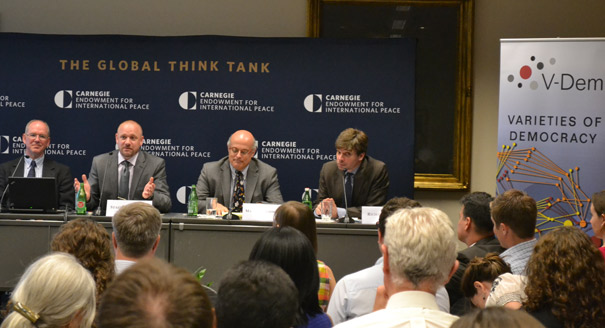
The global diversity of democratic political system continues to pose practical and analytical challenges to policymakers, advocates and researchers. Varieties of Democracy, a collaborative project of fifteen social scientists, seeks to provide a new, comprehensive and analytically rigorous approach to the conceptualization and measurement of democracy around the world. Two of the principal researchers, Michael Coppedge and Staffan Lindberg, from the Varieties of Democracy Project, presented the project’s innovative approach and methodology. International Institute for Democracy and Electoral Assistance's Massimo Tommasoli commented, and Richard Youngs moderated.
Varieties of Democracy Project
- Multiple Models of Democracy: Coppedge and Lindberg explained that the starting point of the Varieties of Democracy (V-Dem) project, initiated in 2012, was the recognition that democracy is a highly complex and multi-faceted concept that cannot be reduced a simple definition or set of indicators. Instead, V-Dem distinguishes between seven core principles of democracy:
- Electoral
- Liberal
- Majoritarian
- Consensual
- Participatory
- Deliberative
- Egalitarian
According to the panelists, this approach aims to integrate a multi-dimensional understanding of democratic governance and address the perceived bias of existing democracy indicators in favor of Western liberal democratic models. - Breaking Down Democracy: In order to compare democratic institutions and practices across countries, the project focuses on disaggregating different aspects of democracy into multiple lower-level components, subcomponents and highly specific indicators, Coppedge and Lindberg said. The project relies on the ratings of hundreds of country experts that provide assessments based on their respective area of expertise. The data will cover all countries since 1900.
- Unique Characteristics: The panelists explained the project’s methodology as well as the unique features of their approach:
- Complexity: V-Dem provides a full set of indices for each conception and component of democracy, allowing for multiple definitions and understandings of democracy.
- Validity: The comprehensive dataset and methodology will ensure greater validity and precision. V-Dem will provide certainty estimates for any given score.
- Transparency: All data will be freely available online in disaggregated form, which will allow researchers and practitioners to examine how different scores were calculated.
- Complexity: V-Dem provides a full set of indices for each conception and component of democracy, allowing for multiple definitions and understandings of democracy.
Implications and Limitations of the Project
- Practical Implications: Tommasoli commented on the practical implications of the project, emphasizing that the V-Dem project is particularly valuable in in the context of international discussions on the post-Millennium Development Goals framework for international development.
- Measuring Sustainability: Political sustainability has previously been largely ignored by the global aid community because it was deemed too politically sensitive and difficult to measure, Tommasoli added. For practitioners and political advocacy NGOs, the V-Dem dataset will provide a quantitative, rigorous backbone to existing qualitative citizen assessments.
- Addressing Subjectivity Concerns: While any evaluations of democracy will ultimately have an element of subjectivity, Coppedge and Lindberg emphasized that V-Dem data is much more comprehensive than existing datasets. The project relies on multiple experts for each issue area within a country, and takes into account coder characteristics.
- Overlapping Models of Democracy: According to the panelists, different models and conceptions of democracy are not necessarily exclusive. If one adopts a broader view of concepts as “participatory” or “liberal” democracy, one can in fact identify significant overlaps.
- Accounting for Cultural Specificity: Coppedge and Lindberg argued that while the project’s methodology inevitably rests on certain understandings of democratic rule, it allows for greater cultural specificity than existing indices. It recognizes that there are multiple manifestations of democracy, for example by taking into account principles such as socioeconomic inequality and access to health and education.
- Aggregating Data Without Losing Complexity: While the researchers are still exploring different data aggregation models, they underlined that the aggregation will happen on multiple levels and that all methods and data used will be publicly available in aggregated and disaggregated form.
Carnegie does not take institutional positions on public policy issues; the views represented herein are those of the author(s) and do not necessarily reflect the views of Carnegie, its staff, or its trustees.
Event Speakers
Michael Coppedge
Staffan Lindberg
Staffan I. Lindberg is a professor of political science and the director for the V-Dem Institute at the University of Gothenburg.
Massimo Tommasoli
Senior Fellow, Democracy, Conflict, and Governance Program

Richard Youngs is a senior fellow in the Democracy, Conflict, and Governance Program, based at Carnegie Europe. He works on EU foreign policy and on issues of international democracy.