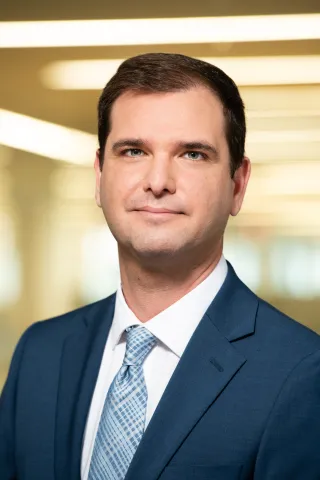
Milan is joined on the podcast this week by Jacob Poushter, the lead author of recent Pew report titled, “India and Pakistan: Rivals with Divergent Views of the Global Order.”
Milan Vaishnav, Jacob Poushter
Has India eliminated extreme poverty? Academic economist Maitreesh Ghatak joins Milan Vaishnav to discuss where India stands in its economic development and quest to decrease poverty across the country.
As India heads to the polls, a new chapter is being written in a very old debate about poverty and inequality in India. This debate has been stirred up by the release of new data from a government-sponsored consumption survey, which some have argued shows a massive decline in poverty in India. Others believe that this data are not so unequivocal and point to a widening gap between top income-earners and ordinary Indians.
To make sense of this debate, Milan is joined on the show this week by Maitreesh Ghatak. Maitreesh is a professor of economics at the London School of Economics, where he has been the director of the Development Economics Group at the research centre, STICERD, since 2005. He is a widely respected voice on India’s economic development and has been especially focused, in recent years, on questions of growth, poverty, and inequality.
Milan and Maitreesh discuss the government’s recent consumption survey, contested claims that India has eliminated extreme poverty, and recent inequality trends. Plus, the two discuss the overall health of the macro-economy and the state of India’s statistical system.
Episode notes:
1. Maitreesh Ghatak and Rishabh Kumar, “Poverty in India Over the Last Decade: Data, Debates, and Doubts,” The India Forum, April 10, 2024.
2. Maitreesh Ghatak, “The rise of the affluent is the real India growth story,” Hindustan Times, February 29, 2024.
3. Maitreesh Ghatak, “The simmering debate over poverty rate,” Mint, May 4, 2023.
4. Maitreesh Ghatak, Ramya Raghavan, and Linchuan Xu, “Trends in Economic Inequality in India,” The India Forum, September 19, 2022.
5. Maitreesh Ghatak, “India’s Inequality Problem,” The India Forum, June 23, 2021.
6. “The Crisis in India’s Economic Data (with Pramit Bhattacharya),” Grand Tamasha, February 12, 2020.
7. “Decoding the Indian Economy (with Pranjul Bhandari),” Grand Tamasha, April 3, 2024.

Carnegie does not take institutional positions on public policy issues; the views represented herein are those of the author(s) and do not necessarily reflect the views of Carnegie, its staff, or its trustees.
Milan is joined on the podcast this week by Jacob Poushter, the lead author of recent Pew report titled, “India and Pakistan: Rivals with Divergent Views of the Global Order.”
Milan Vaishnav, Jacob Poushter
This week, Milan, Sadanand Dhume, and Tanvi Madan discuss the political fall-out of this summer’s Gen Z protests, the political future of the Cockroach Janata Party (CJP), and the churn within the ruling Bharatiya Janata Party (BJP).
Milan Vaishnav, Sadanand Dhume, Tanvi Madan
Josy Joseph joins Milan on the podcast this week to talk about his best-selling new book, The Birth of a Nation: Twenty-One Days That Changed India, which reconstructs the dramatic three weeks leading up to August 15, 1947.
Milan Vaishnav, Josy Joseph
Vidya Mahambare joins Milan on the Season 16 premiere of Grand Tamasha to discuss the economic drivers of the Gen Z protests, the link between unemployment and education, and the futility of the manufacturing versus services debate.
Milan Vaishnav, Vidya Mahambare
This week, Rahul Sagar join Milan to discuss his new book The Birth of Indian Liberalism: Mama Parmanand’s Letters to an Indian Raja, which uncovers an older tradition of Indian liberal thought through a remarkable work first published in 1891 and then largely forgotten for more than a century.
Milan Vaishnav, Rahul Sagar